


This article was automatically translated from the original Turkish version.
+1 More
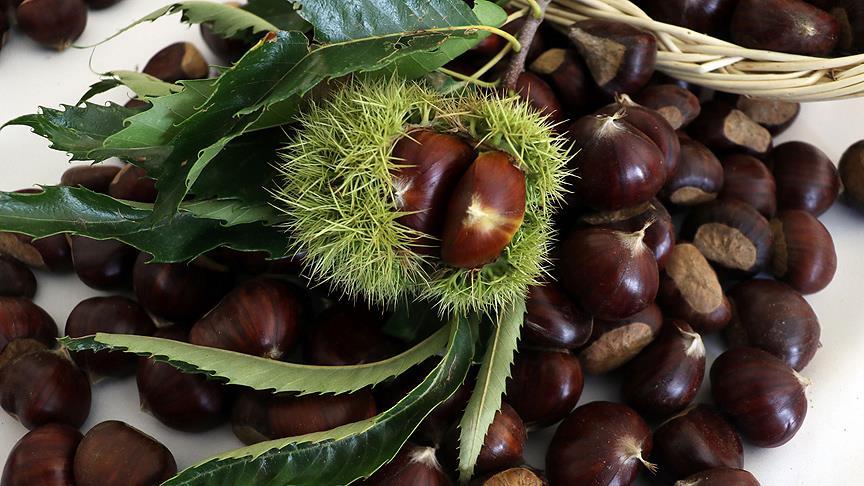
Düzce Chestnut
Type of Geographical İndication | Place of Origin | ||||||||
|---|---|---|---|---|---|---|---|---|---|
File Number | 2019200 | ||||||||
Application Date | 2019-12-02 | ||||||||
Registration Number | 1268 | ||||||||
Registration Date | 2022-12-01 | ||||||||
Product / Product Group(s) | vegetables and mushrooms Processed and unprocessed fruits | ||||||||
Province(s) | Düzce | ||||||||
Applicant/Registrant(s) | Düzce Provincial Directorate of Agriculture and Forestry | ||||||||
Status | Registered | ||||||||
Place of Production | Düzce, Türkiye | ||||||||
Düzce chestnut is a variety of chestnut obtained from the edible seeds of Castanea sativa Mill. trees, which are native to Düzce province in Türkiye and belong to the Fagaceae (beech family).

Düzce Chestnut (Ministry of Culture and Tourism)
Düzce chestnut is obtained both from naturally growing Castanea sativa Mill. trees in the forested areas of Düzce province and through cultivation in chestnut orchards established by grafting trees of various ages.

Düzce Chestnut (Ministry of Culture and Tourism)
Inspections are conducted by an inspection body composed of at least three experts from the Düzce Provincial Directorate of Agriculture and Forestry, Düzce University Faculty of Agriculture and Natural Sciences, and Düzce Chamber of Agriculture, under the coordination of the Düzce Provincial Directorate of Agriculture and Forestry. Inspections are carried out annually during the harvest season (September–November) and may also be performed whenever necessary or upon complaint. All inspection reports are submitted annually to the Turkish Patent and Trademark Office.
Anadolu Ajansı. “Kışın Vazgeçilmezi Kestane Pazara İndi.” Accessed June 3, 2025. https://www.aa.com.tr/tr/turkiye/kisin-vazgecilmezi-kestane-pazara-indi/1270844
Batı Karadeniz Kalkınma Ajansı. "Düzce Kestanesi." Batı Karadeniz Kalkınma Ajansı. Accessed June 3, 2025. https://www.bakab.gov.tr/duzce-kestanesi/
Düzce Kestanesi Directorate of Culture and Tourism. "Düzce Chestnut." Ministry of Culture and Tourism. Accessed June 3, 2025. https://duzce.ktb.gov.tr/TR-337928/duzce-kestanesi.html
Turk Patent and Trademark Office. "Düzce Kestanesi – Coğrafi İşaretler Detay." Accessed June 3, 2025.
Türk Patent ve Marka Kurumu. "Düzce Kestanesi." Accessed June 3, 2025. https://ci.turkpatent.gov.tr/Files/GeographicalSigns/cf3a36e5-0337-4b66-844a-090b66012b05.pdf

Düzce Chestnut
Type of Geographical İndication | Place of Origin | ||||||||
|---|---|---|---|---|---|---|---|---|---|
File Number | 2019200 | ||||||||
Application Date | 2019-12-02 | ||||||||
Registration Number | 1268 | ||||||||
Registration Date | 2022-12-01 | ||||||||
Product / Product Group(s) | vegetables and mushrooms Processed and unprocessed fruits | ||||||||
Province(s) | Düzce | ||||||||
Applicant/Registrant(s) | Düzce Provincial Directorate of Agriculture and Forestry | ||||||||
Status | Registered | ||||||||
Place of Production | Düzce, Türkiye | ||||||||
Distinctive Characteristics
Physical and Chemical Properties
Historical and Local Significance
Production Method
Harvest Period and Storage
Storage
Inspection