


This article was automatically translated from the original Turkish version.
The Dyson Sphere is a theoretical concept in astroengineering that refers to a megastructure or ensemble of megastructures built by an advanced civilization to capture the electromagnetic energy radiated by a star. This concept encompasses both an engineering idea aimed at maximizing energy collection capacity and scientific research fields focused on the indirect detection of such structures through extraterrestrial observations. The Dyson Sphere is not conceived as a solid shell but rather as a dense spherical cluster of satellite-like collectors distributed around the star.
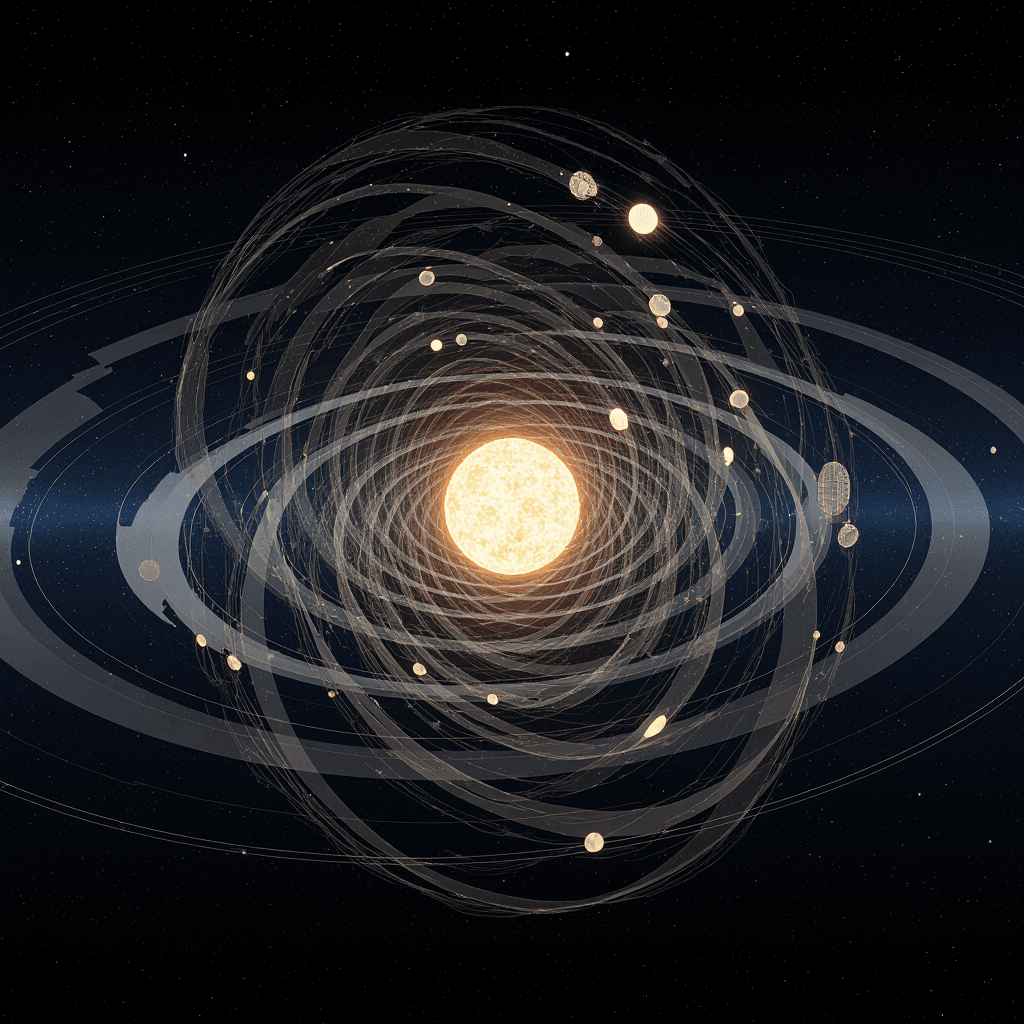
Dyson Sphere (Generated by Artificial Intelligence.)
The idea of the Dyson Sphere is based on the assumption that a civilization can expand its energy scale by systematically harvesting energy emitted by a star. The structure consists of numerous units that absorb, reflect, or redistribute a significant portion of the star’s emitted light. The concept does not correspond to a solid spherical shell; instead, it is interpreted as a spherical swarm of many independent collector satellites in orbit. Such a system could serve not only for energy collection but also for supporting artificial habitats, advanced propulsion systems, or high-capacity computational processes.
The appearance of a Dyson Sphere-like structure to an observer depends largely on the covering fraction of its collection units. When a significant portion of the star’s light is absorbed, the star appears dimmer in the optical band compared to its typical appearance. Conversely, if the absorbed energy is re-radiated as heat, the star may exhibit unexpected brightness in the mid- and far-infrared regions.
Studies have widely used this infrared signature as a target for detection. Models show that when waste heat is emitted within specific temperature ranges, a pronounced excess of infrared brightness arises. However, some research indicates that if waste heat is directed, stored, or transported via non-photonic means, the infrared excess may be lower than expected. Therefore, the combined analysis of optical and infrared data is essential.
In this context, high-precision astrometric missions such as Gaia offer a new method of investigation by directly determining stellar parallaxes. If a star’s true distance, as measured by parallax, is significantly smaller than estimates based on brightness, it may indicate that a portion of the star’s optical light is being blocked. This approach enables the identification of candidates that may correspond to partial structures with high covering fractions. Research has demonstrated that structures obscuring a large fraction of starlight produce a strong dimming in optical brightness, an effect detectable through distance estimation discrepancies.
Two primary observational techniques stand out in the search for Dyson Spheres. The first involves wide-area surveys to detect an infrared excess arising from the star’s energy distribution. This method yields strong results in scenarios where waste heat is prominent. The second involves identifying distance inconsistencies caused by a star appearing dimmer than expected in the optical band. This second method can detect partial obscuration even when waste heat remains undetected.
Studies emphasize that only cases where a large fraction of the star’s light is blocked can be reliably distinguished, due to the high covering fraction required. Furthermore, uncertainties in large datasets, limitations in stellar atmosphere models, and the possibility of multiple solutions complicate interpretation. Therefore, candidate stars must be analyzed individually.
The concept of the Dyson Sphere is not limited to energy-collecting structures. Some studies have examined the gravitational effects of a spherical shell within the context of thin-shell solutions and modified gravity models. In such models, the scalar field generated by the shell can alter the structure of the spacetime outside it. These studies reveal that some solution families in various domains are stable, while others produce singularities at large distances. Consequently, the dynamic behavior of large-scale shells constitutes a research area not only in energy engineering but also in theoretical gravity.
The physical feasibility of a Dyson Sphere depends on engineering parameters such as material supply, orbital stability, radiative equilibrium conditions, and the distribution of collector swarms. Theoretical studies indicate that a dispersed swarm of many collectors orbiting at greater distances from the star offers higher feasibility for less dense and smaller-scale variants. Solid shells achieving complete coverage, however, are not considered feasible due to dynamic instability and structural integrity issues.
The Dyson Sphere, as a megastructure concept designed to elevate the energy usage profile of advanced civilizations, serves as a comprehensive subject of investigation in astrophysics, SETI research, and theoretical engineering. The concept is linked to the physical effects of dense swarms of satellites absorbing most of a star’s light, and modern observational missions enable indirect study of such structures. When theoretical and observational constraints are considered together, the Dyson Sphere emerges as a multidisciplinary research field encompassing both potential technological feasibility and detectable observational signatures.

Conceptual Framework
Astrophysical Behavior and Observational Signatures
Search Techniques and Methodological Limitations
Theoretical Models and Gravitational Effects
Astroengineering Scale and Physical Constraints