

This article was automatically translated from the original Turkish version.
+1 More
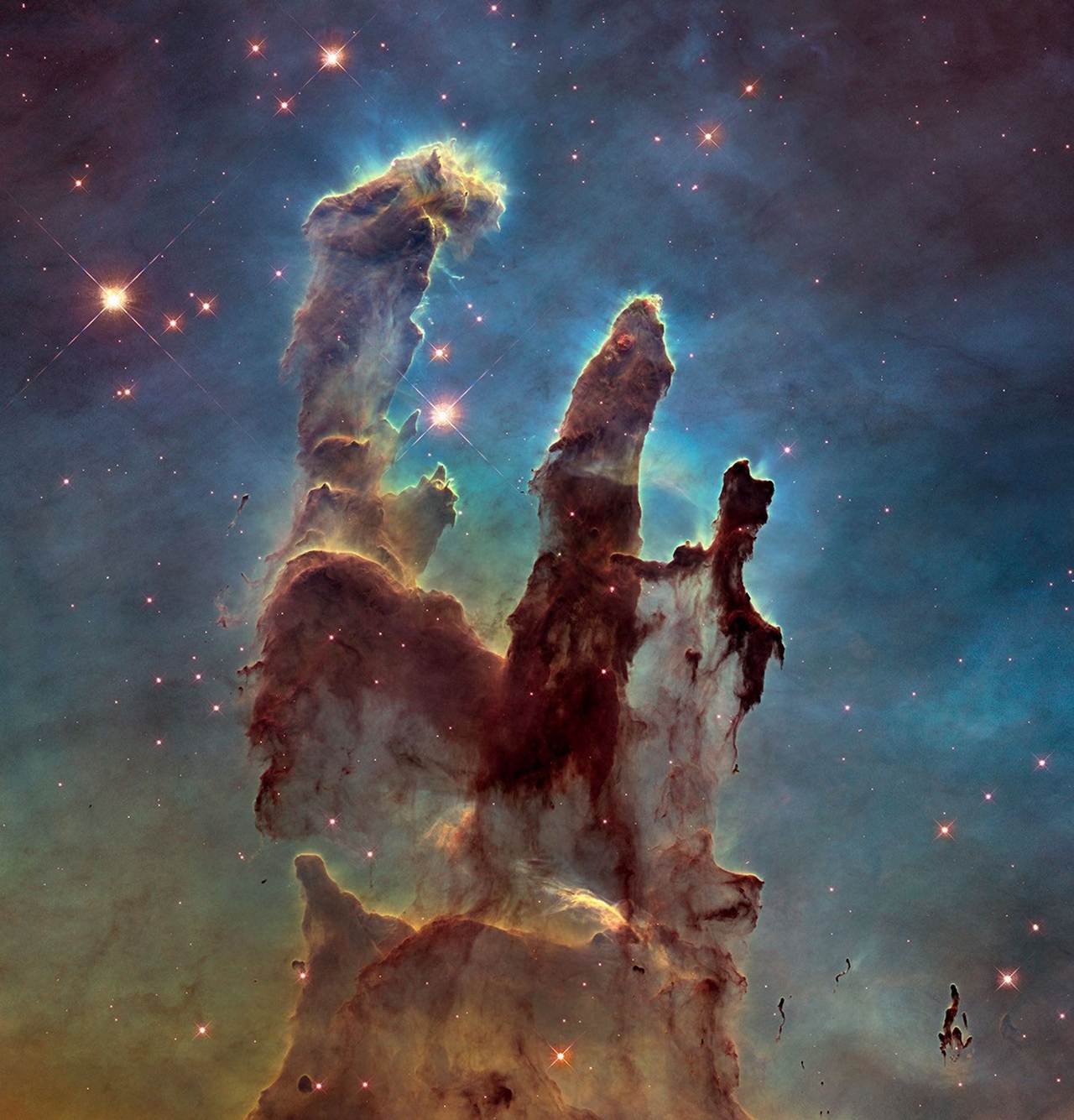
The Eagle Nebula, also known as Messier 16 (M16), is a star-forming region located within the Milky Way Galaxy. This nebula is classified as an H II region situated in the Serpens Cauda constellation, approximately 7,000 light-years from Earth. The Eagle Nebula is shaped by physical processes in the interstellar medium, including high-energy ultraviolet radiation and ionized gases. Structurally, it is particularly notable for dust and gas columns known as the "Pillars of Creation," famously imaged by the Hubble Space Telescope in 1995. However, this designation originates from popular culture rather than scientific usage, and such terms are generally avoided in scientific literature.
M16 was first discovered in 1745 by Swiss astronomer Jean-Philippe de Chéseaux and later added to the catalog by Charles Messier in 1764. Observations made with advanced telescopes from the mid-20th century onward have provided significant insights into the nebula’s structure and star formation activity. Although the high-resolution images captured by the Hubble Space Telescope in 1995 generated widespread public interest, scientific studies focused on phenomena such as photoevaporation, star formation density, and environmental interactions within the region.
Subsequent missions have further expanded our understanding. The Chandra X-ray Observatory has been used to detect high-energy young stars in the area, while the Spitzer Space Telescope provided infrared data revealing stars obscured by dust in the inner regions. Additionally, data from the Gaia mission has delivered highly accurate measurements of the motions and ages of stars within NGC 6611.

The Eagle Nebula imaged by NASA’s Hubble Space Telescope (NASA)
The Eagle Nebula consists largely of ionized hydrogen gas (H II). Such regions form when short-lived, hot O- and B-type stars emit intense ultraviolet radiation that ionizes surrounding neutral hydrogen gas. The young stars within M16 are concentrated primarily in the central open cluster NGC 6611, which contains stars at various evolutionary stages, including protostars with ages of just a few million years.
One of the most striking morphological features of the nebula is a series of column-like structures composed of dense molecular gas and dust, which harbor active star-forming regions. These columns are being eroded from the outside inward through the process of photoevaporation. Ultraviolet radiation from nearby young stars photoionizes the surfaces of the columns, while dense cores of dust and gas within continue to collapse under gravity, contributing to the formation of new stars.
The spectrum of M16 shows a prominent Hα emission line at 656.3 nm, part of the Balmer series of hydrogen, which is the primary source of emission in ionized regions. Additional lines such as [O III] at 500.7 nm and [S II] at 671.6/673.1 nm provide information on ionization levels and gas density. Spectroscopic observations are particularly useful for studying the internal structure and star formation activity within dense knots, or globules, located at the tips of the columns.
Fotometric analyses, especially in the near-infrared (NIR) range, have proven effective in revealing young stars hidden behind dust. Data from infrared telescopes such as Spitzer and Herschel have provided detailed insights into mass accretion rates, temperature distributions, and dust densities during the earliest stages of stellar birth.
Due to its active star formation, the Eagle Nebula serves as a key example in astrophysical research. The density of gas and dust within the columns exceeds the Jeans mass criterion, triggering local gravitational collapse. This process leads first to the formation of protostellar cores and subsequently to young stars achieving hydrostatic equilibrium. The majority of stars in the region belong to the OB spectral type, which results in strong high-energy radiation that interacts with surrounding gas. These interactions are often referred to as feedback mechanisms, capable of both compressing and dispersing nearby gas.
Ultimately, the Eagle Nebula (M16) is regarded as a vital target for studying star formation processes in astrophysics. While its dense gas and dust columns are visually striking, its primary scientific significance lies in the fact that active star formation is occurring within them. The region enables direct observation of astrophysical phenomena such as the effects of high-energy stars, gas dynamics, and photoevaporation processes. In this context, M16 is one of the rare celestial objects where the early stages of stellar evolution can be observed directly.

Observational History and Missions
Physical Properties
Structural Components
Spectroscopic and Photometric Data
Star Formation and Evolution