


This article was automatically translated from the original Turkish version.
+2 More
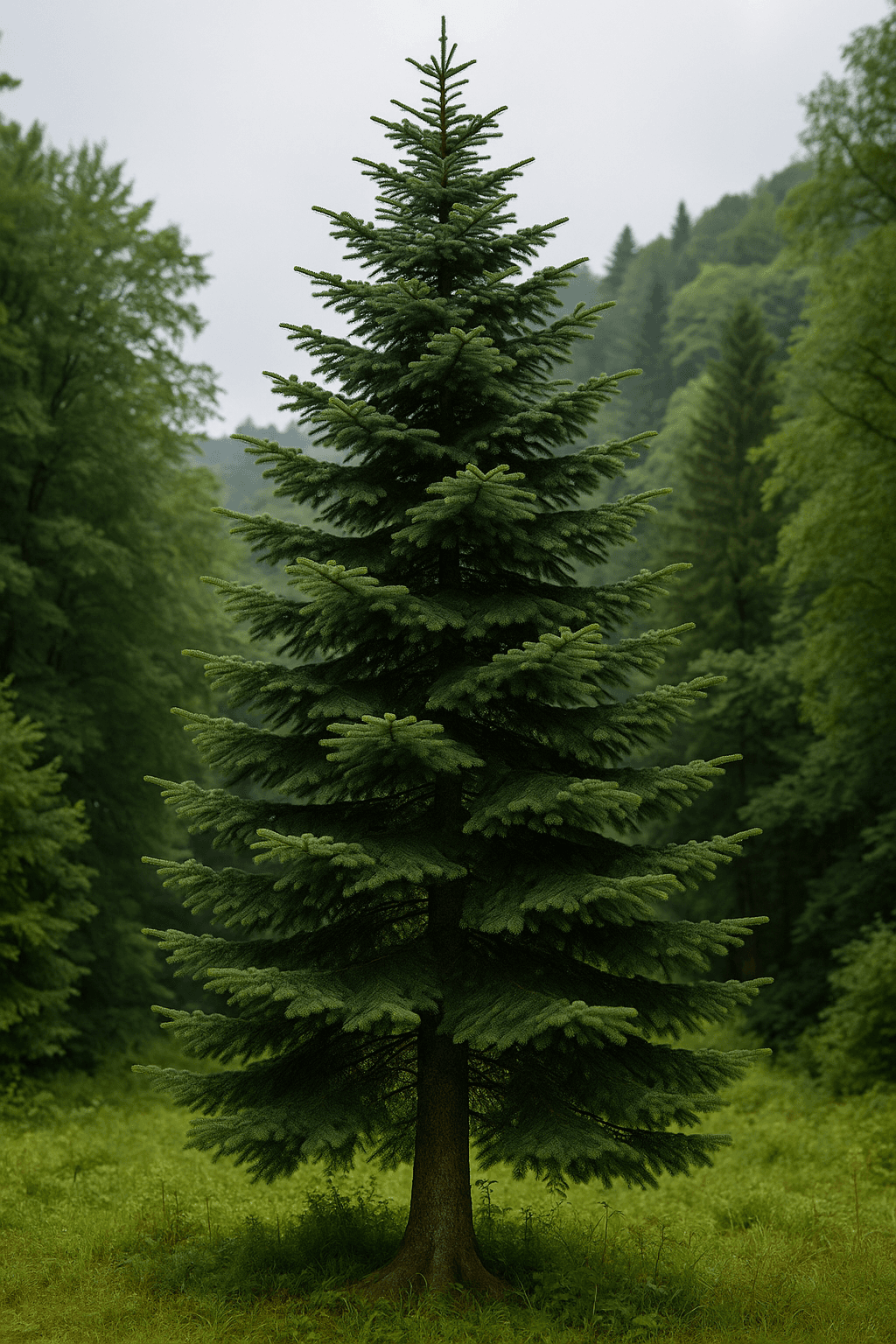
Eastern Black Sea Fir (Abies nordmanniana)
Kingdom (Regnum) | Plantae (Plants) | ||||||||
|---|---|---|---|---|---|---|---|---|---|
Division (Divisio) | Pinophyta (Conifers) | ||||||||
Class (Classis) | Pinopsida (Conifer Class) | ||||||||
Order (Ordo) | Pinales (Conifer Order) | ||||||||
Family (Familia) | Pinaceae (Pine Family) | ||||||||
Genus (Genus) | Abies (Fir) | ||||||||
Species (Species) | Abies nordmanniana (Nordmann Fir) | ||||||||
Eastern Black Sea Fir (Abies nordmanniana), an endemic tree species native to northeastern Türkiye, holds significant importance for both ecosystem health and scientific research. This evergreen conifer typically thrives at high elevations under cool and humid climatic conditions and is distinguished by its long lifespan, large trunk structure, and regular branching pattern. These characteristics make it not only a vital component of the natural landscape but also a critical player in preventing soil erosion, maintaining water balance, and providing habitat for wildlife.
Owing to its aesthetic qualities and uniform pyramidal form, the Eastern Black Sea Fir is highly valued as an ornamental plant in European countries and is intensively cultivated during the Christmas season for cutting. Within forest ecosystems, it forms symbiotic relationships with numerous species such as insects, birds, and fungi and is regarded as a key element in sustaining regional biodiversity. Therefore, it is a species that requires careful attention in both local and international conservation and sustainability policies.
Abies nordmanniana belongs to the class Pinopsida, which includes gymnosperms, and the family Pinaceae, encompassing coniferous trees. The genus Abies, which includes firs, comprises resilient forest trees distributed across the cool temperate zones of the Northern Hemisphere, particularly at variable elevations. The specific epithet nordmanniana honors Russian botanist Alexander von Nordmann, known for his 19th-century studies of the Black Sea flora.
This species is divided into two subspecies based on ecological and morphological differences:
With distinct systematic features, A. nordmanniana exhibits morphological similarities to Abies alba (European Silver Fir) and Abies cilicica (Cilician Fir), but can be easily differentiated by diagnostic criteria such as needle arrangement, cone shape, and growing habitats. This clear taxonomic status provides a significant advantage for accurate identification and effective conservation.
The Eastern Black Sea Fir (Abies nordmanniana) is an evergreen conifer with a limited natural distribution restricted to northeastern Türkiye. It also grows naturally in the western regions of Georgia, immediately east of Türkiye’s borders. Within Türkiye, its primary distribution areas are concentrated in high-elevation mountainous zones, including:
This fir species typically spreads in microclimatic zones characterized by high humidity and low temperature fluctuations. Habitats such as deep valleys, north-facing steep slopes, and moisture-retaining forest clearings provide ecologically favorable conditions for Abies nordmanniana. Key factors influencing its distribution include maritime influence, topography, and the continuity of forest cover.
The Eastern Black Sea Fir (Abies nordmanniana) is a species that develops in high mountain ecosystems dominated by moist and cool climatic conditions. Its natural distribution is concentrated between 1,000 and 2,100 meters elevation. This altitude range corresponds to the typical Black Sea climate, featuring abundant rainfall year-round, cool summers, and mild winters. These climatic conditions support healthy growth by maintaining optimal water balance.

Eastern Black Sea Fir (Generated with AI Assistance)
In terms of soil, this species prefers organic-rich, well-drained, slightly acidic forest soils. A deep and consistently moist soil structure facilitates the expansion of the root system and enables strong anchoring of the tree. Common associated species within the ecosystem include Oriental Beech (Fagus orientalis), Oriental Spruce (Picea orientalis), and locally, Turkish Pine (Pinus brutia). With high shade tolerance, the fir can persist in the understory during its juvenile stage under the canopy of more dominant species; however, as it matures, it prefers open areas with direct sunlight, allowing it to reach dominance in the forest canopy.
The trunk of the Eastern Black Sea Fir exhibits a smooth, cylindrical form in youth, becoming thicker and developing a scaly, fissured bark with age. This trunk structure contributes to the tree’s longevity and resistance to external stressors. The root system is deep and robust, enabling the tree to anchor firmly even on steep slopes and serving as a critical stabilizing factor against natural hazards such as landslides and erosion.
The needles are arranged in two rows in a spiral pattern, each measuring approximately 2 to 3.5 cm in length. The upper surface is dark green and glossy, while the lower surface features two characteristic white stomatal bands. These white bands assist in regulating gas exchange and serve as a key diagnostic feature for species identification. Needle morphology is one of the primary criteria for distinguishing between subspecies, such as Abies nordmanniana subsp. equi-trojani.
The cones of this species develop upright on the upper branches and measure 12 to 20 cm in length. Cylindrical in shape, they contain numerous winged seeds and, upon maturity, disintegrate as their scales separate to release seeds into the environment. The cone axis remains attached to the branch and gradually becomes a bare cylinder. This unique seed dispersal mechanism facilitates the natural expansion of the fir and ensures the continuity of the species.
The Eastern Black Sea Fir (Abies nordmanniana) is a keystone species in the ecological integrity of Black Sea forests. It enhances organic matter production, supports soil fertility, and increases moisture retention capacity. Its root system prevents erosion, while fallen needles and cones decompose to act as natural fertilizers enriching the soil.
The tree trunk provides habitat for lichens and mosses, microorganisms that play critical roles in sustaining the moisture cycle and preserving biodiversity. The evergreen needles of the Eastern Black Sea Fir, remaining green throughout the year, offer shelter and refuge for birds and small mammals during the winter season. Bird species such as crossbills and siskins feed on its seeds, while the tree also provides a suitable microhabitat for insect egg-laying and larval development. Thus, this species directly contributes to the life cycles of numerous organisms at both vertical and horizontal levels within the forest, enhancing the ecosystem’s biodiversity.
The Eastern Black Sea Fir has a limited but unique role in Türkiye’s forestry sector. Its wood is lightweight, homogeneous, and resin-free, making it easy to process. However, its low resistance to natural decay renders it unsuitable for long-lasting construction materials. Consequently, in Türkiye, it is primarily used in packaging industries for crates and pallets, in paper pulp production, and in the ornamental plant market. Additionally, it is utilized in landscaping as container-grown saplings and in ecological restoration projects aimed at rehabilitating degraded forest areas. Nevertheless, most of its natural distribution areas are under protected status, limiting timber production to controlled and minimal levels.
In Europe, Abies nordmanniana stands out as one of the most preferred Christmas tree species. Commercial plantations are established in countries such as Denmark and Germany, with production serving both domestic and export markets. Its ability to retain needles for weeks after cutting, its aesthetic cone appearance, and its symmetrical form ensure high consumer satisfaction. These attributes have made it one of the most economically valuable Christmas tree species in Europe.
The Eastern Black Sea Fir faces various threats due to its restricted natural range and high sensitivity to ecological conditions. Global climate change reduces the survival rate of young individuals, as rising temperatures and irregular precipitation patterns disrupt its growth cycle. At the regional level, deforestation, illegal logging, and conversion of steep slopes to agricultural land are shrinking its habitat and fragmenting populations. Overgrazing damages young firs near the soil surface, inhibiting natural regeneration, while its already limited distribution increases the risk of genetic erosion.
Various conservation initiatives have been implemented in response to these threats. The Ministry of Agriculture and Forestry of the Republic of Türkiye has designated “gene conservation forests” within its natural distribution areas and initiated monitoring programs. Additionally, ex-situ (off-site) conservation efforts are underway through national seed banks to safeguard genetic material. Controlled propagation using seeds from selected individuals is employed both for restoration in natural areas and as a crucial step toward maintaining genetic diversity.
The most common method of propagating the Eastern Black Sea Fir is through seed. However, low germination rates can pose challenges in commercial production. Several critical steps must be observed to ensure the production of healthy, high-quality individuals. First, cones for seed collection are typically harvested between late September and early October. To enhance germination, seeds undergo stratification—a cold-moist treatment involving storage under damp, low-temperature conditions for 2–3 months, thereby simulating natural winter conditions and triggering germination.
During the nursery phase, young fir saplings should be grown in shaded environments with well-drained, organic-rich peat-based soils. This stage is critical for healthy development. Additionally, cloning can be achieved through grafting, where cuttings from genetically superior individuals are transferred onto specialized rootstocks; this method is preferred for propagating elite specimens.
Abies nordmanniana should not be viewed merely as a visual landscape element or a Christmas ornament but as a strategic species within Türkiye’s natural forest fabric. Understanding its ecological role and adaptive capacity is essential to developing appropriate conservation strategies and informed cultivation policies to ensure its transmission to future generations.
Atalay, İbrahim. 2002. *Türkiye’nin Ekolojik Bölgeleri*. İzmir: Meta Basım. Accessed May 23, 2025. https://kutuphane.tarimorman.gov.tr/vufind/Record/20432/Description.
European Forest Genetic Resources Programme (EUFORGEN). "Abies nordmanniana." Accessed May 23, 2025. https://www.euforgen.org/species/abies-nordmanniana/.
Farjon, Aljos. 2010. *A Handbook of the World's Conifers*. Leiden: Brill Academic Publishers. Accessed May 23, 2025. https://www.researchgate.net/publication/285940942_A_Handbook_of_the_World's_Conifers_2_vols.

Eastern Black Sea Fir (Abies nordmanniana)
Kingdom (Regnum) | Plantae (Plants) | ||||||||
|---|---|---|---|---|---|---|---|---|---|
Division (Divisio) | Pinophyta (Conifers) | ||||||||
Class (Classis) | Pinopsida (Conifer Class) | ||||||||
Order (Ordo) | Pinales (Conifer Order) | ||||||||
Family (Familia) | Pinaceae (Pine Family) | ||||||||
Genus (Genus) | Abies (Fir) | ||||||||
Species (Species) | Abies nordmanniana (Nordmann Fir) | ||||||||
No Discussion Added Yet
Start discussion for "Eastern Black Sea Fir (Abies nordmanniana)" article
Taxonomy and Systematic Position
Natural Distribution and Habitat
Distribution Range
Habitat Characteristics
Morphological Characteristics
Trunk and Roots
Needles
Cones
Ecological Role and Contribution to Biodiversity
Forestry and Economic Importance
Threats and Conservation Efforts
Propagation and Cultivation