


This article was automatically translated from the original Turkish version.
+1 More
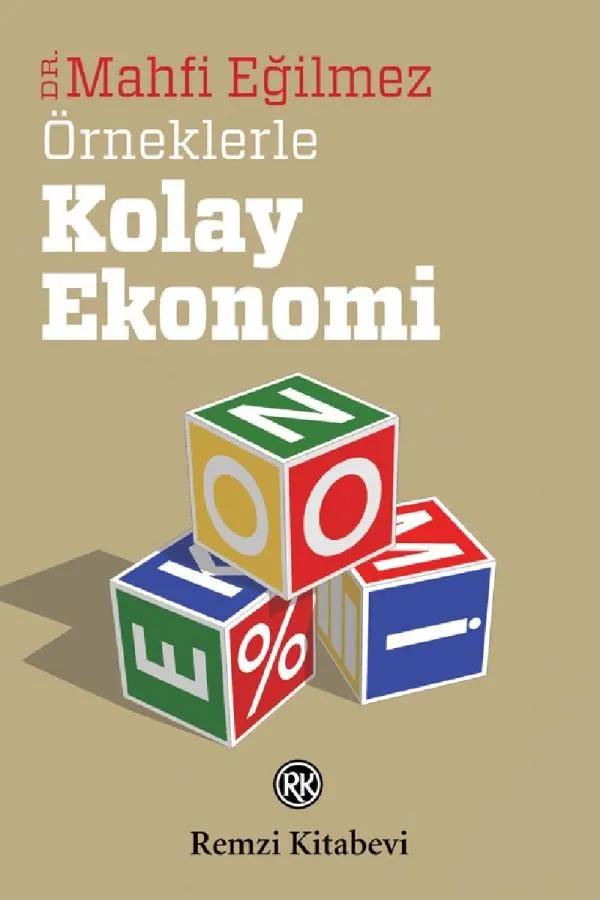
Easy Economics with Examples
Author(s) | Mahfi Eğilmez | ||||||||
|---|---|---|---|---|---|---|---|---|---|
Publisher(s) | Remzi Kitabevi | ||||||||
Publication Year | 2012 | ||||||||
Number of Pages | 192 pages | ||||||||
Easy Economics with Examples is an economics book written by Turkish economist and author Mahfi Eğilmez and first published in 2014 by Remzi Kitabevi. The book aims to explain complex economic concepts in a simple and accessible language, using real-life examples, for readers with little or no prior knowledge of economics.
The primary goal of the book is to enable readers to confidently follow discussions, articles, and statements about economics. With its compact structure of 192 pages, the book addresses economic terms in short sections, each preceded by quotations from renowned thinkers. As of 2024, the book has reached its 33rd printing and has established itself in Türkiye’s economics education and popular economics literature.
Easy Economics with Examples is designed to explain the fundamental concepts and workings of economics in a straightforward manner. The book is structured into short sections, each consisting of one to two pages. Eğilmez seeks to simplify the learning of economics by supporting economic theories and concepts with examples from daily life and historical anecdotes.
The book seeks to answer fundamental economic questions such as: “What is economics and what is it useful for?”, “What are consumption, production, saving, investment, income, and GDP?”, and “How does the economy grow?” It also addresses topics such as unemployment, inflation, interest rates, exchange rates, public finance, external balance, and the global system. Additionally, it includes a section titled “City Myths About Economics,” highlighting common misconceptions about the subject.
The book explores the following key themes and arguments:
Easy Economics with Examples has generally been praised for its clear language and accessible examples. However, some critics have argued that the book remains superficial and may be insufficient for readers seeking more advanced economic analysis. For instance, a reader familiar with Eğilmez’s other work, The Global Financial Crisis, has noted that this book offers a deeper analysis, while Easy Economics with Examples is deliberately limited to a more basic approach. Nevertheless, for its intended audience—those new to economics—this simplicity is widely regarded as the book’s greatest strength. Although some readers feel that the short sections do not explore topics in sufficient depth, the general consensus is that the book is well suited as an introduction to economics.
Eğilmez, Mahfi. Örneklerle Kolay Ekonomi. İstanbul: Remzi Kitabevi, 2014.

Easy Economics with Examples
Author(s) | Mahfi Eğilmez | ||||||||
|---|---|---|---|---|---|---|---|---|---|
Publisher(s) | Remzi Kitabevi | ||||||||
Publication Year | 2012 | ||||||||
Number of Pages | 192 pages | ||||||||
No Discussion Added Yet
Start discussion for "Easy Economics with Examples (Book)" article
Content and Structure
Themes and Core Arguments
Critiques and Discussions