

+2 More


The Edict of Milan was a landmark proclamation issued in 313 AD by Roman emperors Constantine I and Licinius, granting full religious tolerance throughout the Roman Empire and formally legalizing Christianity. It marked a decisive break from centuries of periodic persecution against Christians and is widely regarded as a foundational moment in the development of religious freedom in the Western world.
Prior to the Edict of Milan, Christianity had existed in a state of legal and social uncertainty for nearly three centuries. While early Christians were not always systematically targeted, their refusal to participate in traditional Roman religious rites — particularly emperor worship — was viewed as subversive and dangerous to state unity.
Persecutions were often local and sporadic, but intensified under certain emperors, especially when Christianity’s growth began to challenge imperial authority and Roman religious identity. The most severe and organized persecution came during the reign of Emperor Diocletian, who in 303 AD launched what became known as the Diocletianic (or Great) Persecution. Christian scriptures were burned, churches destroyed, and thousands of believers were imprisoned, tortured, or executed.
In 311 AD, shortly before his death, Emperor Galerius — who had once been a chief architect of the Diocletianic Persecution — issued the Edict of Toleration, acknowledging the futility of the persecutions and allowing Christians to worship as long as they prayed for the well-being of the state. However, this decree was limited in scope and did not guarantee full legal restoration or equality.
Although commonly referred to as an “edict,” the Edict of Milan was not a formal law but a joint imperial rescript, preserved through a letter Licinius sent to the governor of Bithynia. The agreement was reached during a meeting between Constantine and Licinius in the city of Mediolanum (modern-day Milan), shortly after Constantine’s victory over Maxentius at the Battle of the Milvian Bridge in 312 AD — a battle that Constantine reportedly won after receiving a divine sign from the Christian God.
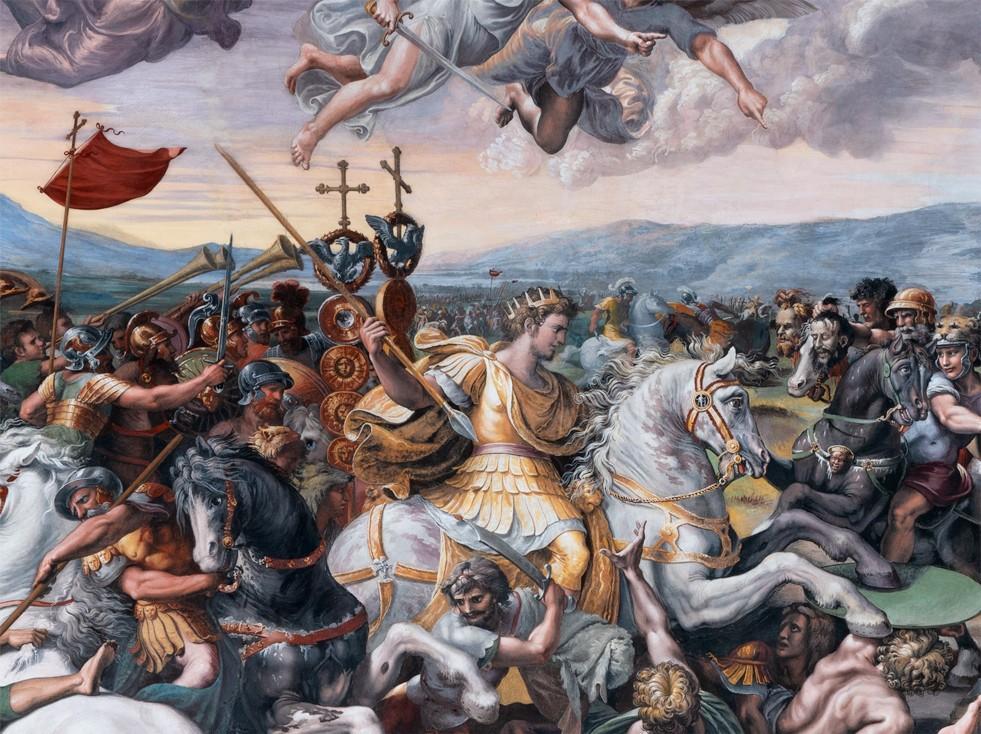
The Battle at Pons Milvius by Giulio Romano (1520-1524) depicts Constantine's victory over Maxentius. (Warfare History)
The Edict declared that:
The motivations behind the Edict were both political and ideological. Constantine had already begun to favor Christianity and may have seen its legal recognition as a tool for imperial unification in a religiously diverse empire. Licinius, ruling in the East, likely saw the alliance with Constantine and the support of Christian subjects as politically expedient.
The Edict of Milan built upon Galerius’s earlier toleration but went further by recognizing religious freedom as a universal right and by restoring the material and institutional position of the Christian Church.
Galerius and Constantine: Edicts of Toleration, Fordham University. https://origin-rh.web.fordham.edu/Halsall/source/edict-milan.asp
Miller, Tim. “Bloody Clash on the Tiber.” Warfare History Network. Erişim Tarihi: 29 Nisan 2025. https://warfarehistorynetwork.com/article/bloody-clash-on-the-tiber/
Raymond van Dam, Remembering Constantine at the Milvian Bridge, 2011. Remembering Constantine at the Milvian Bridge. New York: Cambridge University Press.
William Bright, A History of the Church: From the Edict of Milan to the Council of Chalcedon, 2018. https://blackwells.co.uk/bookshop/product/A-History-of-the-Church-from-the-Edict-of-Milan-A-D-313-to-the-Council-of-Chalcedon-A-D-451-Classic-Reprint-by-Bright-William/9781332755196

No Discussion Added Yet
Start discussion for "Edict of Milan (313)" article
Background: Christian Persecution in the Roman Empire
The Edict of Milan
Motivations and Impact
This article was created with the support of artificial intelligence.