



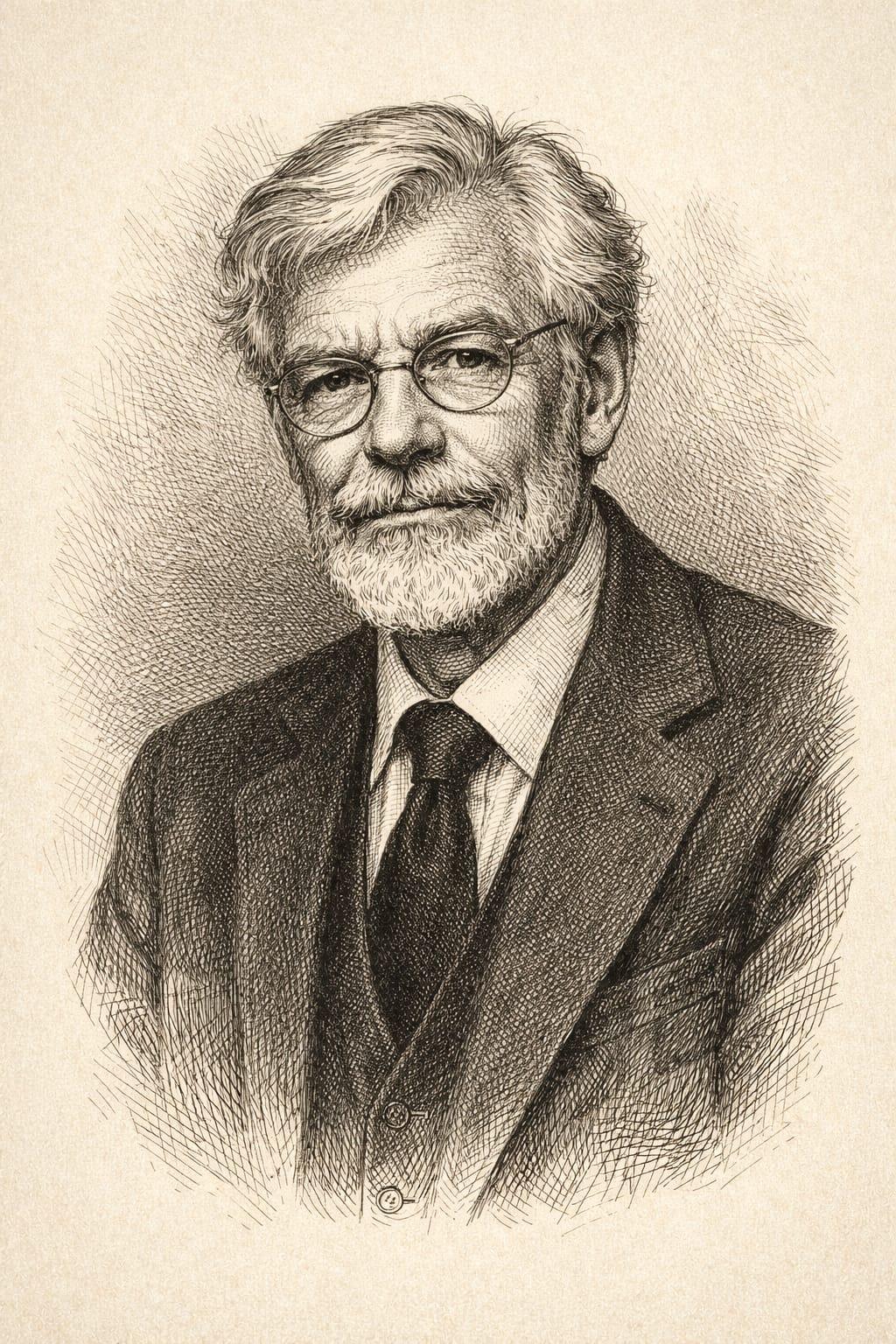
Edsger Wybe Dijkstra (generated by artificial intelligence.)
Doğum tarihi | 1930-05-11 | ||||||||
|---|---|---|---|---|---|---|---|---|---|
Ölüm tarihi | 2002-08-06 | ||||||||
Eş | Maria (Ria) C. Dijkstra Debets | ||||||||
Annesi | Brechtje Cornelia Kluijver | ||||||||
Babası | Douwe Wybe Dijkstra | ||||||||
Çocuk | Rutger M. Dijkstra Femke E. Dijkstra Marcus J. Dijkstra | ||||||||
Place of Death | Nuenen, Netherlands | ||||||||
Place of Birth | Rotterdam, Netherlands | ||||||||
Education | University of Amsterdam (PhD in Computer Science) Leiden University (Mathematics and Theoretical Physics) | ||||||||
Edsger Wybe Dijkstra was a Dutch computer scientist who shaped the theoretical foundations of modern computer science through foundational contributions to algorithm theory, structured programming, and formal methods.
Edsger Wybe Dijkstra was born on 11 May 1930 in Rotterdam, Netherlands, as the third child of a family with four children. His father, Douwe Wybe Dijkstra, was a chemistry teacher; his mother, Brechtje Cornelia Kluijver, although holding no official position, was a trained mathematician. His mother’s agility in manipulating mathematical formulas and her ability to find elegant solutions had a profound impact on Dijkstra’s intellectual development. Graduating from the Gymnasium Erasmianum in Rotterdam with the highest honors, Dijkstra initially considered studying law with the aim of representing the Netherlands at the United Nations; however, encouraged by his family and teachers due to his exceptional performance in science subjects, he turned toward a scientific career【1】.
In this direction, he began studying mathematics and theoretical physics at Leiden University. A three-week programming course he attended in Cambridge in 1951 became a turning point in his career; during this period he concluded that the intellectual challenge of programming exceeded that of theoretical physics. After graduating from Leiden University in 1956, he earned a doctorate in computer science in 1959 from the University of Amsterdam with a thesis titled “Communication with an Automatic Computer.”
Dijkstra began his professional career in 1952 as the Netherlands’ first official programmer at the Mathematical Centre in Amsterdam. In 1962 he continued his academic career as a professor of mathematics at Eindhoven University of Technology, where he played a central role in establishing the computer science school. From 1973 to 1984 he worked as a research scientist for Burroughs Corporation. Although he visited the company’s research centers, he conducted his primary work from his home in Nuenen.
In 1984 he was appointed to the Schlumberger Centennial Chair of Computer Science at the University of Texas at Austin, where he remained until his retirement in 1999 with the title of professor emeritus. Throughout his career he actively participated in institutional bodies such as the Programming Methodology Working Group of the International Federation for Information Processing.
Dijkstra’s contributions spanned algorithm design, programming languages, operating systems, and distributed computing. His shortest path algorithm and minimum spanning tree work developed in the late 1950s are foundational pillars of graph theory. As a member of the ALGOL 60 design team, he ensured the inclusion of recursion in the language and introduced terms such as stack and vector into computing literature. His 1968 paper “Go To Statement Considered Harmful” launched the structured programming movement by linking program quality to the density of GOTO statements【2】.
In concurrent computing, he developed concepts such as mutual exclusion, semaphores, deadlock, the dining philosophers problem, and livelock. He also constructed the layered “THE” multiprogramming system, a precursor to modern operating systems.
Dijkstra argued that programs should not merely be debugged but constructed from the outset with mathematical rigor to ensure correctness. To this end, he developed a program derivation calculus based on the concepts of guarded commands, weakest preconditions, and predicate transformers. He emphasized the notions of invariant relations and variant functions to guarantee loop correctness and asserted that the logical validity of loops must be proven using the principle of mathematical induction. He defined the programming process as the art of organizing complexity and introduced the vision of the “humble programmer,” acknowledging human cognitive limitations【3】.
In 1972 Dijkstra was awarded the ACM Turing Award, regarded as the Nobel Prize of computer science. He received numerous other honors including the AFIPS Harry Goode Award, the IEEE Computer Pioneer Award, the ACM SIGCSE Outstanding Contribution Award, and the C&C Foundation Japan Prize (2002).
One of his most enduring legacies is the collection of over 1300 handwritten technical notes and papers coded as “EWD”【4】. In his scientific work he preferred to use a fountain pen rather than a computer. Other components of his intellectual legacy include:
Dijkstra married Maria (Ria) C. Debets in 1957 and had three children: Marcus, Femke, and Rutger. Because “programmer” was not recognized as a legal profession at the time, he registered his occupation as “theoretical physicist” on official marriage records. An avid player of Mozart on a Bösendorfer piano, Dijkstra traveled with his wife through national parks in Volkswagen minibuses they named “Touring Machine,” and composed many of his papers during these journeys. He positioned himself in society as a “Socratic gadfly” in defense of intellectual honesty. After a long battle with cancer, he died on 6 August 2002 at his home in Nuenen, Netherlands.
Edsger W. Dijkstra Archive. "The EWD Home Page." University of Texas at Austin. Accessed February 7, 2026. https://www.cs.utexas.edu/~EWD/.
Edsger Wybe. Dijkstra Archive. "Obituary: Edger Wybe Dijkstra (1930-2002)." Accessed February 7, 2026. https://www.cs.utexas.edu/~EWD/CSobit.html.
MacTutor History of Mathematics Archive. "Edsger Wybe Dijkstra." J. J. O'Connor and E. F. Robertson. University of St Andrews. Last updated July 2014. Accessed February 7, 2026. https://mathshistory.st-andrews.ac.uk/Biographies/Dijkstra/.
RKKA Digital Library. "The Humble Programmer." Edsger W. Dijkstra. ACM Turing Award Lecture. *Communications of the ACM* 15, no. 10 (1972). Accessed February 7, 2026. http://rkka21.ru/docs/turing-award/ed1972e.pdf.
University of Texas Libraries. "In Memoriam: Edsger Wybe Dijkstra." Texas ScholarWorks. Digital Repository Document. Accessed February 7, 2026. https://repositories.lib.utexas.edu/server/api/core/bitstreams/8a7a5536-ddb7-4d6d-8618-c3a422107d76/content.
University of Toronto. "The Structure of the 'THE'-Multiprogramming System." Edsger W. Dijkstra. Department of Computer Science. Accessed February 7, 2026. https://www.cs.toronto.edu/~chechik/courses05/csc410/readings/dijkstra.pdf.
[1]
MacTutor History of Mathematics Archive. "Edsger Wybe Dijkstra." J. J. O'Connor and E. F. Robertson. University of St Andrews. Last updated July 2014. Accessed 7 February 2026. https://mathshistory.st-andrews.ac.uk/Biographies/Dijkstra/.
[2]
RKKA Digital Library. "The Humble Programmer." Edsger W. Dijkstra. ACM Turing Award Lecture. Communications of the ACM 15, no. 10 (1972). Accessed 7 February 2026. http://rkka21.ru/docs/turing-award/ed1972e.pdf.
[3]
University of Toronto. "The Structure of the 'THE'-Multiprogramming System." Edsger W. Dijkstra. Department of Computer Science. Accessed 7 February 2026. https://www.cs.toronto.edu/~chechik/courses05/csc410/readings/dijkstra.pdf.
[4]
Edsger W. Dijkstra Archive. "The EWD Home Page." University of Texas at Austin. Accessed 7 February 2026. https://www.cs.utexas.edu/~EWD/.

Edsger Wybe Dijkstra (generated by artificial intelligence.)
Doğum tarihi | 1930-05-11 | ||||||||
|---|---|---|---|---|---|---|---|---|---|
Ölüm tarihi | 2002-08-06 | ||||||||
Eş | Maria (Ria) C. Dijkstra Debets | ||||||||
Annesi | Brechtje Cornelia Kluijver | ||||||||
Babası | Douwe Wybe Dijkstra | ||||||||
Çocuk | Rutger M. Dijkstra Femke E. Dijkstra Marcus J. Dijkstra | ||||||||
Place of Death | Nuenen, Netherlands | ||||||||
Place of Birth | Rotterdam, Netherlands | ||||||||
Education | University of Amsterdam (PhD in Computer Science) Leiden University (Mathematics and Theoretical Physics) | ||||||||
Early Life
Professional Career and Institutional Activities
Scientific Contributions and Programming Paradigm
Formal Methods and Program Correctness
Major Achievements and Intellectual Legacy
Personal Life and Death