


This article was automatically translated from the original Turkish version.
Dijkstra's Algorithm is a shortest path algorithm used in graph theory, developed in 1956 by Dutch computer scientist Edsger W. Dijkstra. This algorithm is used to find the shortest paths from a specific starting node to all other nodes in a graph. It operates on weighted graphs—where edges have specific weights—and is valid only for graphs that do not contain negative-weight edges.
Dijkstra's Algorithm employs a greedy approach. At each step, it selects the node with the shortest known distance so far and attempts to extend this path to reach other nodes.
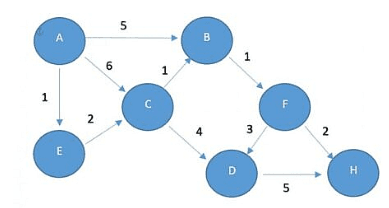
Dijkstra's Algorithm graph
The time complexity of Dijkstra's Algorithm depends on the data structure used:
Here, V represents the number of vertices and E represents the number of edges.
Dijkstra's Algorithm is widely used in fields such as route finding, network routing, and geographic information systems.
Cormen, T. H., Leiserson, C. E., Rivest, R. L., & Stein, C. (2009). Introduction to Algorithms (3rd ed.). MIT Press.
Programiz. "Dijkstra's Algorithm." Accessed [insert date].
Çömez, E. Dijkstra Algoritması.

No Discussion Added Yet
Start discussion for "Dijkstra's Algorithm" article
Working Principle
1- Initialization:
2- Selection of the Node with Shortest Distance:
3- Updating Neighboring Nodes:
4- Marking as Visited:
5- Repetition:
6- Result:
Time Complexity
Limitations