

This article was automatically translated from the original Turkish version.
+1 More
Eldivan Kirazı is a cherry variety cultivated in the Eldivan district of Çankırı Province. A geographical indication certification application was submitted on 12 October 2021 and officially registered on 4 March 2024. The product is classified under the group of processed and unprocessed fruits and vegetables and mushrooms. The registering authority is the Eldivan Municipality. Eldivan Kirazı holds a significant place in the agricultural economy of the district.

Flowering Eldivan Kirazı Tree (AA)
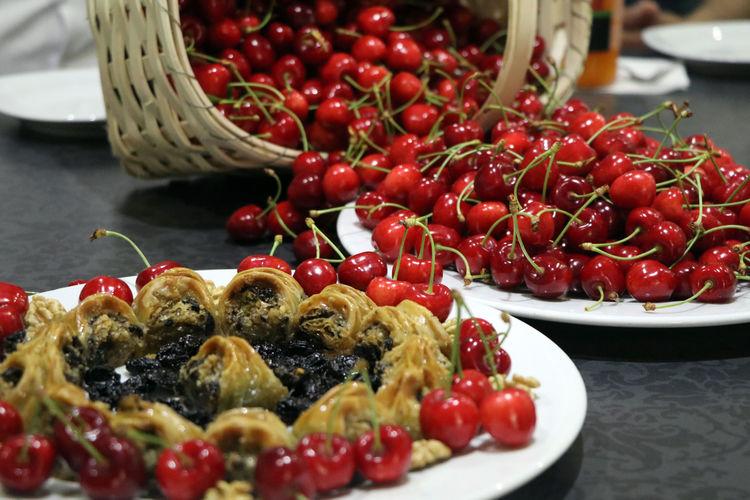
Eldivan Kirazı is cultivated using the Ziraat 0900 variety grafted onto Maxima-6 and Maxima-14 semi-dwarf cherry rootstocks. The fruit skin is glossy dark burgundy and the flesh is cream-pink in color. The fruits have slightly flattened, heart-shaped tips. The fruit stalk is long and the juice is medium in density and cloudy. The average fruit weight soluble dry matter content (%SDMC) and pH values are high with a high sweetness ratio. The flesh-to-pit ratio ranges between 21.50 and 23.00 while the %SDMC content varies between 17.40 and 20.20.
The Eldivan district is characterized by a continental climate. Summers are hot and dry while winters are cold and rainy. The annual average rainfall is approximately 400 mm. The annual average minimum temperature is around 5 °C and the maximum temperature is around 18 °C. These climatic conditions meet the approximately 1000 chilling hours required for optimal cherry fruit production.
The soils contain moderate levels of lime and have a neutral or slightly alkaline pH. Calcium and magnesium content is high. Soil texture consists of sandy loam loam and clay. Of the soils 57 percent are light 29 percent medium and 14 percent heavy. Light-textured soils allow cherry tree roots to penetrate deeply and access groundwater.
In Eldivan Kirazı production the Ziraat 0900 variety is grafted onto Maxima-6 and Maxima-14 semi-dwarf cherry rootstocks. In orchards pruning is generally carried out as yield-oriented shoot pruning. Orchard establishment pruning fertilization irrigation and harvesting are all practiced. Harvesting is performed manually during June July and August. The harvested products are quickly brought to market.

Eldivan Kirazı (AA)
Eldivan Kirazı orchards are established with a planting distance of 5x5 meters. The trees are self-pollinating. Pruning is generally carried out as yield-oriented shoot pruning with minimal additional pruning.
In Eldivan Kirazı cultivation calcium fertilization is applied as foliar feeding. Base fertilization uses 20-20 or 15-15 compound fertilizer. Irrigation in Eldivan Kirazı orchards is carried out by sprinkler method depending on seasonal temperatures. Irrigation is particularly applied before flowering and after fruit set.
Harvesting of Eldivan Kirazı is performed manually during June July and August. The harvested products are quickly brought to market. Due to its structure Eldivan Kirazı is a delicate fruit requiring careful handling during picking and transportation. Harvested products must be brought to market promptly.
All stages of Eldivan Kirazı production take place within the defined geographical boundaries. During production the suitability of the variety and rootstocks is ensured and orchard establishment pruning fertilization irrigation and harvesting are carried out. In processing the cherries are hand-picked and stored according to the methods specified in the registration. The geographical indication emblem is applied on the product or its packaging with the inscription “Eldivan Kirazı”.
Eldivan Kirazı is an important product in the agricultural economy of Eldivan district with a clear link between the geographical boundary and the product’s reputation. The Eldivan Cherry Festival has been held since 1992. Eldivan Kirazı is also used in the production of local specialties such as “cherry basket baklava” using dried cherries.

cherry basket baklava (AA)
The production and use of Eldivan Kirazı are monitored under the coordination of the Eldivan Municipality. The monitoring body consists of at least three experts from the Eldivan Municipality the Chamber of Agriculture and the District Directorate of Agriculture and Forestry. Monitoring is conducted at least once a year with additional inspections carried out when necessary. The variety rootstocks harvesting and storage conditions and use of the geographical indication emblem are controlled. Where required distinctive characteristics are analyzed in laboratories. Monitoring reports are submitted annually to the Turkish Patent and Trademark Office.

Distinctive Characteristics
Climate and Soil Conditions
Production Method
Orchard Establishment and Pruning
Fertilization and Irrigation
Harvesting and Storage
Production and Processing Stages
Cultural and Economic Importance
Monitoring