


This article was automatically translated from the original Turkish version.
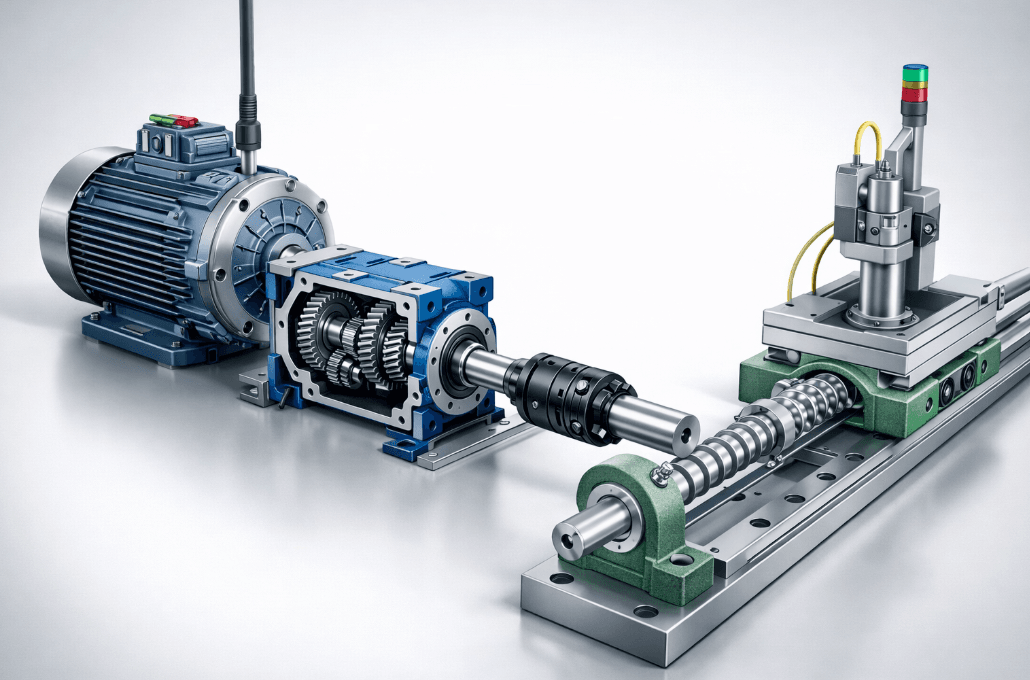
(Generated by Artificial Intelligence.)
Electromechanical Systems
Basic Components | Mechanical Transmission Elements Sensors Actuators | ||||||||
|---|---|---|---|---|---|---|---|---|---|
Control Modes | Proportional+Derivative (PD) Proportional+Integral (PI) Proportional (P) On-Off | ||||||||
Transmission Elements | Linkage Mechanisms Gear Trains Cams Gears | ||||||||
Actuator Types | Relays and Electric Motors (AC/DC/Synchronous) Solenoids Electromagnets | ||||||||
Production Technology | Traditional Manufacturing and Additive Manufacturing (3D Printers/Hybrid Production) | ||||||||
Main Function | Convert electrical energy into mechanical motion or mechanical motion into electrical signals. | ||||||||
Electromechanical systems are a general term for devices that integrate electrical energy with mechanical motion, enabling energy and information conversion between these two physical domains. These systems not only convert electrical energy into mechanical work (actuators/motors) or mechanical motion into electrical signals (generators/transducers), but also manage the reciprocal conversion processes between energy and information. As seen in hard disk drive (HDD) technologies, the encoding of energy into digital information via magnetic flux variations and the transfer of processed information into mechanical positioning signals characterize the information-based energy management capability of these systems.
The operational mechanism of electromechanical systems is based on physical interactions that occur during the transfer of energy from one form to another. This process is carried out according to the following fundamental stages and principles.
The functioning of electromechanical systems is grounded in classical laws of electromagnetism and theories of electromechanical energy conversion. Energy conversion in these systems typically occurs through the following fundamental physical approaches:

Lorentz Force and Faraday’s Law (Generated by Artificial Intelligence.)
The operational process of an electromechanical system begins with the interface between low-power data signals from a control unit and high-current energy supplied by a power source. In modern systems, this stage is not merely an energy input but also a decision-making mechanism that interprets incoming commands from a driver circuit and regulates energy delivery. Upon triggering, electrical energy is transmitted to the system’s active components, where a physical field transformation occurs. The magnetic flux generated in coils or the electric field in piezoelectric materials converts energy from a static form into a field form capable of producing potential work.
This generated electromagnetic field interacts with moving components of the system—such as rotors or pistons—to produce mechanical force. This interaction, shaped by the Lorentz force or reluctance principle, generates torque or linear motion, enabling the system to transition from a static state to a dynamic one. The resulting kinetic energy is transmitted to the point of final application via shafts, gears, or precision actuators, and the process is not limited to unidirectional transfer.
In the final stage of operation, position and velocity data obtained through sensors complete the system’s information loop. These feedback signals, derived from mechanical motion, are converted back into electrical signals and transmitted to the control unit. Thus, a continuous cycle is established between energy, mechanical action, and information, ensuring high-precision operation and stable fulfillment of the intended function.
Modern electromechanical systems do not merely convert energy; they also regulate this conversion. Sensors integrated into the system—such as encoders and tachometers—measure the speed, position, and torque of mechanical motion and transmit this data to the control unit. Based on this information, the electrical input is adjusted in real time to ensure stable and precise system operation.
During operation, not all energy in electromechanical systems is converted into useful output. Various losses occur during energy conversion or transfer. These primarily include copper losses due to electrical resistance in conductors, iron losses caused by hysteresis and eddy currents from time-varying magnetic fields, and mechanical losses arising from friction and air resistance. These losses are fundamental factors directly affecting overall system efficiency. The goal in electromechanical system design is to minimize these losses as much as possible to enhance the effectiveness of energy transfer or conversion.
Electromechanical systems require the coordinated operation of specific key components to convert electrical input into physical output (or vice versa). These parts are examined in three main functional groups:
These components form the “muscle” structure of the system and play a role in energy conversion or the creation of physical interactions. However, not all of these components directly convert energy; some merely facilitate switching or interaction between electrical and mechanical domains.
Electric motors are among the most commonly used components in electromechanical systems. These structures generate rotational motion through magnetic field interactions between the stator (stationary part) and the rotor (moving part). Motors are classified as alternating current (AC) or direct current (DC) motors based on their operating principles and power supply types and are considered primary examples of devices converting electrical energy into mechanical energy.
Solenoids are electromagnetic devices that produce linear motion when an electric current passes through them. They are commonly used in applications such as valve control, actuation of locking mechanisms, or any scenario requiring short-stroke linear motion. Such components exemplify specialized electromechanical structures where an electrical input is converted into a mechanical response.
Relays, however, are not energy conversion components. They function as electromagnetic switches that physically open or close a higher-power electrical circuit using a small electrical control signal. In this capacity, relays serve as components that enable architectural separation between signal and power paths in electromechanical systems.

Electric Actuator (Pixabay)
These components function as the “sensory organs” of electromechanical systems. They detect changes in mechanical conditions within the system and convert this information into electrical signals, transmitting it to the control unit. This enables monitoring of system status and the establishment of feedback-based control mechanisms.
Encoders detect the angular position, rotation amount, and rotational speed of a shaft and generate this information as digital signals. They are critical in applications requiring precise positioning and motion control.
Tachometers are sensors designed to measure the rotational speed of moving parts. The acquired speed data is used to monitor system performance and regulate speed.
Limit switches detect whether a mechanical component has reached a predefined boundary point through physical contact. These switches are widely used in control circuits to ensure safe system operation and prevent mechanical overtravel.
These components serve as passive mechanical elements that modify and regulate the direction, speed, or transmitted force of mechanical motion generated within electromechanical systems. They do not directly produce or convert energy but play a decisive role in system functionality by ensuring motion is transmitted in the desired manner.
Gearboxes and shafts transmit mechanical energy to the point of application by altering the torque and rotational speed produced by a motor or similar driving element according to application requirements. These structures enable controlled and efficient power transmission.
Bearings and bearings are used to reduce friction between moving parts and to support loads appropriately. This minimizes mechanical wear, extends system lifespan, and ensures smoother motion.
Couplings connect two separate shafts to transmit mechanical power. They also accommodate installation tolerances and compensate for minor shaft misalignments, contributing to the safe operation of the system.

Mechanical Components of Electromechanical Systems (Generated by Artificial Intelligence.)
These components serve as elements that regulate and direct the flow of energy in electromechanical systems. The manner in which electrical power is delivered to motors or other components depends on the proper design and use of these structures.
Drivers (driver/inverter) are power electronics-based units that adjust the frequency, amplitude, or voltage of electric current to control the speed, direction of rotation, and torque of a motor. By acting as an intermediary layer between control signals and the power path, they enable the control system to influence motor behavior.
Brushes and commutators are conductive mechanical parts in direct current (DC) machines that transfer electric current from the stationary part to the rotating part (rotor). These components enable the reversal of current direction based on rotor position, forming the fundamental basis of DC machine operation.
In electromechanical systems, fault diagnosis and condition monitoring are technical processes applied to ensure operational continuity and prevent unexpected shutdowns. These processes rely on continuous monitoring of physical parameters and analytical interpretation of collected data.
The operational health of electromechanical systems is monitored by comparing measurement data from components against predefined reference values. This monitoring process forms the foundation of predictive maintenance approaches aimed at detecting failures before they occur.
Vibration analysis is widely used to identify mechanical problems such as bearing wear, shaft misalignment, and imbalance. Changes in the system’s characteristic vibration frequencies are monitored to detect mechanical degradation at early stages.
Thermal monitoring involves examining abnormal temperature increases in system components. Overheating in windings, loose electrical connections, or heat from friction are monitored using infrared (thermal) cameras and temperature sensors. This method is used to identify both electrical and mechanical issues.
Current signature analysis (Motor Current Signature Analysis – MCSA) analyzes harmonic components and irregularities in the current drawn by the motor. This analysis enables prediction of electrical faults such as broken rotor bars, winding short circuits, or magnetic imbalances before the system is shut down.
Acoustic monitoring uses ultrasonic sensors to analyze sounds generated by friction, leaks, or arcing at frequencies beyond human hearing. This approach is considered a complementary diagnostic method, particularly effective in detecting early-stage faults.
When an anomaly is detected in the system, various analytical approaches are employed to accurately determine the root cause of the fault. These methods aim not only to identify the symptom but also to uncover the underlying factors causing the failure.
Data obtained from diagnosis and monitoring processes directly shape maintenance planning in electromechanical systems. This data enables determination of when and to what extent maintenance activities should be performed.
Predictive maintenance analyzes time-dependent trends in monitoring data to predict potential failures before they occur. Intervention timing is determined based on deviations in measured parameters. This method is applied to reduce unplanned downtime and improve the efficiency of maintenance operations.
Preventive maintenance is based on scheduled maintenance regardless of monitoring data, relying on operating hours, number of cycles, or time intervals. Periodic activities include part replacements, cleaning, and general inspections. This approach aims to maintain system reliability.
Aguilera, Efrain, and others. *3D Printing of Electro Mechanical Systems.* 2013. Accessed January 22, 2026. https://hdl.handle.net/2152/88715.
Bozek, Pavol, Pavel, Stepanov, Stanislav, Lagutkin, and Nikitin Yury. “Comprehensive Approach to Technical Conditions of Electromechanical Units in Mechatronic Systems.” *American Journal of Mechanical Engineering* 2, no. 7 (2014): 278–281. Accessed January 22, 2026. https://doi.org/10.12691/AJME-2-7-22.
Green, Daisy Hikari. Electrical Monitoring of Electromechanical Systems, 2022. Massachusetts Institute of Technology. Accessed January 22, 2026. https://dspace.mit.edu/handle/1721.1/144801.
He, Rongrui, and others. "Self-Transducing Silicon Nanowire Electromechanical Systems at Room Temperature." *Nano Letters*. June 2008. Accessed January 22, 2026. https://doi.org/10.1021/nl801071w.
Ho, Chih-Ming, and Yu-Chong Tai. “MICRO-ELECTRO-MECHANICAL-SYSTEMS (MEMS) AND FLUID FLOWS.” *Annual Review of Fluid Mechanics*. January 1998. Accessed January 22, 2026. https://doi.org/10.1146/annurev.fluid.30.1.579.
Ma, Lili, et al. “Development and Implementation of an Assessment Model in a Sophomore Electromechanical Systems Design Laboratory for the ETAC-ABET Accreditation.” *Publications and Research*. Accessed January 22, 2026. https://academicworks.cuny.edu/ny_pubs/768.
Pixabay. "Canon Eos Ef-S 17-85 Lens Is. 2016." Accessed February 14, 2026.

(Generated by Artificial Intelligence.)
Electromechanical Systems
Basic Components | Mechanical Transmission Elements Sensors Actuators | ||||||||
|---|---|---|---|---|---|---|---|---|---|
Control Modes | Proportional+Derivative (PD) Proportional+Integral (PI) Proportional (P) On-Off | ||||||||
Transmission Elements | Linkage Mechanisms Gear Trains Cams Gears | ||||||||
Actuator Types | Relays and Electric Motors (AC/DC/Synchronous) Solenoids Electromagnets | ||||||||
Production Technology | Traditional Manufacturing and Additive Manufacturing (3D Printers/Hybrid Production) | ||||||||
Main Function | Convert electrical energy into mechanical motion or mechanical motion into electrical signals. | ||||||||
No Discussion Added Yet
Start discussion for "Electromechanical Systems" article
Operation of an Electromechanical System
Principles of Energy Conversion
Operational Stages of the System
Feedback and Control Loop
Energy Losses and Efficiency
Components of Electromechanical Systems
Energy Conversion Units (Actuators)
Sensing and Feedback Units (Sensors)
Transmission and Support Components (Mechanical Elements)
Control and Power Interfaces
Fault Diagnosis and Condition Monitoring
Condition Monitoring Methods
Fault Diagnosis Processes
Maintenance Strategies