


This article was automatically translated from the original Turkish version.
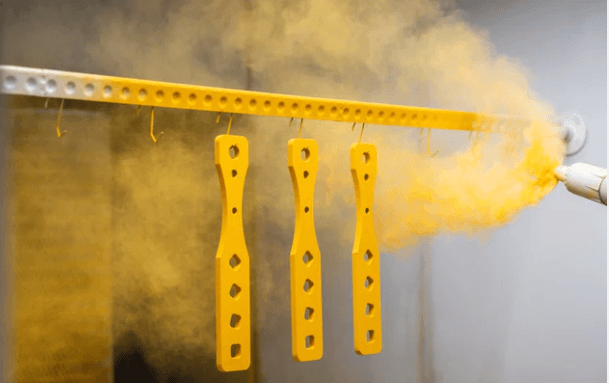
Electrostatic Powder Coating
Method Name | Electrostatic Powder Coating | ||||||||
|---|---|---|---|---|---|---|---|---|---|
Application Method | Negative Charged Powder Spraying + Curing | ||||||||
Oven Temperature | 180–200 °C | ||||||||
Surface Type | Metal (Conductive) | ||||||||
Standards | ISO 8130, ASTM D3451, EN 13438 | ||||||||
Electrostatic powder coating is an industrial painting method based on spraying paint particles in powder form with an electrostatic charge and then curing them through baking. This system provides high adhesion, surface durability, and aesthetic appearance, particularly for metal surface coatings, thanks to its environmentally friendly, solvent-free structure. It is widely preferred in the automotive, white goods, defense industry, and furniture sectors.
Millî Eğitim Bakanlığı (MEGEP). *Elektrostatik Toz Boyama İçin Yüzey Hazırlığı*. Kimya Teknolojisi. Ankara: MEB Yayınları, 2012. Accessed June 17, 2025. .
Millî Eğitim Bakanlığı (MEGEP). *Elektrostatik Toz Boyama*. Kimya Teknolojisi. Ankara: MEB Yayınları, 2012. Accessed June 17, 2025. https://megep.meb.gov.tr/mte_program_modul/moduller_pdf/Elektrostatik%20Toz%20Boyama.pdf.

Electrostatic Powder Coating
Method Name | Electrostatic Powder Coating | ||||||||
|---|---|---|---|---|---|---|---|---|---|
Application Method | Negative Charged Powder Spraying + Curing | ||||||||
Oven Temperature | 180–200 °C | ||||||||
Surface Type | Metal (Conductive) | ||||||||
Standards | ISO 8130, ASTM D3451, EN 13438 | ||||||||
No Discussion Added Yet
Start discussion for "Electrostatic Powder Coating" article
Working Principle
Advantages
Disadvantages
Applications