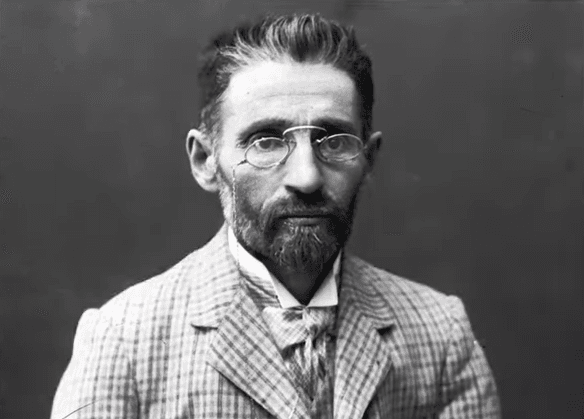
+1 More

Birth Name | Eliezer Yitzhak Perlman | ||||||||
|---|---|---|---|---|---|---|---|---|---|
Doğum tarihi | 1858-01-07 | ||||||||
Place of Birth | Glubokoye, Russian Empire | ||||||||
Religion(s) | Judaism | ||||||||
Education | Sorbonne University | ||||||||
Ölüm tarihi | 1922-12-16 | ||||||||
Place of Death | Jerusalem, British Mandate of Palestine | ||||||||
Occupation(s) | linguist lexicographer Journalist | ||||||||
Political Movement | Zionism | ||||||||
Eliezer Ben Yehuda, born on 7 January 1858 in the town of Glubokoye, then part of the Russian Empire, into a Jewish family. Today, this town is located in the Vitebsk Region of Belarus.
Ben Yehuda received instruction in the Torah and Talmud during his childhood; at the age of 14, his family sent him to Polotsk to study at a yeshiva, a traditional Jewish religious school. Subsequently, in 1877, he moved to Paris to study medicine at the Sorbonne University, where he spent several years taking courses in history, political science and other disciplines to further his education.【1】
The Man Who Revived Hebrew: Eliezer Ben Yehuda (Medium)
During his studies in Polotsk, Ben Yehuda became acquainted with the Haskalah (Jewish Enlightenment). He adopted the unconventional view for his time that Hebrew should not be limited to liturgical use but could serve as a living national language capable of expressing modern thought.
Ben Yehuda was influenced by nationalist movements during his youth. In his first article, published in the Vienna-based journal Ha-Şahar under the title “She’ela Nihbada” (A Burning Question), he argued for the unification of the Jewish people and the central role Hebrew would play in this process. In this 1879 article, he adopted the pen name “Ben Yehuda”, meaning “Son of Judah,” and later made it his official surname.
Eliezer Ben Yehuda abandoned his studies at the Sorbonne University in 1881 and migrated to Palestine, then under Ottoman rule, with the goal of reviving Hebrew as a modern spoken and written language. In 1882, he worked briefly as a Hebrew teacher at the Alliance Israélite Universelle school in Jerusalem.
Even while still in France, Ben Yehuda had resolved to speak only Hebrew with every Jew he met, and he maintained this principle after settling in Palestine. To promote the everyday use of Hebrew, he established a “Hebrew-speaking circle” that included his own family. In line with this goal, he permitted only Hebrew to be spoken with his son, Ben Zion Ben Yehuda (who later changed his name to Itamar Ben Avi), who thereby became the first person in modern times to grow up with Hebrew as a native language.【2】

Eliezer Ben Yehuda at Work (Medium)
Ben Yehuda aimed to transform Hebrew from a language confined to religious texts into a living mother tongue usable in all areas of modern life. His work in education, journalism and lexicography all served this purpose.
At the time of Ben Yehuda’s migration to Palestine, there was no common spoken language among the Jewish population; Jews spoke different languages depending on their countries of origin, primarily Yiddish, Ladino, and Arabic. Ben Yehuda advocated for the spread of Hebrew through education, taught as a teacher, and led efforts to establish the first schools with curricula entirely in Hebrew.
Even before migrating to Palestine, in a 1879 article published in the journal Havazelet, he criticized the use of French, German and English in modern schools in Jerusalem, arguing that these languages alienated children from their families. He emphasized instead that Hebrew was a living language.
First Aliyah immigrants, some of whom were influenced by Ben Yehuda’s writings, adopted Hebrew as a spoken and educational language. From the mid-1880s onward, teachers in newly established agricultural settlements began teaching Hebrew using Hebrew as the medium of instruction. This foundation made possible the opening in 1889 of the first school in Rishon LeZion with a fully Hebrew curriculum.【3】

【4】
In 1890, Ben Yehuda played a leading role in establishing the Hebrew Language Committee (Va‘ad Ha-Lashon). This committee sought to standardize and develop Hebrew in Palestine, working to coin new vocabulary for modern life, unify spelling and pronunciation, and embed the language in education and the press.
Starting in 1884, Ben Yehuda began publishing the newspaper Ha-Tsvi in Jerusalem, later followed by publications titled Ha-Or and Haşkafa. His publishing activities until 1908 provided a platform for debates on language reform as well as the dissemination of cultural and political ideas.

Ha-Tsvi Newspaper (Gdh Tv)
In his journal articles, Ben Yehuda addressed proposals for new Hebrew words, discussions on pronunciation and spelling, intercommunal relations and modernization. His work on Hebrew contributed significantly to the establishment of common linguistic standards.
During his years in Palestine, Ben Yehuda began compiling a comprehensive dictionary of modern Hebrew. He collected words from historical Hebrew texts to create an unbroken linguistic bridge from antiquity to the present. At the same time, to meet the needs of contemporary life, he invented new Hebrew words by drawing on other languages, especially Arabic, Aramaic, and Syriac:【5】
Ha-Tsvi served as a laboratory for these efforts, where he introduced his newly coined words.
Ben Yehuda enriched the Hebrew vocabulary in his comprehensive dictionary project by adapting historical Hebrew words to modern contexts and drawing on other languages. For word creation, he primarily used Ladino, the language spoken by Sephardic Jews.

Grave of Eliezer Ben Yehuda and His Family on Mount of Olives in Jerusalem
【6】
Ben Yehuda died in Jerusalem on 16 December 1922. The comprehensive Hebrew dictionary he initiated was completed after his death. By the time of his passing, Hebrew had become the common language of daily life among the Jewish community in Palestine.
Aytaç, Bedrettin. "İbranicenin Yeniden Doğuşu." *Dil Dergisi* 139 (2008): 25-35. https://doi.org/10.1501/Dilder_0000000087
Gitai, Keren. "Spectra and Corpora of a New Mother Tongue. The Eliezer Ben-Yehuda Library." Bulletin du Centre de recherche français à Jérusalem, 22 (2011). https://journals.openedition.org/bcrfj/6637
Hassan, Ahmad Hassan, and Abdul-Hameed al-Kayyali. “Ben-Yehuda in his Ottoman Milieu: Jerusalem’s Public Sphere as Reflected in the Hebrew Newspaper Ha-Tsevi, 1884-1915.” In *Ordinary Jerusalem 1840-1940: Opening New Archives, Revisiting a Global City*, edited by Angelos Dalachanis and Vincent Lemire, pp. 330-351. Leiden, Boston: Brill, 2018. https://library.oapen.org/viewer/web/viewer.html?file=/bitstream/handle/20.500.12657/25711/9789004375741%20-%20Ordinary%20Jerusalem%2c%201840-1940.pdf?sequence=1&isAllowed=y
Kılınç, Taha. Dil ve İşgal: Eliezer Ben-Yehuda ve Modern İbranicenin Doğuşu. Istanbul: Ketebe Yayınları, 2024.
Mecra Youtube Kanalı. "İbranice'yi dirilten adam: Eliezer Ben Yehuda." Accessed August 14, 2025. https://www.youtube.com/watch?v=LRb5IO51BYU
Silberschlag, Eisig, ed. *Eliezer Ben-Yehuda: A Symposium in Oxford*. Oxford: The Oxford Centre for Postgraduate Hebrew Studies, 1981. https://www.ochjs.ac.uk/wp-content/uploads/2011/09/SILBERSCHLAG-Eisig-Eliezer-Ben-Yehuda-A-Symposium-in-Oxford.pdf
gdh TV Youtube Kanalı. "İbranice'nin Babası: Bir Dilin Dirilişi." Accessed August 14, 2025. https://www.youtube.com/watch?v=32ljo_DIoQs
[1]
Taha Kılınç, Dil ve İşgal: Eliezer Ben-Yehuda ve Modern İbranicenin Doğuşu (İstanbul: Ketebe Yayınları, 2024), 29.
[2]
Bedrettin Aytaç, "İbranicenin Yeniden Doğuşu," Dil Dergisi, 139 (2008): 30. https://doi.org/10.1501/Dilder_0000000087
[3]
Aytaç, "İbranicenin Yeniden Doğuşu," 31.
[4]
Kılınç, Dil ve İşgal: Eliezer Ben-Yehuda ve Modern İbranicenin Doğuşu, 79.
[5]
Kılınç, Dil ve İşgal: Eliezer Ben-Yehuda ve Modern İbranicenin Doğuşu, 77-82.
[6]
Kılınç, Dil ve İşgal: Eliezer Ben-Yehuda ve Modern İbranicenin Doğuşu, 139.

Birth Name | Eliezer Yitzhak Perlman | ||||||||
|---|---|---|---|---|---|---|---|---|---|
Doğum tarihi | 1858-01-07 | ||||||||
Place of Birth | Glubokoye, Russian Empire | ||||||||
Religion(s) | Judaism | ||||||||
Education | Sorbonne University | ||||||||
Ölüm tarihi | 1922-12-16 | ||||||||
Place of Death | Jerusalem, British Mandate of Palestine | ||||||||
Occupation(s) | linguist lexicographer Journalist | ||||||||
Political Movement | Zionism | ||||||||
His Ideas and Name Choice
Migration to Palestine
The Revival of Hebrew
Language Education
Journalistic Activities
Lexicographical Work
Death