

This article was automatically translated from the original Turkish version.
Geographical Indication Type(s) | Mahreç Sign | ||||||||
|---|---|---|---|---|---|---|---|---|---|
Registration Number | 1137 | ||||||||
Product / Product Group(s) | Baking Desserts Dough Products | ||||||||
Applicant/Registrant(s) | Emet Municipality | ||||||||
Geographical Boundary | Emet District Kütahya | ||||||||
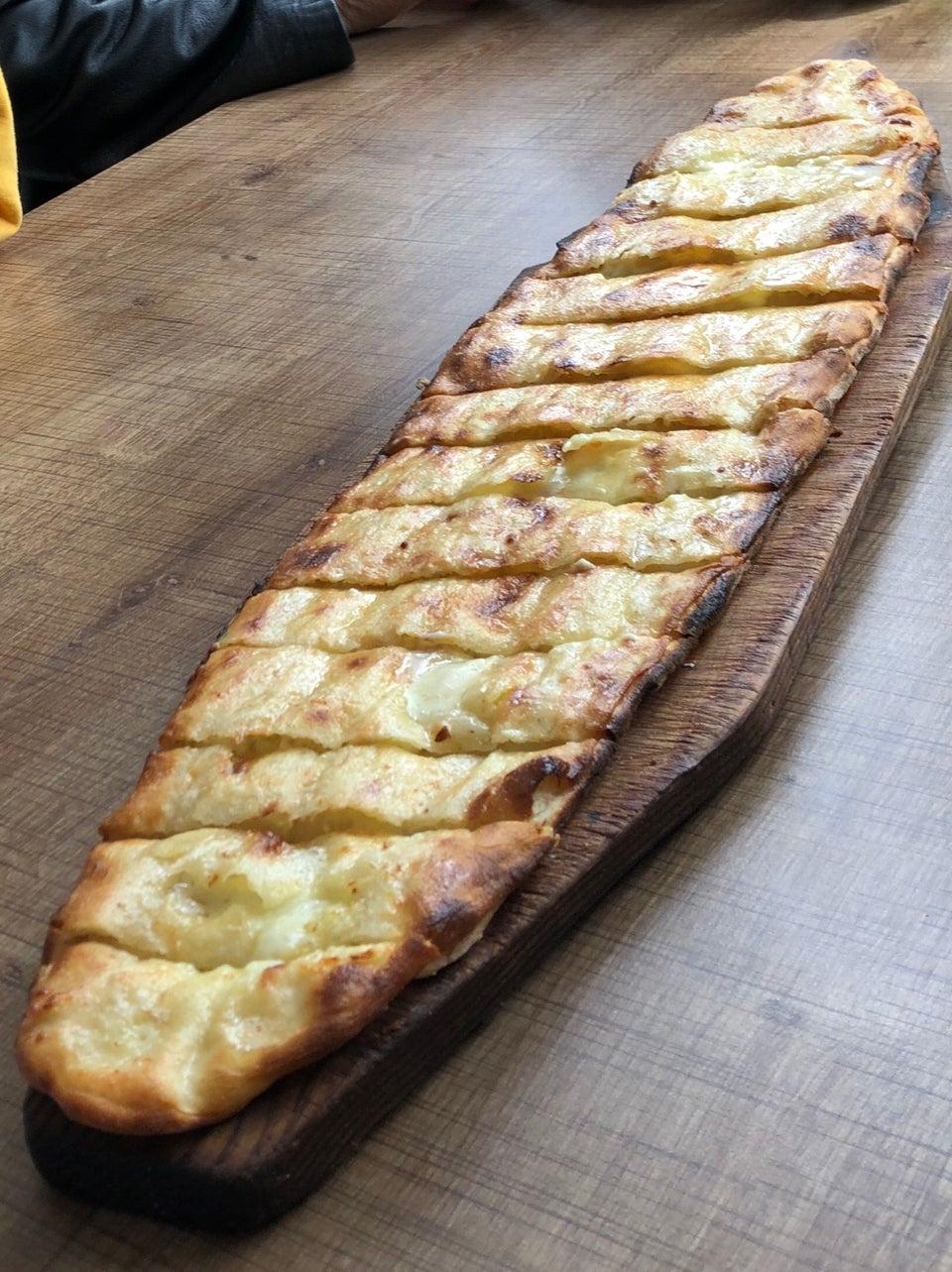
Emet pide is a traditional food product with a history of over 100 years in the Emet district. It holds an important place in the district’s culinary culture and economy. The pide is produced as a closed product by placing goat cheese between two layers of dough that are separately rolled out and baked in a stone oven over wood fire.
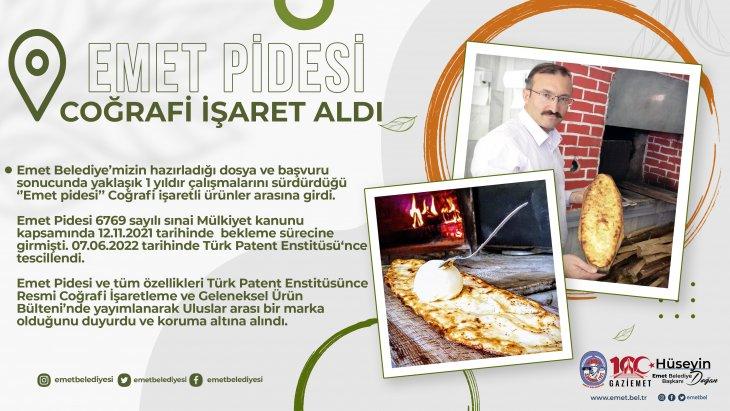
The product’s history extends back to the early years of the Republic. Due to its preparation using local ingredients and traditional cooking methods, Emet pide exhibits a geographical indication. As a result of an application by the Emet Municipality, the geographical indication for Emet pide was officially registered on 7 June 2022.
Emet Pide (Emet Municipality)
Emet pide is registered as a geographical indication of the “certification mark” type. The registration application was submitted by the Emet Municipality on 12 November 2021 and approved by the Turkish Patent and Trademark Office on 7 June 2022. The registration number is 1137 and the application file number is C2021/000471.
The product group is classified as bakery and confectionery products, dough-based items and sweets. The geographical boundary is limited to the Emet district of Kütahya Province. To indicate its geographical indication, the term “Emet Pide” and the certification mark emblem are displayed on the product itself or its packaging. When direct application is not possible, the term and emblem must be visibly displayed on the establishment’s menu or signage.
Emet pide is a closed type of pide made by placing goat cheese between two separately rolled layers of dough and baked in a stone oven over wood fire. The shape of the pide tapers toward the edges. During winter months, matured cow cheese may also be used together with goat cheese.
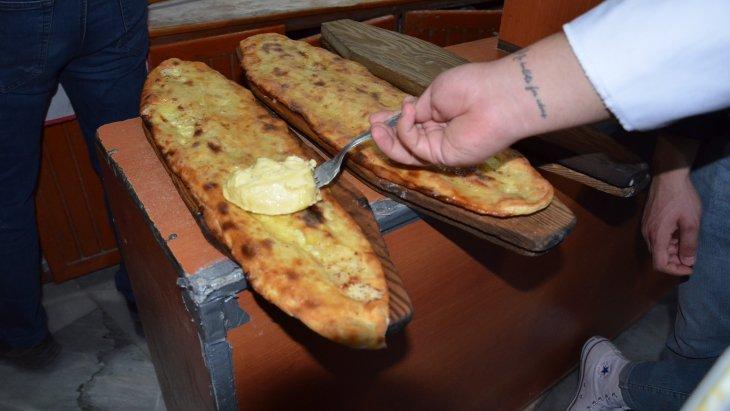
The dough is prepared using wheat flour, drinking water, salt and pre-prepared sourdough starter. The sourdough starter is made using the cooking water of chickpeas. An uncooked Emet pide weighs approximately 360 grams of dough and 150 grams of cheese. After baking, butter is spread on the surface of the pide, then slits are cut into it with a knife and it is returned to the oven. After baking is complete, additional butter is applied to the slits and the pide is cut into portions for serving.
The cheese used in Emet pide production is obtained from the milk of goats and cows raised in the highland pastures and meadows of the Emet district. The dough is prepared using wheat flour, drinking water, salt and pre-prepared sourdough starter. The sourdough starter is made from chickpea cooking water and is left to ferment for 48 hours before use.
The dough is divided into bottom and top portions, rested and rolled out to specific dimensions. The cheese is placed on the bottom layer of dough and covered with the top layer. The pide is briefly baked in a stone oven heated by wood fire. After removal from the oven, butter is applied, slits are cut with a knife and it is served.
Emet Pide (Emet Municipality)
Monitoring of Emet pide is coordinated by the Emet Municipality. The monitoring body consists of at least three members, including one representative each from the Emet District Directorate of Agriculture and Forestry and the Emet Chamber of Tradespeople and Craftsmen.
Inspections verify the suitability of ingredients used in production, compliance with the established production method and the correct use of the term “Emet Pide” and the certification mark emblem. Experts from public or private institutions may be consulted during inspections. Inspections are conducted annually on a regular basis, as needed or upon complaint.
Emet pide demonstrates a geographical indication through its unique traditional production method and ingredients specific to the Emet district. It is served as a local specialty at festivals and events, offered to participants both from within the district and from outside.
Emet Municipality. "Emet Pide Competes with Pizza at EMFEST." Emet Municipality. Accessed August 16, 2025. https://www.emet.bel.tr/emfestte-emet-pidesi-pizzayla-yaristi/1197/
Emet Municipality. "Meşhur Emet Pidemizin Coğrafi İşareti Tescillendi." Emet Municipality. Accessed August 16, 2025. https://www.emet.bel.tr/proje/meshur-emet-pidemizin-cografi-isareti-tescillendi/
Turk Patent and Trademark Office. "Emet Pidesi." Accessed August 16, 2025. https://ci.turkpatent.gov.tr/cografi-isaretler/detay/5487
Turkish Patent and Trademark Office. "Emet Pidesi." Turkish Patent and Trademark Office. Accessed August 16, 2025. https://ci.turkpatent.gov.tr/Files/GeographicalSigns/a74d83ae-8621-430f-9196-99f461600ec4.pdf

Geographical Indication Type(s) | Mahreç Sign | ||||||||
|---|---|---|---|---|---|---|---|---|---|
Registration Number | 1137 | ||||||||
Product / Product Group(s) | Baking Desserts Dough Products | ||||||||
Applicant/Registrant(s) | Emet Municipality | ||||||||
Geographical Boundary | Emet District Kütahya | ||||||||
Geographical Indication and Registration Details
Product Description and Distinctive Characteristics
Production Method
Monitoring and Protection
Cultural and Social Significance