


This article was automatically translated from the original Turkish version.
+1 More
Species | Cousinia mazu-shirinensis | ||||||||
|---|---|---|---|---|---|---|---|---|---|
Family | Asteraceae | ||||||||
Genus | Cousinia | ||||||||
Distribution | Iraq – Erbil Kani Mazu Shirin Region Şırnak Province, Uludere District, Şenoba Village and Surroundings | ||||||||
Local Name | Kızan Thorn Erbil Kızan | ||||||||
Conservation Status (IUCN) | Not Specified (Not Yet Included in the IUCN Classification) | ||||||||
Erbilkızanı is a species belonging to the genus Cousinia of the Asteraceae (daisy) family. According to the Compositae Global Database, the genus Cousinia is represented by approximately 700 taxa worldwide. In the flora of Türkiye, this genus includes 39 species distributed across six sections, 26 of which are endemic. The species was first described in 1972 by Karl Heinz Rechinger in Flora Iranica. 【1】 It was described based on specimens collected in 1961 from the Kani Mazu Şirin region of Erbil Province, Iraq, by A.D.Q. Agnew, Hadač, and Wheeler-Haines.
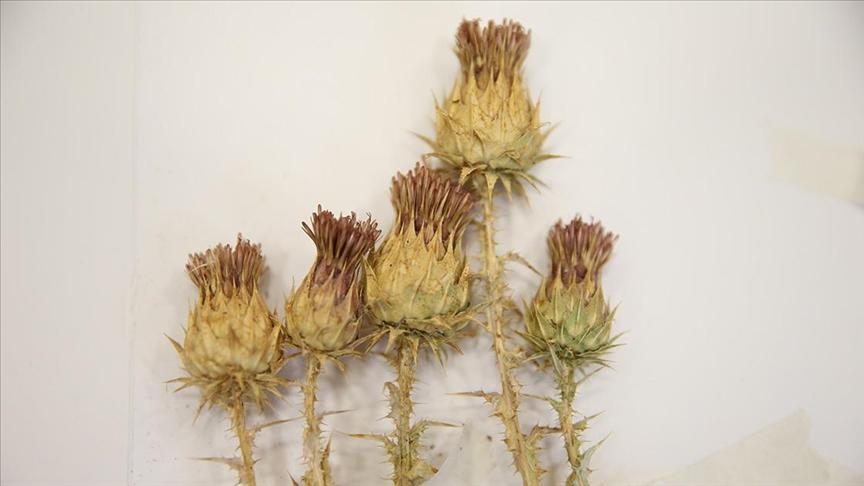
Erbilkızanı (AA)
Cousinia mazu-shirinensis is a biennial or perennial monokarpic herb. It grows to a height of 25–46 cm and typically branches from the base. The stem is slender, cylindrical, and covered with dense spiderwebby hairs at the base and sparser ones toward the upper parts. Leaves are firm-textured, reticulate-veined, and toothed; the lower surfaces are densely covered with spiderwebby hairs, while the upper surfaces have sparse hairs. Basal leaves are elliptic or broadly lanceolate, measuring 15–30 × 4–7 cm; they may be simple or divided into two or three segments. Stem leaves are lobed at the base and become simpler toward the apex, with winged margins up to 4.5–10 mm wide.
Flowers occur in 6–12 heads, each solitary at the tips of branches. Each head contains 40–60 florets; the involucre is ovoid to spherical, measuring 20–35 × 20–55 mm. Phyllaries are arranged in multiple rows, with outer ones broad and inner ones narrow and elongated. Appendages are 8–16.5 × 4–15 mm in size, prominently ridged, and tipped with spines 1–3.5 mm long. Florets are wine-purple in color; anther tubes are of the same color and glabrous. Pappus bristles are 3.5–5.5 mm long. Achenes are blackish-brown, inversely ovoid, and measure 4.5–5.5 × 2–3.5 mm.
Cousinia mazu-shirinensis occurs in open steppes and oak woodlands. The species is naturally found on rugged and exposed slopes at elevations between 950 and 1520 meters.
Cousinia is commonly known as “Kızan” in Türkiye. The scientific name Cousinia mazu-shirinensis refers to its first discovery in the Kani Mazu Şirin region of Erbil Province, Iraq. After its documentation in Türkiye, researchers named the species “Erbilkızanı” to honor the location of its original description.
Cousinia mazu-shirinensis specimens were first collected in 1961 from the Kani Mazu Şirin region of Erbil Province, Iraq, by A.D.Q. Agnew, Hadač, and Wheeler-Haines. The species was scientifically described by Karl Heinz Rechinger in 1972 in Flora Iranica. Its presence in Türkiye was confirmed in 2024 through field surveys conducted by Mehmet Fidan, Süleyman Mesut Pınar, Hüseyin Eroğlu, and Metin Armağan in Şırnak Province.【2】
Individuals of this species were first observed during doctoral research conducted in Şırnak Province in 2012; limited numbers were recorded in the same area in 2015. During field surveys carried out between 2018 and 2019 under the “National Biological Diversity Inventory and Monitoring Project (UBENİS)” by the General Directorate of Nature Conservation and National Parks of the Ministry of Agriculture and Forestry, a widespread population was identified. As a result of these studies, the species was published in 2024 in KSÜ Journal of Agriculture and Nature and officially added to the flora of Türkiye.

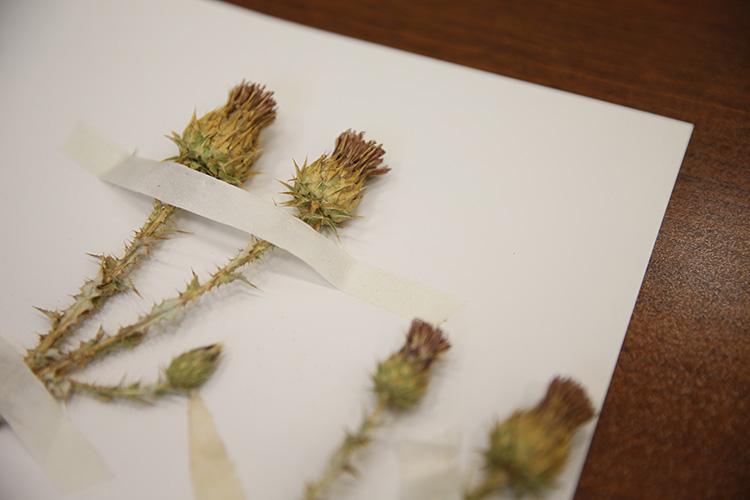
A Visual from the Discovery Process (AA)
Cousinia mazu-shirinensis has been newly recorded in the flora of Türkiye, increasing the number of Cousinia taxa in the country to 42, of which 28 are endemic.
Cousinia mazu-shirinensis specimens are preserved in the Flora and Fauna Center Herbarium of Siirt University (SUFAF) and the Herbarium of Van Yüzüncü Yıl University (VANF). The holotype is housed at the Royal Botanic Gardens, Edinburgh (E00383837); isotypes are held at Kew Herbarium (K000778377) and Vienna Herbarium (W19720001074).【3】 The plant is also conserved in the Botan Herbarium. These herbarium specimens are accessible to researchers and are used for taxonomic identification and comparative studies.
Anadolu Ajansı. “Şırnak'ta bulunan bitki 12 yıllık çalışma sonucu literatüre kazandırıldı.” Accessed October 24, 2025.https://www.aa.com.tr/tr/yasam/sirnakta-bulunan-bitki-12-yillik-calisma-sonucu-literature-kazandirildi/3539709.
Fidan, Mehmet, Süleyman Mesut Pınar, Hüseyin Eroğlu, and Metin Armağan. “A New Record for the Flora of Türkiye: *Cousinia mazu-shirinensis* Rech.f.” *KSÜ Tarım ve Doğa Dergisi* 27, no. 6 (2024): 1298–1303. Accessed October 24, 2025.https://dergipark.org.tr/en/download/article-file/3749602.
JACQ Virtual Herbaria. “*Cousinia mazu-shirinensis* Rech. f. – Specimen Detail (B 1972-0001074).” *JACQ – Virtual Herbaria Data Portal*. Accessed October 24, 2025.https://jacq.org/detail/361861.
Royal Botanic Garden Edinburgh. “Holotype of Cousinia mazu-shirinensis Rech.f. [family Compositae].” JSTOR Global Plants. Accessed October 24, 2025.https://plants.jstor.org/stable/pdf/10.5555/al.ap.specimen.e00383837.
[1]
Fecri Barlık, “Şırnak'ta bulunan bitki 12 yıllık çalışma sonucu literatüre kazandırıldı,” Anadolu Ajansı, 16 Nisan 2025, erişim 24 Ekim 2025, https://www.aa.com.tr/tr/yasam/sirnakta-bulunan-bitki-12-yillik-calisma-sonucu-literature-kazandirildi/3539709.
[2]
Mehmet Fidan, Süleyman Mesut Pınar, Hüseyin Eroğlu ve Metin Armağan, “A New Record for the Flora of Türkiye: Cousinia mazu-shirinensis Rech.f.,” KSÜ Tarım ve Doğa Dergisi 27, no. 6 (2024): 1298–1303, erişim 24 Ekim 2025, https://dergipark.org.tr/en/download/article-file/3749602.
[3]
Royal Botanic Garden Edinburgh. “Holotype of Cousinia mazu-shirinensis Rech.f. [family Compositae].” JSTOR Global Plants (2024): 1–1. Erişim 24 Ekim 2025. https://plants.jstor.org/stable/pdf/10.5555/al.ap.specimen.e00383837.

Species | Cousinia mazu-shirinensis | ||||||||
|---|---|---|---|---|---|---|---|---|---|
Family | Asteraceae | ||||||||
Genus | Cousinia | ||||||||
Distribution | Iraq – Erbil Kani Mazu Shirin Region Şırnak Province, Uludere District, Şenoba Village and Surroundings | ||||||||
Local Name | Kızan Thorn Erbil Kızan | ||||||||
Conservation Status (IUCN) | Not Specified (Not Yet Included in the IUCN Classification) | ||||||||
No Discussion Added Yet
Start discussion for "Erbilkızanı (Cousinia Mazu-shirinensis)" article
Morphological Characteristics
Habitat
Turkish Nomenclature
Discovery and Research Process
Contribution to the Flora of Türkiye
Conservation and Herbarium Information