


This article was automatically translated from the original Turkish version.
+2 More
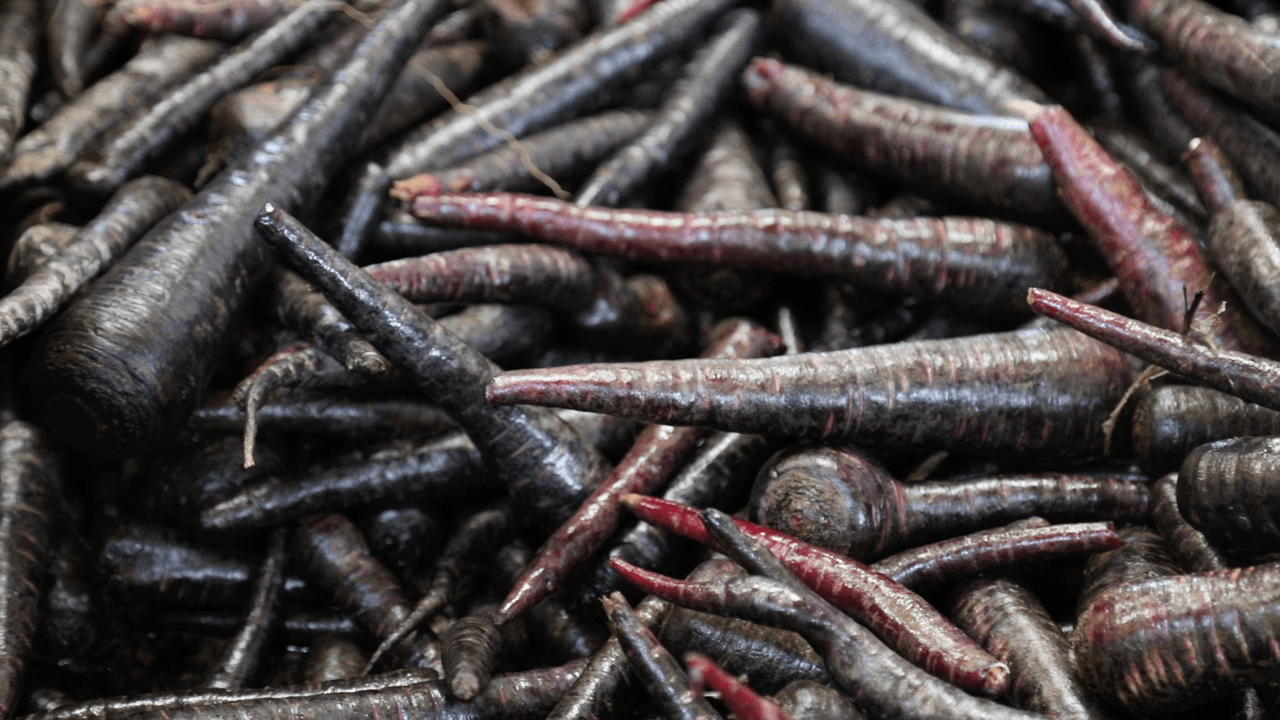
Ereğli Black Carrot
Product / Product Group(s) | Processed and unprocessed fruits and mushrooms vegetables | ||||||||
|---|---|---|---|---|---|---|---|---|---|
Applicant/Registrant(s) | Konya Ereğli Municipality | ||||||||
Registration Date | 09.06.2017 | ||||||||
File Number | C2014/046 | ||||||||
Registration Number | 216 | ||||||||
Place of Production | Konya, Türkiye | ||||||||
Ereğli black (purple) carrot is a local carrot variety produced in the Ereğli district of Konya Province, distinguished by its high anthocyanin content. The product has been officially registered by the Turkish Patent and Trademark Office under the designation “Place of Origin” and protected under Registration No: 216 on 09 June 2017.

Ereğli Siyah Havucu (Turkish Patent)
The Ereğli black carrot belongs to the variety Daucus carota L.ssp. sativus var. atrorubens Alef. Its deep purple color results from high levels of anthocyanin, a natural pigment that occurs in significantly greater concentrations in the soils of Ereğli. The carrot is utilized in various applications including turnip juice, jam, canned products, ice cream, natural food coloring, cosmetic products, and as a table vegetable.
The ascorbic acid (vitamin C) content is 26.40 mg/100 g, one of the highest among black carrot varieties cultivated in Türkiye. The product is also notable for its high sugar content (49.53 g/L) and balanced acidity (pH 6.02).
Physical measurements show an average weight of 111.49 grams, a length of 233 mm, and a diameter of 33.1 mm. The lime/potassium ratio at level 0.5 in Ereğli soils plays a significant role in distinguishing this carrot from varieties grown in other regions.
Seed Production and Planting: Black carrot seeds are obtained from cuttings taken during the flowering period in May. Seeds must be grown at least 500 meters away from other carrot varieties. Sowing is carried out between 10 May and 25 May at a depth of 2.5–3 cm. A seed rate of 300–400 grams per decare is applied.
Soil Preparation: The soil must be loose, rich in organic matter, and permeable, with a pH level between 6 and 6.5. Soil preparation involves two tillage operations. Farmyard manure is carefully mixed in, and fresh manure is not used.
Irrigation and Fertilization: Regular irrigation is crucial for carrot development. Irrigation is performed using sprinkler or drip methods. A balanced ratio of nitrogen and potassium must be maintained, with application rates of 8–10 kg nitrogen, 8–9 kg phosphorus, and 12–16 kg potassium per decare.
Harvesting: Harvesting takes place between 15 October and 25 December. Timely harvesting and avoiding damage to the roots are essential for maintaining product quality.

Ereğli Siyah Havucu (Gokonya)
Production is limited to the Ereğli district of Konya. Major production areas include the villages of Kuzukuyusu, Pınarözü, Sazgeçit, Selvili, Aşıklar, Türkmen, Çiller, and Kamışlıkuyu. Monitoring is conducted at least three times per year by a committee composed of experts from the relevant district agricultural, trade, and health institutions, under the coordination of the Konya Ereğli Municipality. Inspections verify the production location, seed origin, pesticide application schedules, and physical quality criteria.
Gokonya. “Ereğli Siyah (Mor) Havucu.” Accessed May 31, 2025. https://gokonya.com/tr/eregli-siyah-(mor)-havucu
Turk Patent and Trademark Office. "Ereğli Siyah Havucu." Geographical Indication Registration Certificate No: 216. Accessed May 31, 2025. https://ci.turkpatent.gov.tr/cografi-isaretler/detay/38129

Ereğli Black Carrot
Product / Product Group(s) | Processed and unprocessed fruits and mushrooms vegetables | ||||||||
|---|---|---|---|---|---|---|---|---|---|
Applicant/Registrant(s) | Konya Ereğli Municipality | ||||||||
Registration Date | 09.06.2017 | ||||||||
File Number | C2014/046 | ||||||||
Registration Number | 216 | ||||||||
Place of Production | Konya, Türkiye | ||||||||
No Discussion Added Yet
Start discussion for "Ereğli Black Carrot" article
Product Description and Distinctive Characteristics
Production Method
Geographical Boundary and Monitoring