


This article was automatically translated from the original Turkish version.
+1 More
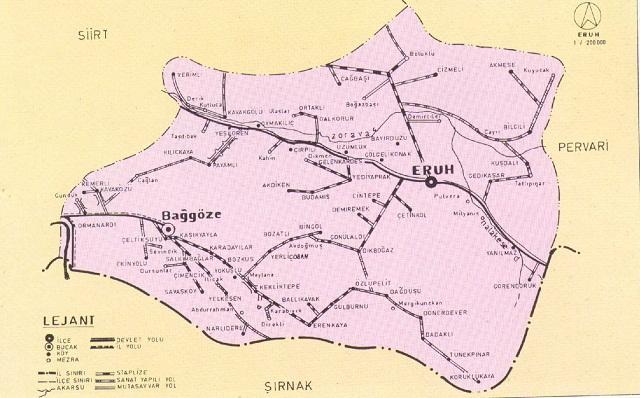
Eruh (District)
Location | Southeastern Anatolia Region Türkiye Siirt Province | ||||||||
|---|---|---|---|---|---|---|---|---|---|
Neighboring Districts | East: Şırnak, West: Siirt, North: Pervari, South: Güçlükonak | ||||||||
Distance to Provincial Center | 53 km | ||||||||
Elevation(s) | 1 125 metres | ||||||||
Area(s) | 1 215 km² | ||||||||
Population | District Center: 10,720, Total (with villages): 20,257 | ||||||||
Eruh is a district隶属于 Siirt Province in the Southeastern Anatolia Region of Türkiye. Eruh, with historical roots extending far into antiquity, is a settlement notable for its geographical structure, economic conditions, and tourism potential. Below, detailed information is provided under the headings of its history, geographical structure, climate, plant vegetation, social and economic structure, tourism potential, and demographic structure.
Although the exact founding date of Eruh is unknown, the region’s history extends back to 1000 BCE. During this period, Eruh was under Urartian rule and subsequently came under the dominion of the Assyrians, Persians, Seljuks, and Islamic empires. During the Ottoman period, it was incorporated into Ottoman territories during the reign of region alongside Yavuz Sultan Selim. As one of the oldest districts of Siirt Province, Eruh’s administrative history is documented in the 1288 AH (1872 CE) Diyarbekir Salname, which lists it as one of four accident under Siirt Sanjak, with place noted as its status. At that time, the nahiyas of Zilan, Dergül, and Pervari were subordinate to Eruh. According to the 1315 AH (1899 CE) Bitlis Salname, Eruh was recorded as a kaza under Siirt Sanjak, encompassing the nahiyas of Dergül, Lodi, and Hazelnut. It is understood that between these two dates, the Pervari Nahiyeh was separated from Eruh and became an independent district. After the establishment of the Republic, Eruh retained its status as a district under Siirt Province, a status it maintains today.
Eruh is located in the Southeastern Anatolia Region at 42° east longitude and 38° north latitude. To its east lies Şırnak, to its west Siirt, to its north Pervari, and to its south Güçlükonak districts. Eruh is situated 53 km from the center of Siirt Province at an elevation of 1,125 meters and has a surface area of 1,215 km². It occupies a central position along the main road (98 km) connecting Siirt and Şırnak provinces.
Eruh’s topography is predominantly mountainous, undulating, and rugged. The southern and northern boundaries are formed by extensions of the Southeastern Taurus Mountains, which connect with the mountains of Şırnak and Hakkâri. The highest points in the district are Tarti (Terazın) Mountain at 2,265 meters and Tünek (Aval) Mountain at 2,100 meters. The Terazın and Çirav plateaus on Tarti Mountain and the Geri and Short Çeşme plateaus in the Cevizlik Valley serve as important areas for livestock grazing.
The main water sources in Eruh are the Zorava Creek and the Şikefta Creek. The Zorava Creek originates near the Tatlıpınar hamlet of Kuşdalı Village and joins the Botan River at the Botan Bridge within the boundaries of Sağlarca Village in Siirt. The Mir Suyu, emerging from Görendoruk Village, forms the Şikefta Creek and merges with the Zorava Creek near the Mergi hamlet of Bilgili Village before flowing into the Botan River. The discharge of these creeks is particularly low during write months.
Due to its location straddling both Eastern and Southeastern Anatolia, Eruh exhibits climatic characteristics of both regions. Generally, a continental climate prevails, with cold, wet winters and hot, dry summers. Average annual temperatures range between 14–31°C, while the annual precipitation volume is 67,401 m³.
The vegetation cover, shaped by the district’s mountainous and rugged terrain, is predominantly sparse and steppe-like. Due to limited arable land, the vegetation mainly consists of pastures supporting transhumance and livestock farming, along with trees of economic value such as pistachio and grape like.
Eruh’s social structure has been shaped by its geographical location and economic activities. The majority of the population maintains a traditional lifestyle and engages in small-scale livestock farming. Population are distributed between the district center and villages; the population of the district center is 10,720, while the total population including villages is 20,257. Educational facilities include the Eruh Vocational School affiliated with Siirt University. Established in 2009, the school offers education in three departments and has a male student dormitory with a capacity of 350 and a female student dormitory with a capacity of 100.
Eruh’s economy is directly influenced by its rugged terrain, surrounded on all sides by mountains. Arable land is scarce, and existing agricultural activities primarily meet households’ basic bread needs and are not considered a commercial source of income. The majority of the population sustains itself through small-scale livestock farming. After livestock, the most important income source is pistachio cultivation. Additionally, small scale vineyards contribute to household livelihoods. Transportation infrastructure, particularly due to the low standard of roads and difficulties during village months, remains a limiting factor for economic development. The district center is connected to Siirt by a 54 km asphalt road.
Eruh possesses tourism potential due to its historical and natural attractions. Notable sites include:
Eruh’s total population is 20,257, of which 10,720 reside in the district center and the remainder in villages. The district’s mountainous terrain and limited economic opportunities contribute to low population density. The majority of the population lives in rural areas and depends on traditional livelihoods.
Eruh is a district notable for its rich historical heritage, natural beauty, and cultural legacy. However, its economic and social development has been constrained by geographical challenges and infrastructure deficiencies. The utilization of its tourism potential and the improvement of transportation conditions present significant opportunities for the district’s future.
Eruh Belediyesi. "Cografyası." Accessed April 8, 2025. https://www.eruh.bel.tr/sayfa/cografyasi.html.
Eruh Belediyesi. "Ekonomi." Accessed April 8, 2025. https://www.eruh.bel.tr/sayfa/ekonomi.html.
Eruh Belediyesi. "Gezilecek Yerler." Accessed April 8, 2025. https://www.eruh.bel.tr/sayfa/gezilecek-yerler.html.
Eruh Belediyesi. "Tarihçemiz." Accessed April 8, 2025. https://www.eruh.bel.tr/sayfa/tarihcemiz.html.
Siirt Valiliği. "Eruh." Accessed April 8, 2025. http://siirt.gov.tr/eruh.

Eruh (District)
Location | Southeastern Anatolia Region Türkiye Siirt Province | ||||||||
|---|---|---|---|---|---|---|---|---|---|
Neighboring Districts | East: Şırnak, West: Siirt, North: Pervari, South: Güçlükonak | ||||||||
Distance to Provincial Center | 53 km | ||||||||
Elevation(s) | 1 125 metres | ||||||||
Area(s) | 1 215 km² | ||||||||
Population | District Center: 10,720, Total (with villages): 20,257 | ||||||||
History
Geographical Structure
Climate and Vegetation
Social Structure
Economic Structure
Tourism Potential
Demographic Structure