

This article was automatically translated from the original Turkish version.
+2 More
Type(s) | Olympic Sports Structure Ski Jumping Facility | ||||||||
|---|---|---|---|---|---|---|---|---|---|
Location | Türkiye Erzurum | ||||||||
Relationship with Tourism | Building Group Related to Erzurum Tourism Plans Sports Tourism Infrastructure Sports Facilities Within Winter Tourism | ||||||||
Units Within the Facility | Tower Cafe (At the Summit of the Largest Tower) Viewing and Usage Areas Landing Slopes Jumping Towers | ||||||||
Usage Areas | International Sports Events Athlete Training Ski Jumping Competitions | ||||||||
Location in Türkiye | The First and Only Olympic-Quality Facility Built for Ski Jumping | ||||||||
Tallest Tower | 125 Meters | ||||||||
Number of Towers | 5 Units | ||||||||
Construction Period | 7 January 2011 | ||||||||
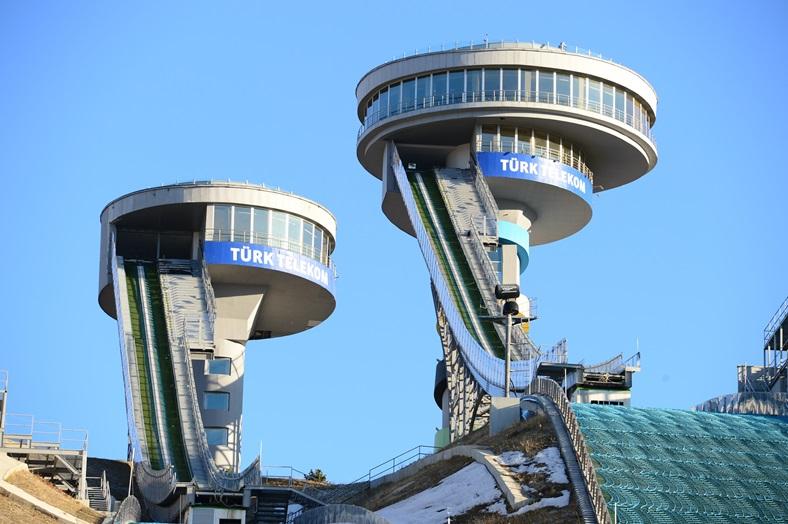
Erzurum Jumping Towers, are sports facilities constructed in the city center of Erzurum for ski jumping. The towers form a complex consisting of jumping platforms at different heights and associated landing slopes. The structure group was planned to serve athletes’ training and competition needs within the framework of winter sports activities and has functioned as part of Erzurum’s winter sports infrastructure.

Erzurum Jumping Towers (T.C. Erzurum Governorship)
Erzurum Jumping Towers are located in the Kiremitliktepe area of Erzurum city center. The site is situated within the region where the city’s winter sports facilities are concentrated and is conveniently close to the urban center in terms of accessibility. The towers were constructed on a sloping terrain selected with consideration of topographical conditions suitable for ski jumping.
The Erzurum Jumping Towers are the first Olympic-standard facilities in Türkiye built specifically for ski jumping. The complex consists of jumping towers at various levels and their associated landing slopes. The structure group was designed to enable sporting activities in compliance with international standards, with simultaneous evaluation of athlete usage, technical requirements, and environmental conditions. The site serves not only sporting purposes but also functions as a key component of Erzurum’s winter sports infrastructure.

Erzurum Jumping Towers (Anadolu Agency)
Erzurum Jumping Towers were constructed to meet the infrastructure needs for ski jumping during the 2011 Winter Universiade held in Erzurum. Construction was completed in late 2010, and the facilities were inaugurated on 7 January 2011. Following the opening, the towers were used for sporting events during and after the Winter Universiade.
After the 2011 Winter Universiade, the use of the facilities continued through sporting activities as well as maintenance and operational efforts. However, a landslide on 15 July 2014 caused a significant disruption to the operation of the jumping tower complex and directly affected its usability. Following this event, technical assessments and evaluations of the towers and landing slopes became a priority.【1】

Erzurum Jumping Tower Landing Slope (Anadolu Agency)
Erzurum Jumping Towers consist of five separate towers and their associated landing slopes, designed in accordance with the technical requirements of ski jumping. The towers were planned at heights of 20, 40, 60, 95, and 125 meters to enable athletes to perform jumps at different levels and disciplines. The structure group was developed based on standardized dimensions and arrangements used in international sporting events.【2】
The towers feature a structural system combining reinforced concrete and steel elements. The platforms where athletes prepare for their jumps are located at the upper sections of the towers and are arranged to connect directly to the landing slopes. Within the complex, there are two jumping towers and two corresponding ramps for K125 and K95 competitions, as well as three separate training ramps for the K65, K40, and K20 categories. The peak elevation of the K95 and K125 jumping hills is 1,995 meters above sea level, while their lowest point is at 1,902 meters. The architectural design prioritized functionality, adopting a minimalist approach aligned with athlete safety and technical requirements.【3】

Construction of Erzurum Jumping Towers (Anadolu Agency)
The jumping towers consist of vertical structural elements rising into a main body with jumping platforms positioned at their upper sections. These platforms include take-off points that allow athletes to gain speed and transition areas directing them toward the landing slopes. The placement of the towers was planned with consideration of distances between them and their connections to the ski jumps.
The landing slopes and tracks were designed with specific inclines and lengths to ensure athletes can land safely after their jumps. The slopes consist of wide concrete surfaces extending along the hillside, with their alignment and positioning determined to harmonize with the natural topography of the terrain. These areas were arranged to meet the technical criteria required for both competition and training use.

Ski Jumper Launching from Erzurum Jumping Towers (Anadolu Agency)
Erzurum Jumping Towers are a sports facility designed to host training and events for ski jumping. Thanks to its tower and track configuration, which allows athletes to train at various levels, the facility has been used for both national and international sporting activities. The structure group has been regarded as one of the key infrastructure elements of winter sports events held in Erzurum.【4】
The facility area has not been limited solely to ski jumping but has also served a supportive role in athlete camps and preparation programs. The area, organized for use during both summer and winter seasons, has been included among the facilities in Erzurum’s sports infrastructure intended for continuous use.

Ski Jumper Launching from Erzurum Jumping Towers (Anadolu Agency)
The jumping towers have been used for athlete development, training, and competitions in ski jumping. The towers at varying heights have provided athletes with a progressive framework for technical development. In this regard, the facility has been regarded as a functional sports area for both professional athletes and those at developmental stages.【5】
The design of the facility aimed not only for seasonal winter use but also for year-round sporting activities. During summer, the area has been utilized for training and preparation, while in winter it has been dedicated to ski jumping activities. This dual-use approach aligns with Erzurum’s goal of becoming a year-round center for sports tourism.【6】

Landslide Event at Erzurum Jumping Towers (Anadolu Agency)
On 15 July 2014, a landslide occurring in the area of the Erzurum Jumping Towers directly affected the operation of the facility. As a result of the landslide, the landing slopes connected to the jumping towers were damaged and rendered unusable. Following the event, field inspections were conducted and it was determined that ground movements continued in the landslide zone.【7】
Prior to the landslide, cracks had been observed in the ground around the landing slopes and had been repaired. Observations after the landslide revealed that ground movements along the slope hosting the ramps continued, limiting the usability of the area. It was determined that the incident was related not to the tower structures themselves but to the landing slopes and surrounding ground conditions.【8】

Repair Works at Erzurum Jumping Towers (Anadolu Agency)
As a result of the landslide, the landing slopes of all five jumping towers became completely non-functional, while no significant damage was observed in the upper structural elements of the towers. The fact that the landing slopes consisted of concrete surfaces placed directly on the slope and the underlying ground conditions contributed to the severity of the landslide. After the event, the facility was unable to continue hosting sporting activities.【9】
Inspections revealed that the landing slopes consisted of a concrete layer approximately 40 centimeters thick placed directly on the slope. It was determined that drainage measures in the slope area were inadequate and that necessary static and seismic stability calculations for the slope had either not been conducted or were incomplete. This condition was assessed as a contributing factor to the occurrence of the landslide.【10】

Recent Repairs at Erzurum Jumping Towers (Anadolu Agency)
Following the 2014 landslide, the Erzurum Jumping Towers were closed to sporting activities, and various initiatives were launched to restore their usability. Due to the inoperability of the landing slopes, safety of the site became the primary concern, and the current condition of the facility and required interventions fell under the responsibility of relevant institutions.
In subsequent years, maintenance, repair, and seasonal preparation works have been carried out for the jumping towers and surrounding area. These efforts aimed to make the facility suitable for athlete use, ensure its safety, and improve infrastructure conditions. Through periodic preparation works, the jumping towers have continued to remain part of Erzurum’s sports facilities.

Ski Jumper Launching from Erzurum Jumping Towers (T.C. Erzurum Governorship)
Erzurum Jumping Towers were used for ski jumping competitions during the 25th Winter Universiade held in Erzurum from 27 January to 6 February 2011. The event, involving approximately 3,500 athletes from 57 countries across 11 disciplines, saw the towers function as part of Erzurum’s winter sports infrastructure. The towers were also used by athletes during the European Youth Olympic Festival held in Erzurum in February 2017.【11】

Ski Jumper Launching from Erzurum Jumping Towers (T.C. Erzurum Governorship)
In addition to their sporting function, the jumping towers are among the structures featured in promoting Erzurum’s winter tourism potential. The complex is recognized as one of the prominent facilities in Erzurum’s winter tourism offerings and has been considered a key element in the city’s sports- and tourism-oriented planning. The Kule Kafe located at the summit of the largest tower is one of the publicly accessible areas of the facility and offers panoramic views of the city of Erzurum.
Anadolu Ajansı. "Atlama Kulelerinde Sona Doğru." October 16, 2016. Accessed January 30, 2026. https://www.aa.com.tr/tr/spor/atlama-kulelerinde-sona-dogru/665758.
Anadolu Ajansı. "Atlama Kulelerinde Çökme." July 15, 2014. Accessed January 30, 2026. https://www.aa.com.tr/tr/spor/atlama-kulelerinde-cokme/141293.
Anadolu Ajansı. "Erzurum'daki Atlama Pistlerinin Onarımı Sürüyor." October 13, 2015. Accessed January 30, 2026. https://www.aa.com.tr/tr/spor/erzurumdaki-atlama-pistlerinin-onarimi-suruyor/438471.
Anadolu Ajansı. "Genç Kayakçılar Erzurum'da." Foto Galeri. February 23, 2012. Accessed January 30, 2026. https://www.aa.com.tr/tr/pg/foto-galeri/genc-kayakcilar-erzurumda.
Anadolu Ajansı. "Türkiye'nin Tek Kayakla Atlama Kuleleri Taşıma Karla Atlayışa Hazırlandı." December 31, 2017. Accessed January 30, 2026. https://www.aa.com.tr/tr/spor/turkiyenin-tek-kayakla-atlama-kuleleri-tasima-karla-atlayisa-hazirlandi/1019468.
Anadolu Ajansı. "Türkiye'nin Tek Kayakla Atlama Kuleleri Yeni Teknolojisiyle Dünyanın Sayılı Merkezleri Arasına Girecek." October 18, 2025. Accessed January 30, 2026. https://www.aa.com.tr/tr/spor/turkiyenin-tek-kayakla-atlama-kuleleri-yeni-teknolojisiyle-dunyanin-sayili-merkezleri-arasina-girecek/3720321.
Anadolu Ajansı. "Türkiye'nin Tek Kayakla Atlama Kulelerinin Pistleri Ahşapla Yenileniyor." May 28, 2025. Accessed January 30, 2026. https://www.aa.com.tr/tr/spor/turkiyenin-tek-kayakla-atlama-kulelerinin-pistleri-ahsapla-yenileniyor/3550436.
Atatürk Üniversitesi Faculty of Tourism. "25th Winter Universiade Symbol: 'Jumping Towers'." *ATA-TURİZM Haber Bülteni*, no. 10 (2021/2). Accessed January 30, 2026. https://birimler.atauni.edu.tr/turizm-fakultesi/wp-content/uploads/sites/74/2022/02/ATA-TURIZM-Haber-Bulteni-10.-Sayi.pdf.
Aziziye Kaymakamlığı. "Atlama Kuleleri." Accessed January 30, 2026. https://aziziye.gov.tr/atlama-kuleleri.
Erzurum Gençlik ve Spor İl Müdürlüğü. "Atlama Kuleleri Sezona Hazır." November 15, 2016. Accessed January 30, 2026. https://erzurum.gsb.gov.tr/HaberDetaylari/1/73691/atlama-kuleleri-sezona-hazir.aspx.
Erzurum Valiliği. "Kiremitlik Tepe Kayakla Atlama Kuleleri." Accessed January 30, 2026. https://www.erzurum.gov.tr/atlamakuleleri.
Institute of Civil Engineers Erzurum Branch. "Report on Jumping Towers." August 26, 2014. Accessed January 30, 2026. https://erzurum.imo.org.tr/TR,37976/atlama-kuleleri-ile-ilgili-imo-raporu.html.
TRT Haber. "Erzurum'un Simgelerinden Kayakla Atlama Kuleleri Yaz Kış Sporculara Ev Sahipliği Yapıyor." January 22, 2021. Accessed January 30, 2026. https://www.trthaber.com/haber/guncel/erzurumun-simgelerinden-kayakla-atlama-kuleleri-yaz-kis-sporculara-ev-sahipligi-yapiyor-549716.html.
Çelik, Semet, Mehmet Özyazıcıoğlu, Remzi Şahin, Habib Uysal, F. Zehra Çakıcı, and Ekrem Kalkan. "The Destruction of Erzurum Ski Jumping Complex by a Landslide: Evaluation of an Engineering Design Failure." *Landslides* 16, no. 1 (2019): 189–203. Accessed January 30, 2026. https://avesis.atauni.edu.tr/yayin/a9206f1a-a842-410d-add9-5484a14fa115/emthe-em-emdestruction-em-emof-em-emerzurum-em-emski-em-emjumping-em-emcomplex-em-emby-em-ema-em-emlandslide-em-emevaluation-em-emof-em-eman-em-emengineering-em-emdesign-em-emfailure-em.
[1]
Chamber of Civil Engineers, "IMo Report on the Jumping Towers," 26 August 2014, Last Access: 30 January 2026, https://erzurum.imo.org.tr/TR,37976/atlama-kuleleri-ile-ilgili-imo-raporu.html
[2]
Chamber of Civil Engineers, "IMo Report on the Jumping Towers," 26 August 2014, Last Access: 30 January 2026, https://erzurum.imo.org.tr/TR,37976/atlama-kuleleri-ile-ilgili-imo-raporu.html
[3]
Erzurum Governorship, "Kiremitliktepe Ski Jumping Towers," Last Access: 30 January 2026, https://www.erzurum.gov.tr/atlamakuleleri
[4]
TRT News, "Erzurum’s Icons: Ski Jumping Towers Host Athletes in Summer and Winter," 22 January 2021, Last Access: 30 January 2026, https://www.trthaber.com/haber/guncel/erzurumun-simgelerinden-kayakla-atlama-kuleleri-yaz-kis-sporculara-ev-sahipligi-yapiyor-549716.html
[5]
TRT News, "Erzurum’s Icons: Ski Jumping Towers Host Athletes in Summer and Winter," 22 January 2021, Last Access: 30 January 2026, https://www.trthaber.com/haber/guncel/erzurumun-simgelerinden-kayakla-atlama-kuleleri-yaz-kis-sporculara-ev-sahipligi-yapiyor-549716.html
[6]
Erzurum Provincial Directorate of Culture and Tourism, "Winter Tourism," Last Access: 30 January 2026, https://erzurum.ktb.gov.tr/tr-56072/kis-turizmi.html
[7]
Chamber of Civil Engineers, "IMo Report on the Jumping Towers," 26 August 2014, Last Access: 30 January 2026, https://erzurum.imo.org.tr/TR,37976/atlama-kuleleri-ile-ilgili-imo-raporu.html
[8]
Chamber of Civil Engineers, "IMo Report on the Jumping Towers," 26 August 2014, Last Access: 30 January 2026, https://erzurum.imo.org.tr/TR,37976/atlama-kuleleri-ile-ilgili-imo-raporu.html
[9]
Chamber of Civil Engineers, "IMo Report on the Jumping Towers," 26 August 2014, Last Access: 30 January 2026, https://erzurum.imo.org.tr/TR,37976/atlama-kuleleri-ile-ilgili-imo-raporu.html
[10]
Chamber of Civil Engineers, "IMo Report on the Jumping Towers," 26 August 2014, Last Access: 30 January 2026, https://erzurum.imo.org.tr/TR,37976/atlama-kuleleri-ile-ilgili-imo-raporu.html
[11]
Atatürk University Faculty of Tourism, ATA-TURİZM News Bulletin, Issue 10 (2021/2): 13, Last Access: 30 January 2026, https://birimler.atauni.edu.tr/turizm-fakultesi/wp-content/uploads/sites/74/2022/02/ATA-TURIZM-Haber-Bulteni-10.-Sayi.pdf


Type(s) | Olympic Sports Structure Ski Jumping Facility | ||||||||
|---|---|---|---|---|---|---|---|---|---|
Location | Türkiye Erzurum | ||||||||
Relationship with Tourism | Building Group Related to Erzurum Tourism Plans Sports Tourism Infrastructure Sports Facilities Within Winter Tourism | ||||||||
Units Within the Facility | Tower Cafe (At the Summit of the Largest Tower) Viewing and Usage Areas Landing Slopes Jumping Towers | ||||||||
Usage Areas | International Sports Events Athlete Training Ski Jumping Competitions | ||||||||
Location in Türkiye | The First and Only Olympic-Quality Facility Built for Ski Jumping | ||||||||
Tallest Tower | 125 Meters | ||||||||
Number of Towers | 5 Units | ||||||||
Construction Period | 7 January 2011 | ||||||||
No Discussion Added Yet
Start discussion for "Erzurum Jumping Towers" article
Location and General Features
History
Architectural and Technical Structure
Physical Characteristics of the Towers
Jumping Slopes and Tracks
Uses
Sporting Activities
Summer and Winter Use
The 2014 Landslide and Its Consequences
Effects of the Landslide
Structural and Ground Findings
Repair, Strengthening, and Current Status
Role in Erzurum’s Winter Sports and Tourism