

This article was automatically translated from the original Turkish version.
+1 More
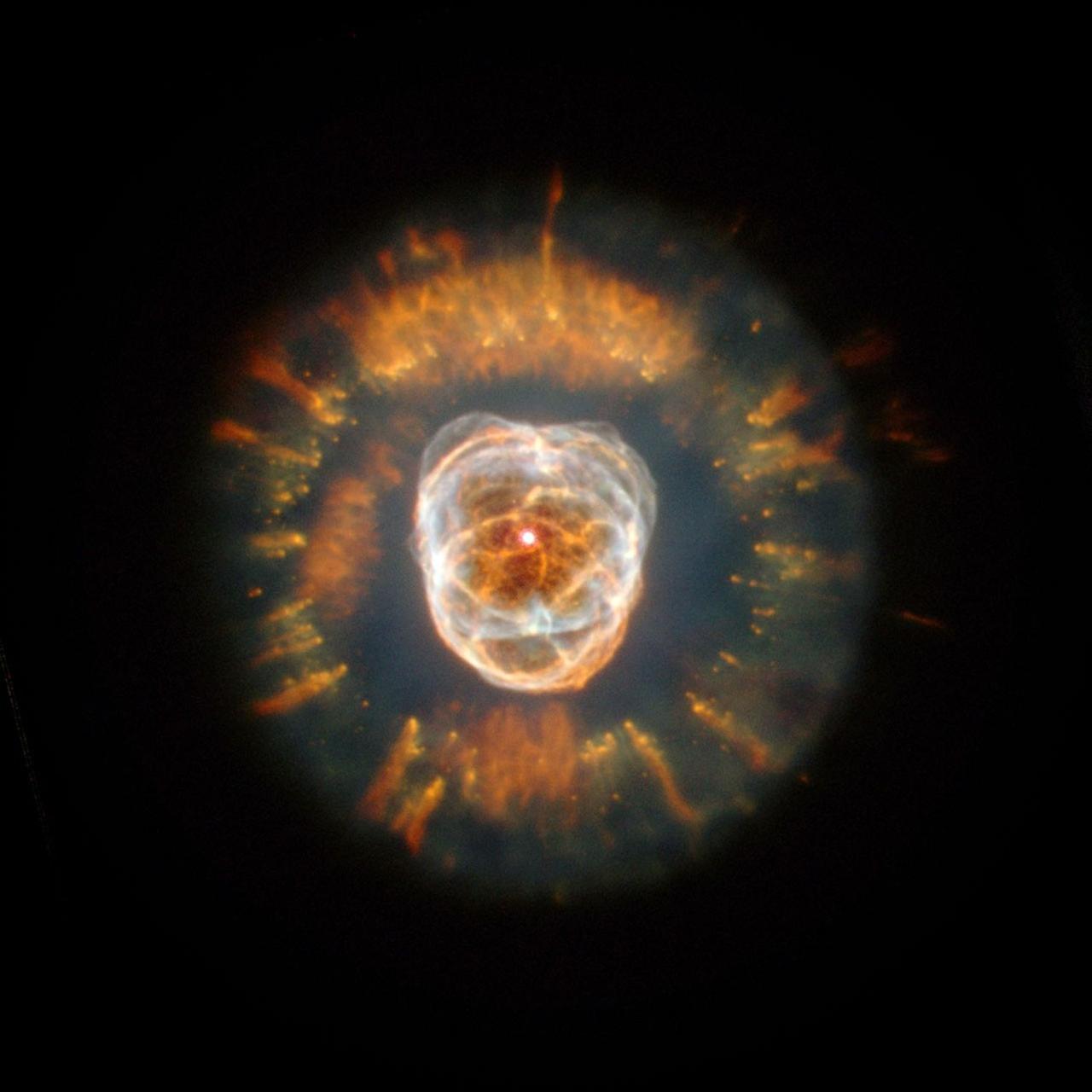
Eskimo Nebula (NGC 2392) is a deep-sky object belonging to the planetary nebula class. Located approximately 2,870 light-years from Earth in the direction of the Gemini constellation, it was discovered in 1787 by William Herschel. The structure earned its popular name "Eskimo" due to the resemblance of its outer envelope to a fur-lined hood surrounding a human face. In modern astronomy, however, it is referred to primarily by its NGC catalog number, NGC 2392.

Eskimo Nebula (NASA)
The Eskimo Nebula is notable for its double-layered structure. The inner region exhibits fluorescence due to intense ultraviolet radiation emitted by the central white dwarf. The outer region consists of a symmetric shell composed of low-density, inflated, tubular structures formed from ionized gas shaped by stellar winds emanating from the central star.
High-resolution images captured by the Hubble Space Telescope have revealed the nebula’s complex structure in great detail. These observations have enabled detailed study of the dense gas clumps within the inner region and the filamentary, thread-like structures in the outer shell.
Spectroscopic analyses show that NGC 2392 is composed predominantly of ionized hydrogen (Hα), helium (He II), oxygen ([O III]), and nitrogen ([N II]). These ions are excited by the intense ultraviolet radiation from the central star, producing the nebula’s luminosity. The [O III] emission lines are responsible for the bright green-blue regions, while Hα lines contribute to the red hues observed in the nebula.
The star at the center of NGC 2392 began its life as a Sun-like star. Near the end of its life, it expelled its outer layers into space, forming a planetary nebula. The remaining core continues to emit radiation as a hot white dwarf. This phase represents the final stage of stellar evolution following the red giant phase. The current temperature of the central star is measured at approximately 40,000–50,000 Kelvin, producing sufficient photon flux to drive the ionization processes observed in the nebula.
Matter in the outer shell of the Eskimo Nebula is expanding outward at a velocity of approximately 100 kilometers per second. This expansion results from stellar winds emitted by the central star and past episodes of mass loss. The inner shell moves more slowly than the outer shell, and this difference in expansion rates causes the nebula’s layers to gradually separate over time.
NGC 2392 is bright enough to be observed with amateur telescopes. During winter months, under dark sky conditions, it can be easily located in the direction of the Gemini constellation. Its apparent magnitude allows detailed structural features to be studied with medium-sized telescopes. Observations by advanced facilities such as the Hubble Space Telescope and the Chandra X-ray Observatory have revealed the multi-layered nature and dynamic evolution of this object.
X-ray observations conducted by the Chandra Space Telescope have detected X-ray emissions originating from high-temperature plasmas at the center of NGC 2392. These emissions arise from shock waves generated when stellar winds from the central star collide with surrounding material. These findings provide critical data for understanding high-energy processes in planetary nebulae.
NGC 2392 presents a classic example of a planetary nebula, distinguished by its structural complexity and hot central star. Its multi-layered morphology, ionized gas composition, and evolutionary history make it an important subject of astronomical research. Data obtained from advanced observatories play a crucial role in understanding the late stages of stellar evolution.
ESA/Hubble. "NGC 2392." *ESA/Hubble Images.* Accessed July 16, 2025. https://esahubble.org/images/heic9910a/.
NASA. "NGC 2392." *NASA Science – Hubble.* Accessed July 16, 2025. https://science.nasa.gov/asset/hubble/ngc-2392/.

No Discussion Added Yet
Start discussion for "Eskimo Nebula (NGC 2392)" article
Physical Properties and Observations
Spectroscopic Properties and Evolutionary Process
Dynamic Properties and Kinematics
Observability and X-ray Observations