


This article was automatically translated from the original Turkish version.
+1 More
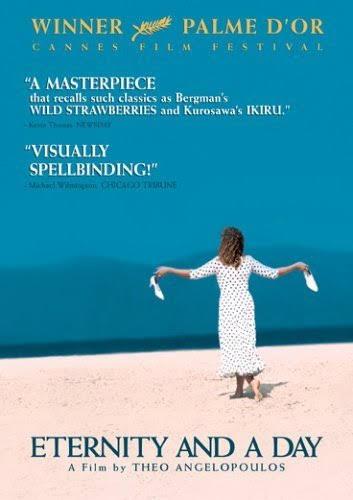
Eternity and a Day
Director(s) | Theo Angelopoulos | ||||||||
|---|---|---|---|---|---|---|---|---|---|
Cast(s) | Achileas Skevis Fabrizio Bentivoglio Isabelle Renauld Bruno Ganz | ||||||||
Music(s) | Eleni Karaindrou | ||||||||
Duration | 137 minutes | ||||||||
Language(s) | Greek | ||||||||
Genre | Drama | ||||||||
Release Date | 1998-05-23 | ||||||||
Eternity and a Day (Greek original title: Μια αιωνιότητα και μια μέρα / Mia aioniótita kai mia méra) is a feature film directed by Greek filmmaker Theo Angelopoulos and released in 1998. The film stars Bruno Ganz in the lead role and features a screenplay written by Angelopoulos, Tonino Guerra, Petros Markaris, and Giorgio Silvagni. Produced by Theo Angelopoulos Productions, it is a co-production between Greece, France, Germany, and Italy. The cinematography is by Andreas Sinanos and Yorgos Arvanitis, while the musical score is composed by Eleni Karaindrou. The film won the Palme d’Or at the 1998 Cannes Film Festival. This 137-minute production was filmed in Greek and has been screened at international film festivals around the world.

Scene from Eternity and a Day (IMDB)
The film centers on an elderly poet battling a terminal illness as he reflects on his past during what may be his final day. The protagonist, Alexandros, turns inward to memories of his life, particularly his relationship with his late wife Anna. Throughout the film, time is presented in a non-linear structure, with fluid transitions between past, present, and imagination to convey the character’s inner world.
Alexandros’s experiences over the course of a single day are interwoven with his personal memories. A key element of the narrative is his encounter with a young Albanian boy attempting to enter Greece illegally. The interaction between Alexandros and the child prompts the protagonist to reevaluate his relationship with the past and the social environment around him. In this way, the film constructs a fictional framework that explores themes of time, memory, death, and belonging.
The film reflects Theo Angelopoulos’s distinctive cinematic style, marked by long, static shots, minimal dialogue, poetic visual composition, and the powerful use of silence. Cinematography is by Yorgos Arvanitis. Eleni Karaindrou’s score enhances the film’s emotional and melancholic atmosphere.

Scene from Eternity and a Day (IMDB)
The film has been widely regarded by both cinema critics and academic circles as Angelopoulos’s most emotionally resonant and universal work. Particularly in analyses focusing on aging, migration, and time, the film is noted for establishing an aesthetic bridge between Europe’s border crises and the individual’s inner turmoil. Bruno Ganz’s performance has been praised by critics as a restrained yet deeply intense portrayal.
IMDb. “Eternity and a Day (1998).” Accessed May 13, 2025. https://www.imdb.com/title/tt0156794/.
Rotten Tomatoes. “Eternity and a Day.” Accessed May 13, 2025. https://www.rottentomatoes.com/m/eternity_and_a_day.

Eternity and a Day
Director(s) | Theo Angelopoulos | ||||||||
|---|---|---|---|---|---|---|---|---|---|
Cast(s) | Achileas Skevis Fabrizio Bentivoglio Isabelle Renauld Bruno Ganz | ||||||||
Music(s) | Eleni Karaindrou | ||||||||
Duration | 137 minutes | ||||||||
Language(s) | Greek | ||||||||
Genre | Drama | ||||||||
Release Date | 1998-05-23 | ||||||||
No Discussion Added Yet
Start discussion for "Eternity and a Day (Film)" article
Summary
Themes
Narrative and Aesthetics
Awards
Criticism and Academic Commentary