

This article was automatically translated from the original Turkish version.
Explorer 1
Launcher | NASA | ||||||||
|---|---|---|---|---|---|---|---|---|---|
Producer(s) | NASA JPL | ||||||||
Launch Date | 1958-02-01 | ||||||||
Launched Rocket | Juno-1 | ||||||||
Mission Duration | 120 days | ||||||||
Explorer 1 is the first artificial satellite successfully placed into orbit by the United States of America. Launched on 31 January 1958, it was a direct response to the Soviet Union’s launches of Sputnik 1 and Sputnik 2 during the Space Race of the Cold War. Explorer 1’s mission did not merely achieve a technological milestone; it also marked the first major scientific discovery of the space age by revealing the existence of the Van Allen radiation belts surrounding Earth. This historic mission was the result of a collaborative effort between the U.S. Army Ballistic Missile Agency (ABMA), the Jet Propulsion Laboratory (JPL), and a team from the University of Iowa led by Dr. James Van Allen.

The development of Explorer 1 took shape within the framework of the International Geophysical Year (IGY) 1957–1958. Both the United States and the Soviet Union had announced intentions to launch satellites into Earth orbit for this scientific initiative. The United States’ first official program for this purpose was the Vanguard Project, a civilian effort managed by the Navy. However, the successful launch of Sputnik 1 by the Soviet Union on 4 October 1957 caused a shock in American public opinion and political circles. This event initiated what became known as the “Sputnik Crisis,” a period during which U.S. technological superiority was called into question. The crisis deepened further on 6 December 1957 when the Vanguard rocket exploded on the launch pad in full view of the world.
In the wake of this failure, the U.S. administration decided to revert to a previously shelved military rocket project jointly developed by ABMA under Wernher von Braun and JPL at the California Institute of Technology. This team was given the task of placing a satellite into orbit just 84 days after the launch of Sputnik.

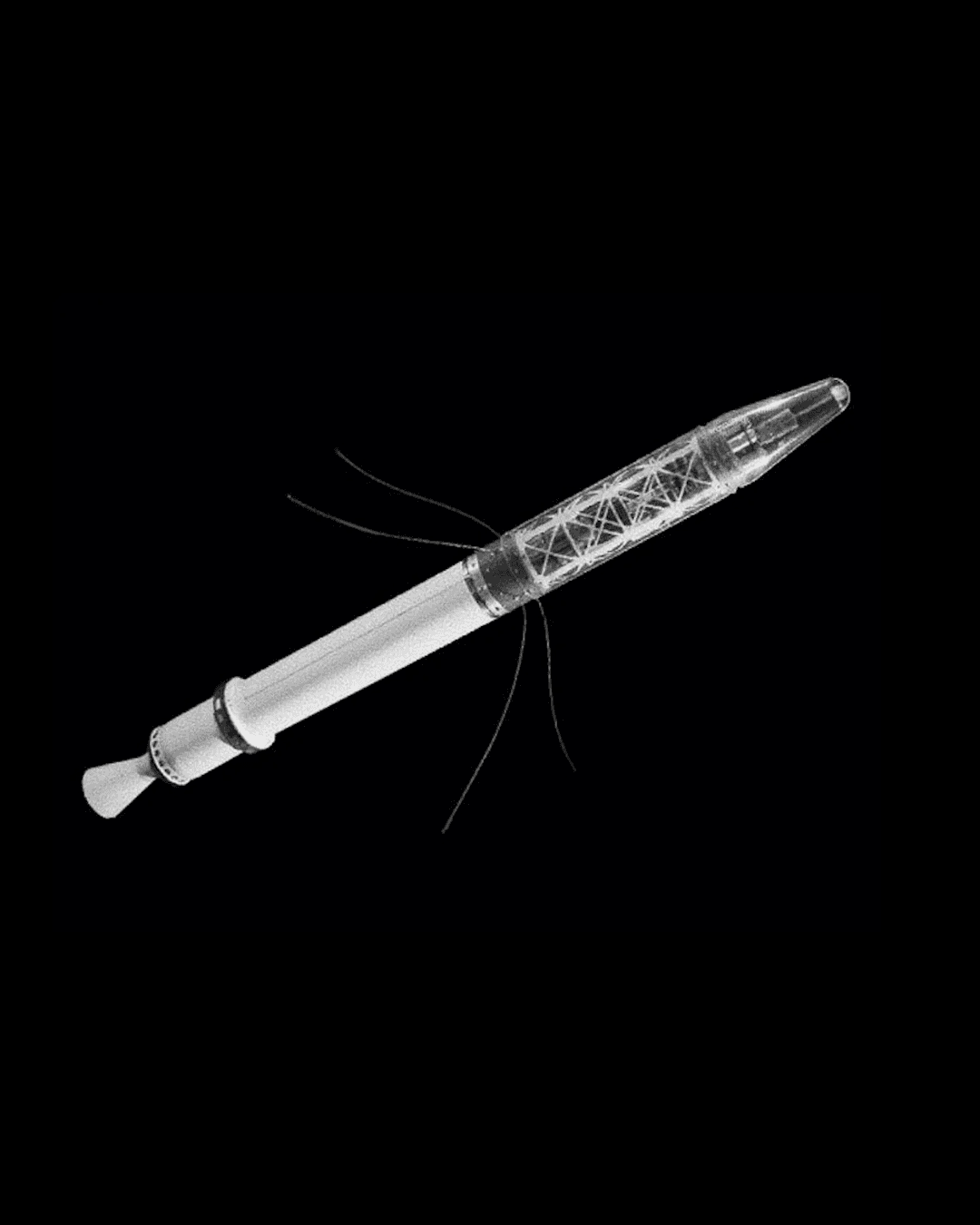
Explorer 1 was designed as a streamlined, pencil-shaped satellite integrated with the fourth and final stage of its launch rocket. It had a total length of 203 cm and a diameter of 15.2 cm. The satellite’s total mass was 13.9 kg, of which 8.3 kg consisted of scientific instruments. Stability in orbit was achieved by spinning the satellite around its long axis at 750 revolutions per minute (spin-stabilization). Electrical power was supplied by mercury batteries, whose lifespan determined the duration of the mission.
The satellite’s scientific payload was designed and built by Dr. James Van Allen and his team. The primary objective was to measure the intensity of cosmic rays in orbit.
The rocket that carried Explorer 1 into orbit was named Juno I. It was essentially a modified version of the Jupiter-C sounding rocket, adapted for satellite launch capability. The Jupiter-C itself was a modified variant of the U.S. Army’s Redstone ballistic missile, developed for high-altitude tests. Juno I was a four-stage launch vehicle:

Launch and Orbit Explorer 1 was successfully launched on 31 January 1958 at 22:48 local time from Cape Canaveral. It entered a highly elliptical orbit around Earth, with a perigee of 358 km and an apogee of 2,550 km, completing one full revolution approximately every 114.8 minutes.
Data from the satellite revealed an anomaly that initially puzzled scientists. The Geiger counter registered cosmic rays as expected at lower altitudes but suddenly stopped counting and displayed zero readings as the satellite approached its highest orbital points. At first, this was assumed to be an instrument malfunction. However, Dr. Van Allen and his team developed a correct hypothesis: the counter had not failed; rather, the radiation levels were so intense that the sensitive Geiger-Müller tube became completely saturated and temporarily ceased functioning.
This hypothesis was definitively confirmed several months later by data from Explorer 3, which was launched in March 1958. Combining data from both satellites, scientists mapped two massive, toroidal (ring-shaped) belts of energetic particles trapped by Earth’s magnetic field. These entirely new radiation belts were named the Van Allen Belts in honor of their discoverer.
Jet Propulsion Laboratory. "Explorer 1." Accessed July 6, 2025. https://www.jpl.nasa.gov/missions/explorer-1
NASA History Program Office. "Explorer-I and Jupiter-C." Accessed July 6, 2025.
NASA. "Explorer 1 Overview." Accessed July 6, 2025. https://www.nasa.gov/mission_pages/explorer/explorer-overview.html
NASA. "The 'Original' Explorer 1." Accessed July 6, 2025.

Explorer 1
Launcher | NASA | ||||||||
|---|---|---|---|---|---|---|---|---|---|
Producer(s) | NASA JPL | ||||||||
Launch Date | 1958-02-01 | ||||||||
Launched Rocket | Juno-1 | ||||||||
Mission Duration | 120 days | ||||||||
Historical Background and the Sputnik Crisis
Spacecraft and Scientific Instruments
Design and Construction
Scientific Instruments
Launch Vehicle: Juno I
Mission and the Discovery of the Van Allen Belts
Scientific Discovery