This article was automatically translated from the original Turkish version.
+1 More
Red deer
Team(s) | Artiodactyla | ||||||||
|---|---|---|---|---|---|---|---|---|---|
Family | Cervidae | ||||||||
Diet(s) | Herbivorous | ||||||||
Habitat | shrublands and semi-open natural areas forest-grassland transition areas Open forests | ||||||||
Specie(s) | Dama dama | ||||||||
Gender | Dama | ||||||||
Class | Mammalia | ||||||||
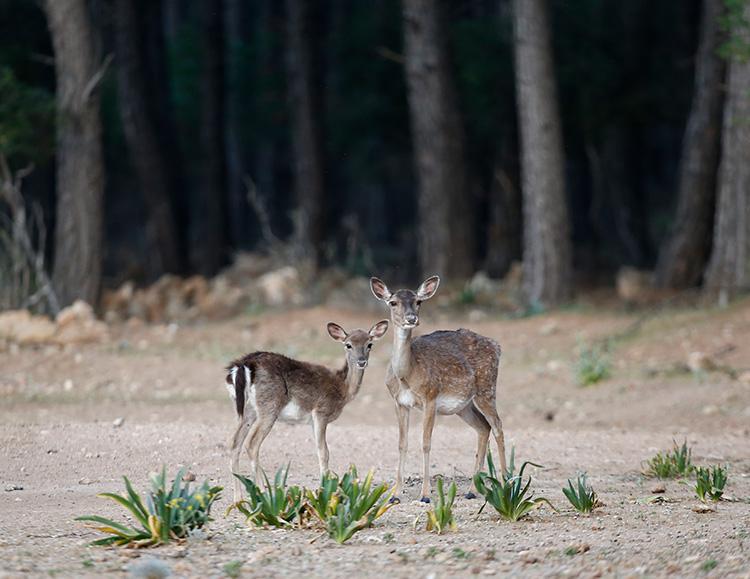
The fallow deer (Dama dama) is one of the most visually variable members of the Cervidae family, exhibiting four main coat color variations: white, menil (light-colored), black, and the typical pale reddish-brown. In the most common "typical" form, prominent white spots appear on the back and flanks during summer; in winter, the coat becomes dull and takes on a gray-brown tone, with spots nearly disappearing entirely. A dark stripe running from the neck to the tail encircles the white rump area, creating a distinctive appearance. This species also possesses a longer tail than other deer species, with the edges of the tail covered in white hairs.
The most distinguishing feature of males is their broad, palmate (antler-like) antlers, which typically reach full development after the age of three. These antlers are shed annually in spring and regrow over the summer, covered in a velvety skin that eventually mineralizes. Additionally, in adult males, the Adam’s apple is prominently visible from the outside. Both sexes possess scent glands beneath the eyes, between the hooves, and at the fetlocks; these glands play a critical role in social communication and territorial marking.
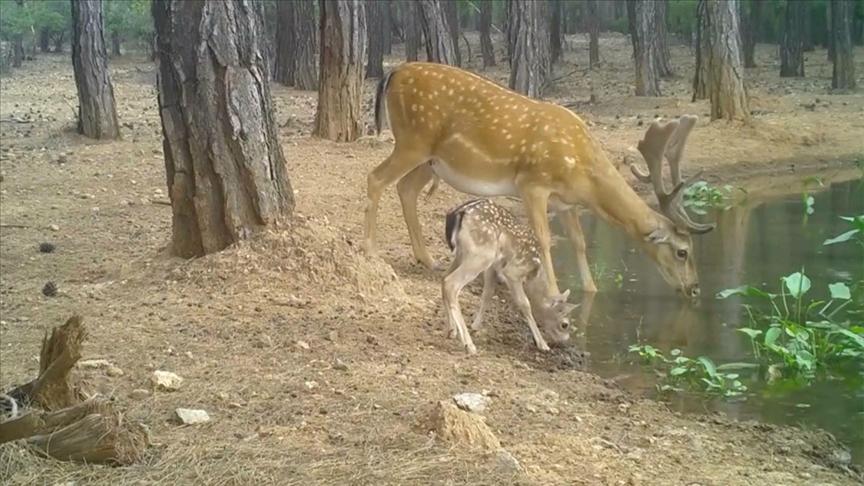
Fallow deer and fawn reflected in a pond at Düzlerçamı, Antalya (Anadolu Ajansı)
Taxonomically, the genus Dama belongs to the subfamily Cervinae within the family Cervidae. It is generally divided into two subspecies: the European fallow deer (Dama dama dama) and the Mesopotamian (Iranian) fallow deer (Dama dama mesopotamica). Although some authorities recognize these as separate species, recent genetic studies confirm that the two forms are closely related but have become distinctly differentiated due to prolonged geographic isolation. The European form has a smaller body size and different antler morphology compared to the Mesopotamian form.
Anatolia and southern Europe are considered the native range of the fallow deer, having served as refugia during the post-glacial period. The species was transported by ancient civilizations such as the Phoenicians and Romans to many parts of the world; however, the native (autochthonous) population in Türkiye holds unique value as the species’ genetic center. Historically widespread across the Mediterranean, Aegean, and Marmara regions, the species has been confined to a reduced range due to habitat loss and overhunting.
Today, the only natural and genetically pure population in Türkiye resides in the Antalya Düzlerçamı region. While the global status of the species is listed as “Least Concern” (LC), the native Turkish population is assessed as “Critically Endangered” (CR) at the national level due to genetic bottlenecking and anthropogenic pressures.【1】
The skull structure of fallow deer is shorter and broader compared to that of the genus Cervus. Their dental formula is adapted to a herbivorous diet, and upper canines are typically absent. Their digestive systems possess a relatively large rumen-reticulum volume in proportion to body mass; this anatomical feature indicates a higher capacity for digesting fibrous plant material than many other deer species. Physiologically, male reproductive capacity and testis size vary seasonally, reaching peak levels during the mating season. The species’ genetic map consists of 68 chromosomes at the diploid level.

Fallow deer body structure (Pexels)
Fallow deer prefer heterogeneous habitats consisting of scattered woodlands, shrublands, and open grasslands. Such areas provide both open spaces for foraging and dense vegetation for cover. Their diet is highly flexible, shifting seasonally among grasses, herbaceous plants, maquis shoots, acorns, wild pear, and wild fruits. These animals are most active during early morning and twilight hours, spending the remainder of the day resting and ruminating in sheltered areas.
The social structure of the species varies according to habitat openness and season. Females, young, and juvenile males typically form stable family groups, while adult males live either solitarily or in small bachelor herds outside the breeding season. Herds tend to be larger in open areas but smaller in dense forested habitats. Fallow deer possess highly developed senses of smell and hearing and are extremely wary animals. When threatened, they raise their tails or emit characteristic “barking” calls to alert other members of the herd; during flight, females typically lead the group.
Reproductive activity is triggered by day length, with the mating season, known as the “rut,” peaking in autumn. During this period, males dig pits in the soil to mark territory, rub scent glands on vegetation, and produce low-frequency “bellowing” calls to attract females. Births occur between late spring and early summer, following a gestation period of approximately eight months. Usually a single fawn is born; fawns are born with spotted coats and are concealed by their mothers among tall grasses. Female fawns may enter the reproductive cycle at around one and a half years of age.
Apollonio, Marco, Stefano Focardi, Silvano Toso, and Laura Nacci. “Habitat Selection and Group Formation Pattern of Fallow Deer Dama Dama in a Submediterranean Environment.” Ecography 21, no. 3 (1998): 225–34. Accessed February 6, 2026. http://www.jstor.org/stable/3682973
Elçin, Süleyman. “Alageyikler nesillerinin devamı için başka yaşam alanlarına naklediliyor.” Anadolu Ajansı. Accessed February 6, 2026.
Feldhamer, George A., Kelly C. Farris-Renner, and Celeste M. Barker. “Dama Dama.” Mammalian Species, no. 317 (1988): 1–8. Accessed February 6, 2026. https://doi.org/10.2307/3504141
Janssen, Vincent M. A. Fotoğraf: “Orman Ağaçlar Hayvan Portre Modu,” Pexels. Accessed February 6, 2026. https://www.pexels.com/tr-tr/fotograf/orman-agaclar-hayvan-portre-modu-3048723/
Olğaç, Kemal Tuna, Koray Tekin, Muhammed Enes İnanç, Mehmet Borga Tirpan, Ali Daşkın, and Ergün Akçay. “Alageyiklerde (Dama dama dama) Başlıca Androlojik Değerlendirmeler.” Veteriner Hekimler Derneği Dergisi 85, no. 1 (2014): 15–20. Accessed February 6, 2026. https://dergipark.org.tr/en/download/article-file/405389
Sapmaz, Rabia. “Nesli tehdit altındaki alageyik ve yavruları, su içerken fotokapanla görüntülendi.” Anadolu Ajansı. Accessed February 6, 2026. https://www.aa.com.tr/tr/gundem/nesli-tehdit-altindaki-alageyik-ve-yavrulari-su-icerken-fotokapanla-goruntulendi/3757646
Özkan, Murat. “Alageyiğin Anavatanı Türkiye.” Türk Tarım Orman Dergisi, February 3, 2022. Accessed February 6, 2026. https://www.turktarim.gov.tr/Haber/742/alageyigin-anavatani-turkiye
[1]
1. Murat Özkan, “Alageyiğin Anavatanı Türkiye,” Türk Tarım Orman Dergisi, 3 Şubat 2022, erişim 6 Şubat 2026, https://www.turktarim.gov.tr/Haber/742/alageyigin-anavatani-turkiye.

Red deer
Team(s) | Artiodactyla | ||||||||
|---|---|---|---|---|---|---|---|---|---|
Family | Cervidae | ||||||||
Diet(s) | Herbivorous | ||||||||
Habitat | shrublands and semi-open natural areas forest-grassland transition areas Open forests | ||||||||
Specie(s) | Dama dama | ||||||||
Gender | Dama | ||||||||
Class | Mammalia | ||||||||
No Discussion Added Yet
Start discussion for "Fallow deer (Dama dama)" article
Taxonomic Classification and Systematic Information
Historical and Current Distribution in Türkiye
Anatomical Structure and Physiological Characteristics
Habitat Preferences and Feeding Ecology
Social Organization and Behavioral Patterns
Reproductive Biology and Fawn Development