This article was automatically translated from the original Turkish version.
Developer(s) | The Fedora Project (Community) Red Hat (Sponsor) | ||||||||
|---|---|---|---|---|---|---|---|---|---|
Initial Release | Fedora Core 1 (September 20, 2004) | ||||||||
Release Cycle | Approximately every six months (Approximately 13 months of support per release) | ||||||||
Core Philosophy | Four Foundations: Freedom, Friends, Features, First | ||||||||
Desktop Environments | MATE (via Spins) Cinnamon Xfce KDE Plasma GNOME (Workstation default) | ||||||||
License Status | 100% Free and Open Source | ||||||||
Fedora Linux is a free and open source operating system platform designed for hardware clouds and containers. Fedora is a popular and widely used distribution that forms the foundation of Red Hat Enterprise Linux (RHEL).
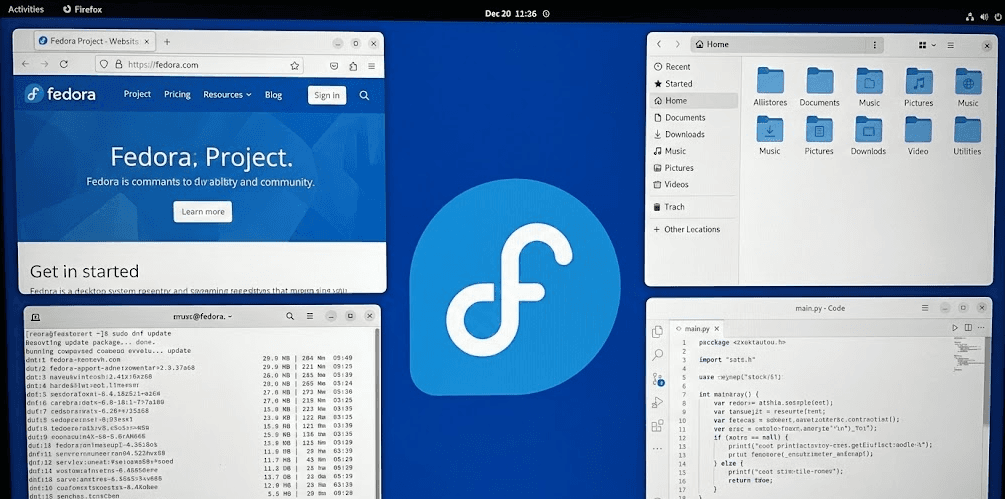
Fedora operating system (generated by artificial intelligence)
A Linux distribution such as Fedora consists of a kernel, desktop environments such as GNOME and KDE, GNU components, the X window system and many other components. Linux is an advanced implementation of a multitasking and multithreaded operating system and is available on various architectures including Intel Alpha PowerPC and Sparc.
Fedora is developed collaboratively which means no single company is solely responsible for its development or ongoing support. The sharing of this development burden among individuals and companies has fostered the emergence of a broad and efficient ecosystem and contributed to software innovation. Over 1000 developers from at least 100 different companies contribute to each release of the Linux kernel.
Fedora has served as an important platform for scientific and technological research:
Fedora Linux has been used as a testbed to evaluate the empirical network performance of security protocols in Virtual Private Network (VPN) applications. In these studies the performance of cryptographic algorithms such as DES 3DES and AES commonly used to implement IPSec VPNs was analyzed on a network consisting of a router and Windows desktop operating systems.
Fedora Core Linux 5.0 ran under WiiBench a benchmarking application designed to measure web server characteristics such as concurrent user count and requests per second.
The Fedora Project offers various Fedora Linux variants tailored to different user needs and target use cases:
1. Fedora Workstation: A polished easy to use and reliable operating system for laptops and desktop computers. It features the GNOME desktop environment and includes a comprehensive set of tools for developers and creators.
2. Fedora Server: A flexible and powerful server operating system packed with the latest open source data center technologies. It is designed to run applications on bare metal or in the cloud.
3. Fedora CoreOS: An automatically updating minimal and container-focused operating system.
4. Fedora IoT: A platform that provides a robust foundation for Internet of Things (IoT) ecosystems and Device Edge environments.
5. Fedora Cloud: A powerful and minimal base operating system image tailored for both general and many specialized cloud use cases.
The complete Fedora 9 distribution if developed using traditional proprietary methods is estimated to have cost approximately 10.8 billion US dollars based on 2008 software development costs.
The Fedora 9 distribution contained a total of 204500946 physical lines of source code (SLOC). This represents an approximate 680 percent increase in the codebase over the 30 million lines analyzed in Red Hat Linux 7.1 in 2002.
The estimated cost of developing only the Linux kernel is calculated at 1.4 billion US dollars. The kernel itself in Fedora 9 consists of 6772902 physical lines of source code.
Krafft, Dean B., Aaron Birkland, and Ellen J. Cramer. "NCore: Architecture and Implementation of a Flexible, Collaborative Digital Library." *arXiv:0803.1500* (2008). Accessed December 16, 2025. https://arxiv.org/abs/0803.1500
Lagoze, Carl, Dean B. Krafft, Susan Jesuroga, Tim Cornwell, Ellen J. Cramer, and Edwin Shin. "An Information Network Overlay Architecture for the NSDL." *arXiv:cs/0501080* (2005). Accessed December 16, 2025. https://arxiv.org/abs/cs/0501080
Lagoze, Carl, Sandy Payette, Edwin Shin, and Chris Wilper. "Fedora: An Architecture for Complex Objects and their Relationships." *arXiv:cs/0501012* (2005). Accessed December 16, 2025. https://arxiv.org/abs/cs/0501012
Payette, Sandra, and Carl Lagoze. "Flexible and Extensible Digital Object and Repository Architecture (FEDORA)." *Second European Conference on Research and Advanced Technology for Digital Libraries, Lecture Notes in Computer Science*, Vol. 1513 (1998): 41–59. Accessed December 16, 2025. https://www.cs.cornell.edu/payette/papers/ECDL98/FEDORA.html
Payette, Sandra, and Thornton Staples. "The Mellon Fedora Project: Digital Library Architecture Meets XML and Web Services." *Proceedings of the 6th European Conference on Research and Advanced Technology for Digital Libraries* (2002). Accessed December 16, 2025. https://www.dlib.org/dlib/april03/staples/04staples.html
Pennock, M. "Fedora: Digital Repositories and Digital Curation." University of Edinburgh Institute for Advanced Studies (2006). Accessed December 16, 2025. https://era.ed.ac.uk/bitstream/handle/1842/3360/Pennock%20fedora.pdf
Staples, Thornton, Ross Wayland, and Sandra Payette. "The Fedora Project: An Open-source Digital Object Repository Management System." *D-Lib Magazine* 9, no. 4 (April 2003). Accessed December 16, 2025. https://www.dlib.org/dlib/april03/staples/04staples.html
Wilcox, David. "Stewarding Research Data with Fedora." IFLA (International Federation of Library Associations and Institutions) Repository (2017). Accessed December 16, 2025. https://repository.ifla.org/handle/20.500.14598/6113

Developer(s) | The Fedora Project (Community) Red Hat (Sponsor) | ||||||||
|---|---|---|---|---|---|---|---|---|---|
Initial Release | Fedora Core 1 (September 20, 2004) | ||||||||
Release Cycle | Approximately every six months (Approximately 13 months of support per release) | ||||||||
Core Philosophy | Four Foundations: Freedom, Friends, Features, First | ||||||||
Desktop Environments | MATE (via Spins) Cinnamon Xfce KDE Plasma GNOME (Workstation default) | ||||||||
License Status | 100% Free and Open Source | ||||||||
Architecture and Development Structure
Research and Application Areas
VPN Performance Analysis
Web Server Comparison
Fedora Releases and Variants
Cost Estimation
Code Size
Kernel Cost