


This article was automatically translated from the original Turkish version.
+1 More
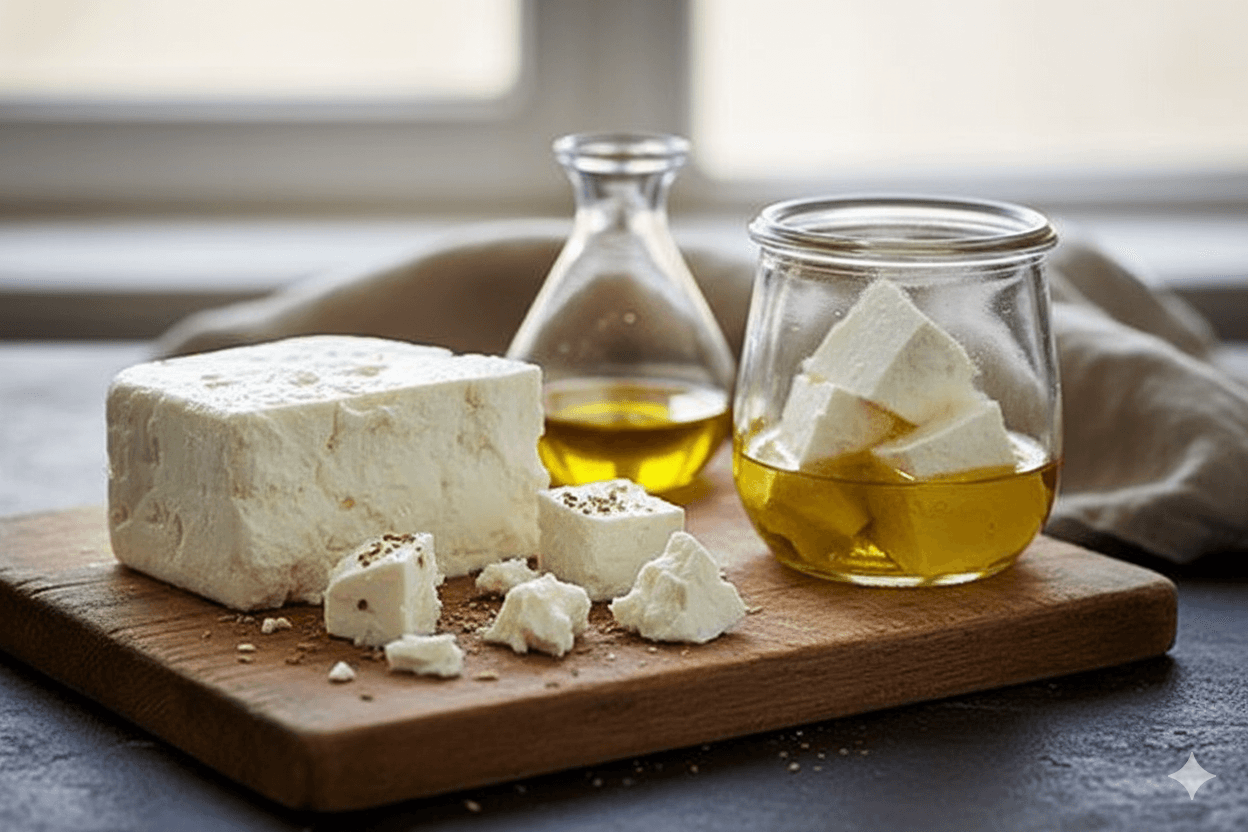
Feta (Generated with Artificial Intelligence)
Registered Name | Feta | ||||||||
|---|---|---|---|---|---|---|---|---|---|
Type(s) | Protected Designation of Origin (PDO) | ||||||||
Product Type | Food | ||||||||
Country | Greece | ||||||||
Status | Registered | ||||||||
File Number | PDO-GR-0427 | ||||||||
Registration Date | 15/10/2002 | ||||||||
Feta PDO (Φέτα) is a Greek cheese with a Protected Designation of Origin (PDO) status, characterized by its salty and slightly acidic flavor. This PDO status guarantees that all stages of production, processing, and preparation occur within a defined specific region (Greece). The product’s description and method of production are defined as an expression of the country’s unique terrain and its accumulated knowledge spanning over two millennia.
The history of Feta dates back more than 2000 years. The name “Feta,” which today is used, originates from the 17th century and refers to the process of cutting the cheese into slices; however, the cheese itself appears in much earlier literature. An early form of Feta is mentioned in Homer’s Odyssey, where the hero Odysseus takes the cheese made by the Cyclops Polyphemus as he escapes from his cave.
Today, Feta holds a flagship position among Greece’s geographical indications and accounts for approximately 10% of Greek food exports, demonstrating its international reputation.
Traditional production methods are directly tied to the country’s specific climatic conditions. The geography of Greece is characterized by steep mountain slopes and a hot, dry climate. This has resulted in limited land suitable for widespread cattle farming. In adaptation to these conditions, the Greek population turned to raising hardy sheep and goats capable of thriving in such harsh environments.
The distinctive flavors of Feta are possible only because sheep and goats graze on Greece’s unique flora. Over 6000 different plant species grow in the country, 15% of which are endemic; this level of biodiversity is significantly higher than in many geographically larger nations. When combined with traditional production methods, this biodiversity forms a fundamental reason why authentic Feta can be produced only in Greece.
Feta PDO is made exclusively from milk obtained from native sheep and goat breeds. This milk imparts to Feta its characteristic white color and a flavor sometimes described as slightly peppery.
Milk Quality and Processing The milk used in production is collected seasonally and must contain at least 6% fat. The cheese can be made from either pasteurized or unpasteurized (raw) milk. However, the addition of colorants, preservatives, lacto-proteins, casein salts, concentrated or powdered milk is not permitted during production.
Coagulation, Straining, and Salting After delivery to the dairy, the milk is coagulated and placed into molds for the straining process. Traditionally, these molds have numerous small holes, and no pressure is applied to the curd during straining.
Once removed from the molds, the cheese is cut into pieces and coated with coarse-grained salt. At this stage, microorganisms that contribute to Feta’s flavor develop on the surface of the curd.
Ripening The ripening of the cheese occurs in two stages:
The total time required for ripening is at least two months. Only after completion of this process does the cheese develop the rich taste and aroma that distinguish Feta.
European Commission. "EUGI00000013179 (Feta (PDO)) Kaydı." *E-Ambrosia Geographical Indications Register*. Accessed October 24, 2025. https://ec.europa.eu/agriculture/eambrosia/geographical-indications-register/details/EUGI00000013179.
European Commission. "Feta PDO." Accessed October 24, 2025. https://agriculture.ec.europa.eu/farming/geographical-indications-and-quality-schemes/geographical-indications-food-and-drink/feta-pdo_en.

Feta (Generated with Artificial Intelligence)
Registered Name | Feta | ||||||||
|---|---|---|---|---|---|---|---|---|---|
Type(s) | Protected Designation of Origin (PDO) | ||||||||
Product Type | Food | ||||||||
Country | Greece | ||||||||
Status | Registered | ||||||||
File Number | PDO-GR-0427 | ||||||||
Registration Date | 15/10/2002 | ||||||||
History and Origin
Geographical Link and Terroir
Production Process