


This article was automatically translated from the original Turkish version.
+1 More
Fiber Optic Cable
Heading | Fiber Optic Cable | ||||||||
|---|---|---|---|---|---|---|---|---|---|
Category | Communication Technologies | ||||||||
Basic Components | Core, cladding, protective coating | ||||||||
Mod Types | Singlemode, Multimode | ||||||||
Material Types | Glass fiber, plastic fiber, plastic-coated silica fiber | ||||||||
Standards | ITU-T G.652, G.655, G.657; OM1, OM2, OM3, OM4 | ||||||||
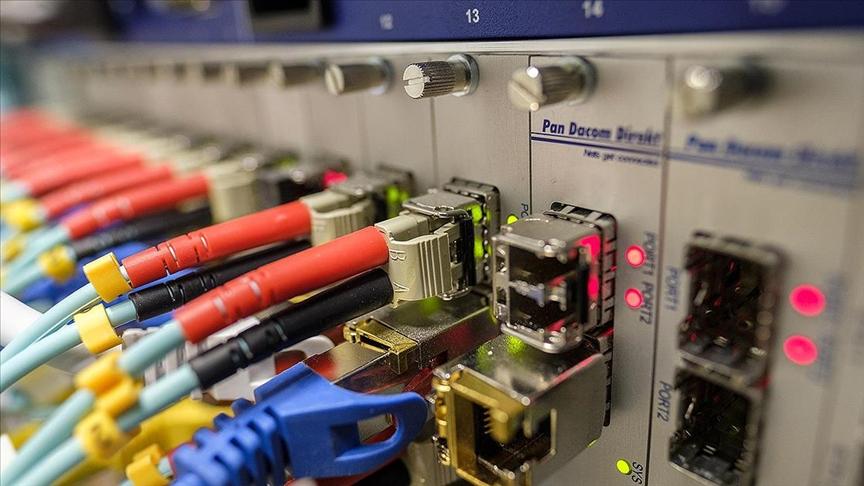
Fiber optic cable is a modern communication medium consisting of a core made of glass or plastic, designed to transmit light signals at high speeds with minimal loss. These cables transmit data via photons rather than traditional electrical signals, thereby playing a crucial role in communication needs requiring long distances and high bandwidth.

Fiber optic cable image (AAnatolia Agency)
The foundations of fiber optic communication were laid in the 19th century with John Tyndall’s demonstration of the principle of total internal reflection. In the 1960s, with the advancement of laser technology, it was demonstrated that glass fibers could transmit light over short distances.
Fiber optic cables consist of three fundamental layers:

Fiber optic cable structure (medium)
Fiber optic cables operate based on fundamental principles of optical physics—particularly total internal reflection, critical angle, and refractive index difference. When light is directed into the core such that it cannot pass into the cladding, it undergoes total internal reflection within the medium. This allows light waves (photons) to be transmitted as signals over very long distances. This principle is applied at the optical boundary between the core, which has a higher refractive index, and the cladding, which has a lower refractive index.
Fiber optic cables are classified according to standards established by international telecommunications and industry organizations. These standards vary based on the cable’s physical structure, bandwidth capacity, and application areas.
Multimode fibers: Widely used for short-distance, high-speed network connections. These cables are classified as OM1, OM2, OM3, and OM4. OM1 fibers have a 62.5 micrometer core diameter and offer low bandwidth. OM2, OM3, and OM4 have a 50 micrometer core diameter and represent variants capable of operating at progressively higher frequencies. OM3 and OM4 are particularly preferred for next-generation network applications such as 10 Gigabit Ethernet due to their ability to support longer distances.
Singlemode fibers: Used for longer-distance and higher-capacity data transmission. The most widely adopted international standards for this type include the ITU-T G.65x series. The G.652 standard is commonly used in local area networks within buildings and FTTx (Fiber to the x) applications. The G.655 standard covers non-zero dispersion-shifted (NZD) fibers that enable high-speed transmission with lower dispersion and are used in terrestrial long-haul networks. Finally, the G.657 standard defines bend-insensitive fiber structures and is preferred in access networks requiring tight installation conditions. These standards determine the physical durability and signal transmission performance of fiber optic cables, enabling appropriate selection for specific applications.
ITU-T standards:
Fiber optic cables are not only data transmission media but also serve as high-sensitivity sensors:
In these applications, microscopic imperfections in the cable affect the reflection time of light, enabling precise monitoring of environmental changes.
Fiber optic cables play a critical role in both traditional communication and scientific measurement fields. By enabling high-performance data transmission based on light, and by being usable even in complex environments, they have become the backbone of modern technologies.
Kocaeli Büyükşehir Municipality. *Fiber Optik İletişim Teknolojileri*. Kocaeli: European Union and Republic of Turkey Financial Support Project, 2016. https://www.scribd.com/document/495648500/6635708a-212c-453e-b92c-981fb966fe56
Ocak, Mahir E. “Dünyayı Gözlemleyen Fiber Optik Kablolar.” Bilim ve Teknik, May 2022, pp. 54–59. .
Çakın, Harun. *Fiber Optik Teknolojisi ve Karmaşık Yapılarda Fiber Uygulamaları*. İstanbul: Tyco Elektronik AMP Tic. Ltd. Şti. https://acikerisim.nku.edu.tr/items/2d29b11b-f447-414e-aa7d-2f4b78000014.

Fiber Optic Cable
Heading | Fiber Optic Cable | ||||||||
|---|---|---|---|---|---|---|---|---|---|
Category | Communication Technologies | ||||||||
Basic Components | Core, cladding, protective coating | ||||||||
Mod Types | Singlemode, Multimode | ||||||||
Material Types | Glass fiber, plastic fiber, plastic-coated silica fiber | ||||||||
Standards | ITU-T G.652, G.655, G.657; OM1, OM2, OM3, OM4 | ||||||||
History
Fiber Optic Structure
Dimensions
Operating Principle
1. By Material
2. By Refractive Index Profile
3. By Mode Type
Standards
Singlemode Fibers
Advantages
Disadvantages
Applications
Scientific Applications (Sensor Use)