
This article was automatically translated from the original Turkish version.
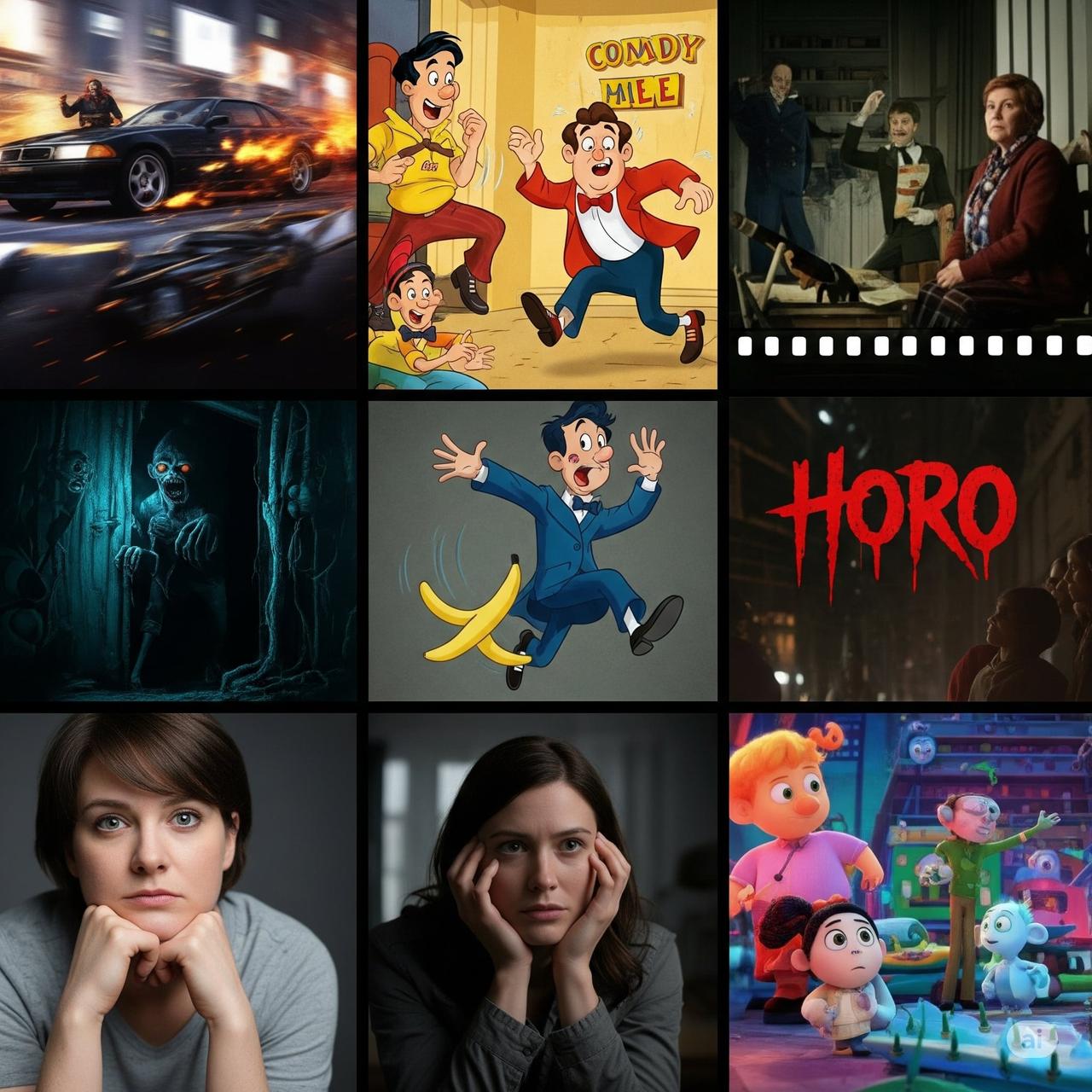
Fiction Genres in Cinema (Generated by Artificial Intelligence.)
Also Known as | Assembly | ||||||||
|---|---|---|---|---|---|---|---|---|---|
Primary Purpose | To combine images and sounds to create a meaningful whole | ||||||||
Pioneers | Georges Méliès, Edwin S. Porter, D.W. Griffith | ||||||||
Theorists | Lev Kuleshov, Sergei Eisenstein | ||||||||
Key Concept | Kuleshov Effect | ||||||||
Modern Tools | Adobe Premiere Pro, Final Cut Pro, Avid Video Composer | ||||||||
Film editing is one of the fundamental elements that distinguish cinema from other art forms. In its simplest definition, it is the process of assembling images and sounds captured at different times and places to create a unified purpose and meaning. Editing, synonymous with the French term “montage,” is an artistic and technical process that constructs a film’s narrative, rhythm, emotional impact, and spatial-temporal perception. Professionals who carry out this process are called editors or editing operators. This process includes stages such as arranging raw footage according to the screenplay, determining the duration and transition points of scenes, combining sound and music with visuals, and adding visual effects.
In the early years of cinema, pioneers such as the Lumière Brothers shot and displayed films in a single take without cuts. During this period, cinema was largely seen as a recorded form of theater. However, over time, it was discovered that film negatives could be cut and assembled to tell a story. French filmmaker Georges Méliès developed fundamental editing techniques still in use today—such as accelerated and slowed motion, superimposition, and fade-outs—demonstrating that cinema could function as a storytelling medium and that audiences would accept disruptions in the natural flow of images.

A Visual Representing the Development of the Editing Technique in Cinema (Generated by Artificial Intelligence)
The cinematic potential of editing was advanced by American and Soviet filmmakers. American director Edwin S. Porter presented one of the earliest examples of parallel editing in his film The Life of an American Fireman (1903), showing events occurring simultaneously in different locations in sequence. This technique added tension and coherence to the narrative by interweaving the rescue operation inside a building with the firefighters’ efforts outside. D.W. Griffith further contributed to the evolution of cinematic language through films like The Birth of a Nation (1915), using parallel editing. These innovations, combined with techniques such as close-ups, proved that cinema was not merely a tool for recording events but also an art form capable of generating meaning and emotion.
The theoretical foundations of editing as an art were established by Soviet filmmakers. Lev Kuleshov created landmark experiments that revealed editing’s role in meaning creation. In his most famous experiment, the “Kuleshov Effect,” he edited a neutral close-up of actor Ivan Mosjoukine’s face in sequence with images of a plate of soup, a coffin, and a woman. Despite the actor’s expression remaining unchanged, viewers reported feeling hunger, sadness, and desire respectively based on the image that followed. This experiment demonstrated that the meaning of a shot is determined by its context—the shots preceding and following it—and that editing directly shapes audience perception. Kuleshov likened editing to assembling individual cubes with letters written on them to form words or sentences. His students Vsevolod Pudovkin and Sergei Eisenstein built upon these foundations to develop their own editing theories.
In terms of narrative, editing refers to how the temporal and causal flow of a film’s subject is organized. This organization determines the film’s structure, rhythm, and impact on the viewer. The main narrative editing types are as follows:
Linear Editing (Continuous Editing): This is the form of editing in which events are told in chronological order with clear cause-and-effect relationships. Transitions between shots are as seamless and fluid as possible, aiming to allow the viewer to follow the story without distraction. In this technique, continuity of motion, lighting, costume, and setting is essential. The goal is for the viewer to perceive each shot as a natural continuation of the previous one. This technique is commonly used in mainstream narrative cinema, particularly in genres such as crime, adventure, and drama.
Parallel Editing (Cross-Cutting / Intercutting): This involves showing two or more events occurring in different locations but generally within the same time frame, presented in sequence through cuts. This technique is used to establish connections between events, heighten tension, create contrast, or emphasize thematic elements. For example, alternating between shots of a fleeing character and those of the pursuer is a classic application of parallel editing. This method enhances the mystery and emotional impact of events, placing the viewer in an active role.
Flashback: This is a jump in the narrative from the present moment to a past event. It is used to explain character motivations, reveal a significant past occurrence, or add depth to the story.
Flashforward: This is a jump in the narrative from the present moment to a future event. It is often employed to create suspense by revealing the outcome of an event in advance or to explore themes such as fate.
These editing types focus on the logic of shot assembly and the intended effect. Developed by the Soviet Montage School, these approaches reveal that editing is not only a tool for storytelling but also for conveying ideas and emotions.
Contrast Editing (Rhythmic Editing): This involves placing two shots with opposing or contradictory meanings in immediate succession. For example, abruptly cutting from a calm, peaceful scene to a violent one creates shock, confusion, or highlights the contradiction between two states.
Formal Editing (Thematic Editing): This is a transition created by establishing a visual similarity between two different shots—such as shape, color, or movement. For example, cutting from a spinning wheel to a spinning record.
Jump Cut: This involves deliberate disruptions in temporal or spatial continuity within the flow of an event. By creating sudden jumps between shots, it alienates the viewer, conveys the rapid passage of time, or adds dynamism to the narrative. It is often a stylized technique favored by experienced directors.
Intellectual Montage: Developed by Sergei Eisenstein, this theory aims to generate an abstract thought or concept by combining shots that are not directly related. The goal is to compel the viewer to derive a new, intellectual meaning from the juxtaposition of two images. Eisenstein believed this method demonstrated that cinema could express abstract ideas like language.
Other Conceptual Types: In addition, there are techniques such as Metaphorical Editing, which reinforces an idea by exploiting similarities between two shots, and Associative Editing, which seeks to evoke associations between shots. Furthermore, Eisenstein also contributed the concept of Audiovisual Editing, in which sound and image do not merely coincide but form a complex, multi-layered unity.

A Visual Representing Editing Types in Cinema (Generated by Artificial Intelligence)
The editing process requires different priorities and techniques depending on the type of production (drama, documentary, advertisement, etc.).
Drama Editing: In fictional films, editing focuses on constructing the narrative and emotional structure of the screenplay as effectively as possible. Traditionally, this process was carried out using analog devices such as the Moviola, involving physically cutting and splicing film. This process occurred in two stages: the rough cut and the final cut. Today, digital editing systems have streamlined this process, allowing directors and editors to work faster, access material more easily, experiment with editing choices, and incorporate visual effects.
Documentary Editing: In documentaries, editing typically involves selecting from a large volume of raw material—archival footage, interviews, and recordings—to construct a narrative. Sometimes, the opposite problem arises: insufficient material presents a challenge. The goal in documentary editing is to present events within a logical framework, and continuity rules are often less rigid than in fictional films. Elements such as photographs, graphics, animations, music, and voice-over narration are used to support the narrative.
Advertising Editing: Advertising films must deliver their message quickly, clearly, and effectively within a limited time frame—usually 30 to 60 seconds. Therefore, advertising editing typically features rapid sequences, intense visual effects, attention-grabbing text, and impactful music.
Music Video Editing: Music videos differ fundamentally from other video genres in that editing is driven primarily by the audio (music) rather than the visuals. The rhythm of the editing must directly match the rhythm and structure of the music. In this genre, where visual aesthetics take precedence, the narrative structure may be present, or the editing may be entirely based on performance or abstract imagery.
Abay, Bilge Yüce. "Sinematografinin Temel Öğesi Kurgu: 'Quentin Tarantino Filmlerindeki Şiddet Sahneleri Örneği'." Master's thesis, Ordu Üniversitesi, 2015. Accessed August 6, 2025. https://earsiv.odu.edu.tr/jspui/handle/11489/350.
Duralı, Levent. "Drama Dışı Televizyon Programlarında Kurgu ve Görüntüleme Estetiği." Accessed August 6, 2025. https://www.academia.edu/18014221/DRAMA_DISI_TELEVIZYON_PROGRAMLARINDA_KURGU.
Nizam, Feridun. “Mekanik Sağlığın Ötesinde Estetik Onarımda ‘Sinemada Kurgu’.” *International Periodical for the Languages, Literature and History of Turkish or Turkic* 6, no. 2 (2017): 301-306. Accessed August 6, 2025. https://www.ceeol.com/search/article-detail?id=581177.
İspir, Naci, and Zekeriya Kaya. “Sinemada Postmodern Arayışlar.” *Akademik Bilişim Konferansı Bildirileri*, 2005. Accessed August 6, 2025. https://dergipark.org.tr/en/download/article-file/31280.
Fiction Genres in Cinema (Generated by Artificial Intelligence.)
Also Known as | Assembly | ||||||||
|---|---|---|---|---|---|---|---|---|---|
Primary Purpose | To combine images and sounds to create a meaningful whole | ||||||||
Pioneers | Georges Méliès, Edwin S. Porter, D.W. Griffith | ||||||||
Theorists | Lev Kuleshov, Sergei Eisenstein | ||||||||
Key Concept | Kuleshov Effect | ||||||||
Modern Tools | Adobe Premiere Pro, Final Cut Pro, Avid Video Composer | ||||||||
No Discussion Added Yet
Start discussion for "Fiction Genres in Cinema" article
The Development and Fundamental Approaches of Editing
Editing Types According to Narrative Forms
Technical and Conceptual Editing Types
Editing Approaches According to Production Type