

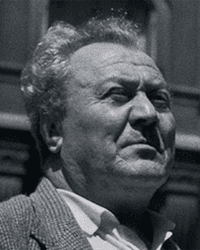

Fikret Mualla
Death(Text) | 1967, Paris | ||||||||
|---|---|---|---|---|---|---|---|---|---|
Birth(Text) | 1903, Istanbul | ||||||||
Artistic Style | Expressionist | ||||||||
Education | Saint Joseph French School Munich and Berlin Academies of Fine Arts Galatasaray High School | ||||||||
Fikret Mualla Saygı was born in 1903 in Istanbul into a wealthy and respected family.
The artist spent his childhood in Istanbul, attending Saint Joseph French School and later completing his education at Galatasaray High School. During his school years, Mualla attracted attention for his interest in sports, but suffered a serious accident during a football match that resulted in a broken right leg, leaving him with a lifelong limp. In the years 1918–1920, he lost his mother due to the Spanish flu, and during this period he experienced conflicts within his family, particularly with his father, whose relationship with him gradually deteriorated.
As a result of the hardships he endured, Fikret Mualla developed a rebellious personality. At his father’s insistence, he was sent to Switzerland to study engineering.
However, he abandoned his engineering studies and transferred to the Munich Academy of Fine Arts due to his growing passion for art. Mualla continued his artistic education at the Berlin Academy of Fine Arts, and during his time in Germany, his drawings were published in several periodicals of the era, drawing attention.
After leaving Germany, Fikret Mualla moved to Paris, where he continued his work for a time; however, due to financial difficulties, he was forced to return to Türkiye in 1927. In Türkiye, he worked as a drawing teacher at Galatasaray High School and also created illustrations for books and costume designs for theatrical productions.
In 1930, he illustrated Nazım Hikmet’s poem “Varan 3” and the play “Why Did Benerci Kill Himself?”, and designed costumes for the operettas “Lüküs Hayat”, “Delidolu”, and “Saz Caz”. In 1934, in accordance with the Surname Law, he adopted the surname “Saygı”, chosen by his father. That same year, he was appointed as a teacher at Ayvalık Middle School, but soon left this position as well.
Following his father’s death in 1938, Mualla used his inheritance to settle in Paris in 1939 (Azamet, 2012: 12).
However, living conditions in Paris deteriorated with the outbreak of World War II, and his health problems worsened. During this period, he contracted cirrhosis and spent much of his life in hospitals. In 1962, after suffering a stroke, the artist continued his life with the support of Raoul Anglès, the mayor of a village in southern France, and his wife Madame Anglès. Fikret Mualla died in 1967 in a home for the homeless.
Fikret Mualla is described as a self-taught painter who, despite receiving formal art education, primarily developed his skills through his own efforts. Despite the hardships he faced, he made art an integral part of his life.
The artist nourished his fears and anxieties while also producing work under their influence, developing a distinctive style.
He intuitively employed bright, rich, and harmonious colors, selecting hues according to his emotional state. During periods of sadness, he favored black, white, and gray; during happier times, he chose vibrant and saturated colors. This approach to color corresponded closely with his understanding of line. For him, line was color and color was line.
He favored techniques that allowed for rapid execution and produced results aligned with his psychological state, particularly gouache and watercolor. These expressive works are interpreted as efforts to alleviate his sense of isolation. He depicted ordinary moments of daily life: people walking on the streets, eating, playing music, or engaging in games.
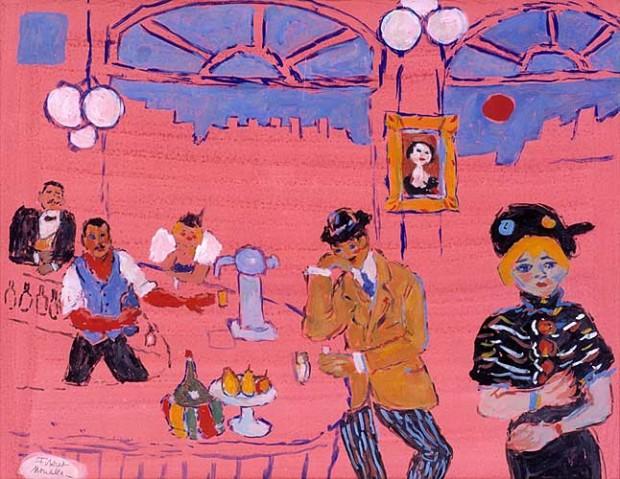
Fikret Mualla’s “Pink Coffee Painting” (ÖzÜARTS)
His artistic career is divided into two stylistic phases: Istanbul and Paris.
During his Istanbul period, he focused on themes such as the Golden Horn, cemeteries, mosques, Bosphorus views, women learning the new alphabet, nudes, landscapes, and portraits. In his Paris period, the dominant themes were Parisian streets, churches, cafés, bars, bourgeois figures, patients, and the mentally ill.
There are few technical or stylistic differences between the two periods; however, in terms of color usage, Istanbul-era works predominantly featured earth tones such as yellow and brown, while Paris-era works emphasized vibrant primary and secondary colors such as red, blue, yellow, and orange.
This shift can be explained by the more dynamic lifestyle Mualla led in Paris.
AA. "Paris’te Ünlenen Ressam Fikret Mualla." Anadolu Ajansı, Accessed May 15, 2025. https://www.aa.com.tr/tr/kultur-sanat/pariste-unlenen-ressam-fikret-mualla/1916254.
Aktaş Özkafacı, Aysun. "Kaostan Düzene Geçiş: Sanat ve Yaratıcılık Bağlamında Ressam Fikret Mualla Saygı’nın Yaşamına Bütüncül Bakış." Accessed May 15, 2025. https://dergipark.org.tr/tr/download/article-file/2179698.
Arts Ozyegin. "Fikret Mualla." Accessed May 15, 2025. https://arts.ozyegin.edu.tr/tr/artist/fikret-mualla.
Şirin, Bahar, and Necla Coşkun. "İkonografi ve İkonoloji Yöntemi ile Fikret Mualla Saygı’nın ‘Yeni Harfleri Öğrenen Kızlar’ Adlı Eserinin Analizi." Accessed May 15, 2025. https://dergipark.org.tr/tr/download/article-file/2612984.

Fikret Mualla
Death(Text) | 1967, Paris | ||||||||
|---|---|---|---|---|---|---|---|---|---|
Birth(Text) | 1903, Istanbul | ||||||||
Artistic Style | Expressionist | ||||||||
Education | Saint Joseph French School Munich and Berlin Academies of Fine Arts Galatasaray High School | ||||||||
Education Abroad
Return to Türkiye and Early Artistic Work
Paris Period and Final Years
Artistic Approach
General Artistic Philosophy
Use of Color and Line
Technical Preferences and Subject Matter
İstanbul and Paris Periods