


This article was automatically translated from the original Turkish version.
Fire Cult in Turkish Mythology encompasses the totality of beliefs and practices that developed around the conception of fire as a being endowed with a “soul”recognized as possessing a soul and treated as a living entity, centered on functions of purification, protection, healing, and establishing connection with the sacred. Within this framework, fire is regarded not merely as an ordinary element fulfilling daily needs but as a “sacred” instrument surrounded by specific rules and taboos.
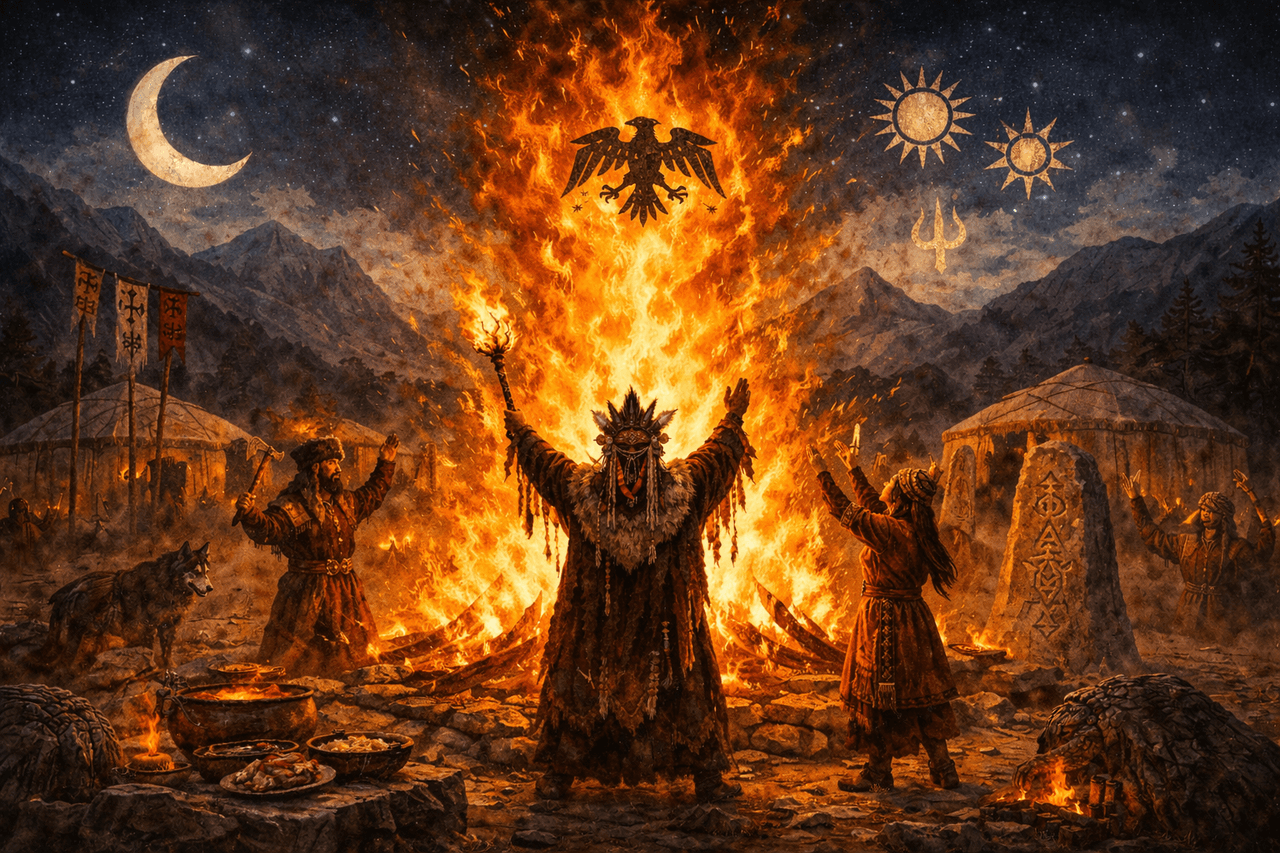
Ateş Kültü (Yapay Zekâ ile Oluşturulmuştur)
In assessments of the fire cult, a central debate arises regarding whether the relationship with fire constitutes “worship” or rather a comprehensive set of practices grounded in reverence and purification. While some narratives describe fire as a divine element, other approaches explain its sanctity through practical functions such as purification, cleanliness, removal of negative influences, and the expression of wishes or requests.【1】
Narratives concerning the origin of fire position it not merely as a technical invention but as an element granted or taught to humans. In Altai traditions, fire is associated with the god Ülgen, who generated sparks by rubbing two stones together, thereby teaching people how to ignite dry grass. Similarly, accounts describing fire as descending from the sky or being linked to lightning reinforce its status as “holy.” This origin framework forms the foundational layer supporting the idea that fire must be preserved and surrounded by specific behavioral codes.
One distinguishing feature of the fire cult is the conception of fire as a living entity possessing a “soul.” In this view, human attributes are ascribed to fire; in certain narratives, it is referred to as “Od Ana” and depicted as a female being. The attribution of life to fire leads to the cultural normalization of behavioral norms, where actions involving fire are evaluated in terms of benefit or harm, determining what should be performed or avoided.
Fire is seen as an instrument for protection against evil spirits and malevolent forces. In this context, the idea of “purification through fire” is prominent in both ritual practices and everyday behavioral patterns. It is believed that objects or individuals can be cleansed of negative influences through fire and smoke, placing the “cleansing” nature of fire at the center. Jumping over fire during seasonal rituals such as Nevruz and Hıdrellez is performed for this purpose.
The therapeutic and curative aspect of fire is a significant component of both mythological conceptions and folk practices. Beliefs exist that fire or smoke possesses healing properties against illness or negative influences. In healing rituals, smudging is practiced, and in some regions, healing through smoke is still applied.
Fire is not only a purifying element but also assumes a mediating role between humans and supernatural beings. This mediation contributes to the formation of ritual arrangements centered around fire, such as the specific manner of kindling sacred fire.
In the fire cult, the theme of the “hearth” is the primary indicator of fire’s association with family and lineage continuity. The hearth fire occupies the center of a home, family, and domestic order. Thus, expressions such as “the hearth going out” signify not only a physical event but also an adverse condition in terms of familial or ancestral continuity. Practices of reverence surrounding the hearth and fire serve a function of preserving social memory; in some traditions, transferring the old fire to a new location or leaving small offerings at the fire are linked to this continuity.
Fire and Hearth Cult among the Turks (TRT Avaz)
Jumping over fire is regarded as a practice intended to avoid misfortunes and negative influences throughout the year. This practice emphasizes the “purifying” effect of fire; in some accounts, ashes are also scattered in specific locations for protective purposes.
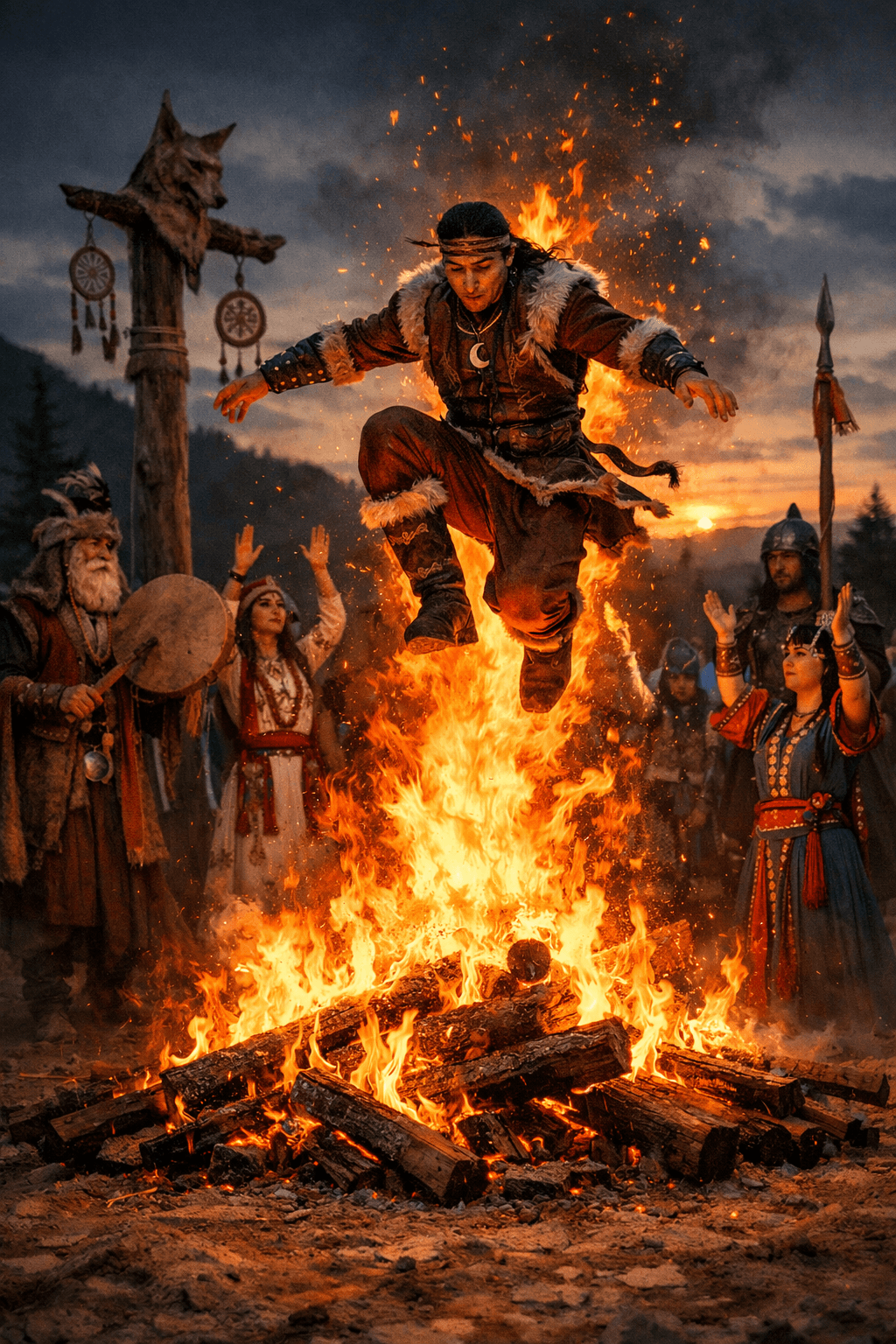
Ateşten Atlama Ritüeli (Yapay Zekâ ile Oluşturulmuştur)
The tradition of smudging in Anatolia is connected to the fire cult. Practices involving incense burning or candle lighting, particularly around tombs, are associated with purification and cleanliness, protection from the evil eye, expulsion of evil spirits, and the expression of intentions or wishes. This perspective highlights how the ritual dimension of fire gradually transformed over time into practices centered on smoke and incense.
Lead pouring is a practice based on the belief that the vapor or smoke produced when molten lead is poured into cold water neutralizes or reveals malevolent forces. In this ritual, lead is first melted over fire, then brought into contact with water. The resulting vapor is accepted as purifying and healing.
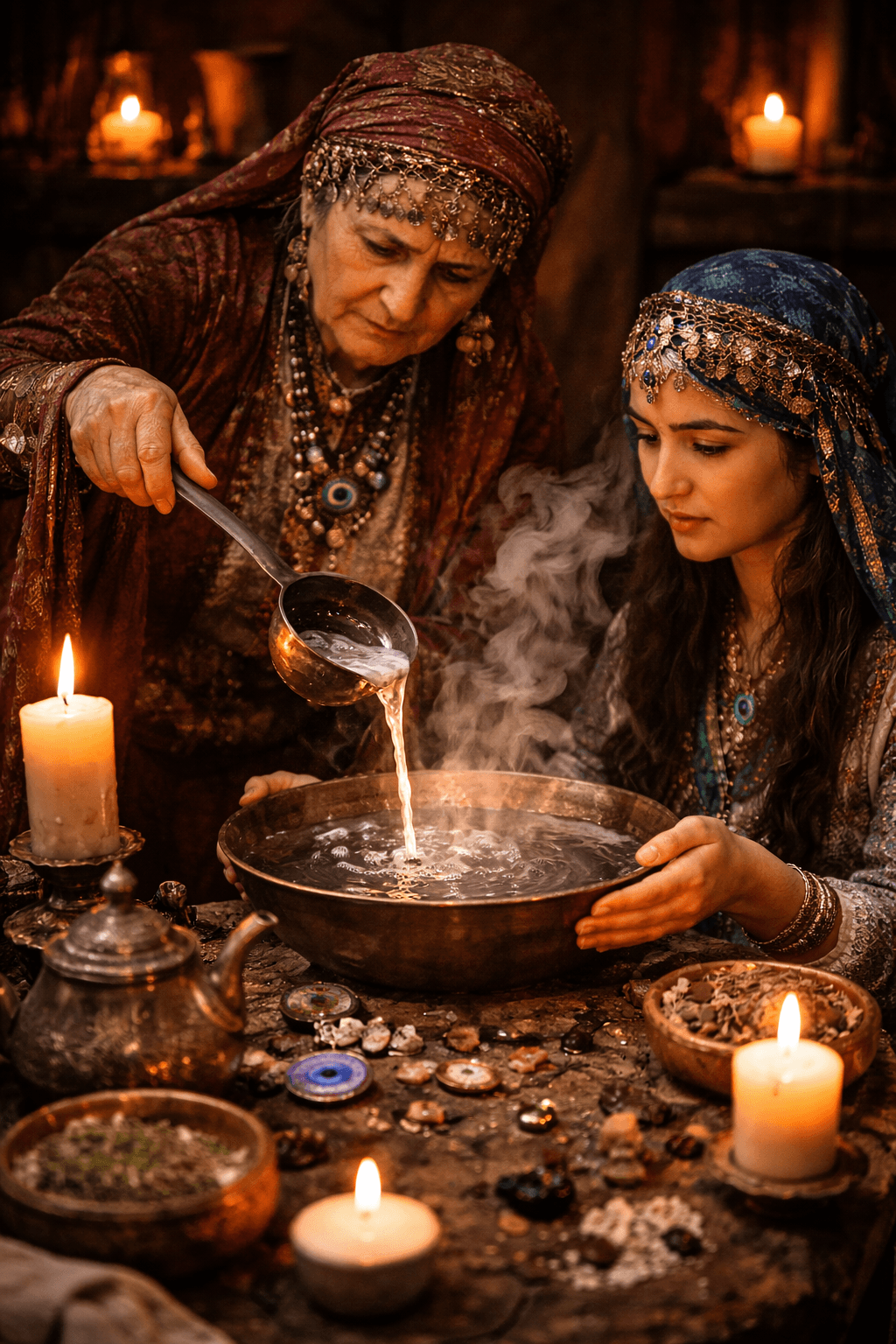
Kurşun Dökme Ritüeli (Yapay Zekâ ile Oluşturulmuştur)
Certain beliefs and rituals associated with the fire cult have not disappeared entirely but have persisted through historical interactions with diverse religious and cultural contexts, adapting and transforming over time. Some practices have been preserved, while others have acquired new meanings. Even today, specific behavioral patterns related to fire continue in various regions. For example, some people believe that extinguishing fire with water brings bad luck; therefore, they prefer to let the fire die out naturally or disperse the embers rather than use water. Similarly, behaviors considered disrespectful—such as spitting on fire, kicking it, or throwing garbage onto it—are avoided.
The belief in fire’s purifying and healing power is also evident in contemporary practices. For instance, the custom of burning incense is applied both to cleanse spaces and to protect against negative energy or the evil eye; in this practice, fire becomes the carrier of the purifying function through smoke. In some customs associated with the evil eye—such as moving incense around specific corners of a house or smudging newly acquired objects—the role of fire as a protective element is clearly evident. Additionally, in seasonal rituals linked to the annual cycle—such as lighting fire during seasonal transitions or specific days, jumping over fire, or gathering around fire—the meanings of “renewal” and “purification from evil” come to the fore.
These local observations are significant because they demonstrate how historical forms of the fire cult have persisted by adapting to new contexts. Notably, the same behaviors are today often explained in terms of “tradition,” “good luck,” or “protection,” yet they continue to carry traces of the original sacredness, reverence, and purifying concepts attributed to fire.
Bütüner, Şahin. “Ateş Kültü Bağlamında Anadolu’da Tütsü Geleneği.” *RumeliDE Dil ve Edebiyat Araştırmaları Dergisi*, no. 31 (2022): 975–983. Accessed January 5, 2026.https://dergipark.org.tr/en/pub/rumelide/article/1222165
Gömeç, Saadettin Yağmur. “Eski Türklerde Ateş Kültürü ve Sosyolojik Gerçekler.” *Tarih Araştırmaları Dergisi* 44, no. 78 (April 2025): 1–13. Accessed January 5, 2026.https://dergipark.org.tr/tr/download/article-file/4559168
Gülyüz, Bahriye Güray. “İslam Öncesi Türk Kültüründe Ateş ve Ateşe Hükmedenler (Maddi Kültür İzleri Işığında).” *Trakya Üniversitesi Edebiyat Fakültesi Dergisi* 9, no. 17 (2019): 201–223. Accessed January 5, 2026.https://dergipark.org.tr/en/download/article-file/633610
Kırcı, Emine. “Türk Kültüründe Ateşle İlgili İnanışlar.” In *Folkloristik: Prof. Dr. Dursun Yıldırım Armağanı*, edited by Metin Özarslan and Özkul Çobanoğlu, pp. 398–407. Ankara: Türkiye Diyanet Vakfı Yayınları, 1998. Accessed January 5, 2026.https://turkoloji.cu.edu.tr/HALKBILIM/emine_kirci_turk_kulturunde_atesle_ilgili_inanislar.pdf
Polat, İrfan. “Kurşun Dökme Geleneği ve Ateş Kültü ile İlişkisi.” *Akademik MATBUAT* 4, no. 1 (2020): 11–26. Accessed January 5, 2026.https://dergipark.org.tr/tr/download/article-file/1236545
TRT Avaz. "Türklerde Ateş ve Ocak Kültürü." YouTube. Accessed January 5, 2026.https://www.youtube.com/watch?v=A_cWHZcPPTA
Öztürk, Veysel Eren. “Eski Türk İnançlarında Ateş Kültü ve Günümüze Yansımaları.” *Bayterek Uluslararası Akademik Araştırmalar Dergisi* 6, no. 2 (2023): 285–302. Accessed January 5, 2026.https://dergipark.org.tr/tr/pub/buaad/article/1116089
[1]
Şahin Bütüner, “Ateş kültü bağlamında Anadolu’da tütsü geleneği,” RumeliDE Dil ve Edebiyat Araştırmaları Dergisi, no. 31 (2022): s.1 Erişim 5 Ocak 2026

No Discussion Added Yet
Start discussion for "Fire Cult in Turkish Mythology" article
Approach to the Fire Cult
Mythological Origins and the Bestowal of Fire
Personification of Fire: Od Ana and the Soul Belief
Functions
Purification and Protection from Malevolent Influences
Healing and Cure
Mediation and Communication
Hearth, Family, and Continuity
Ritual Practices
Jumping Over Fire and Use of Ashes
Smudging and Purification Through Smoke
Lead Pouring
Contemporary Reflections