


This article was automatically translated from the original Turkish version.
+2 More
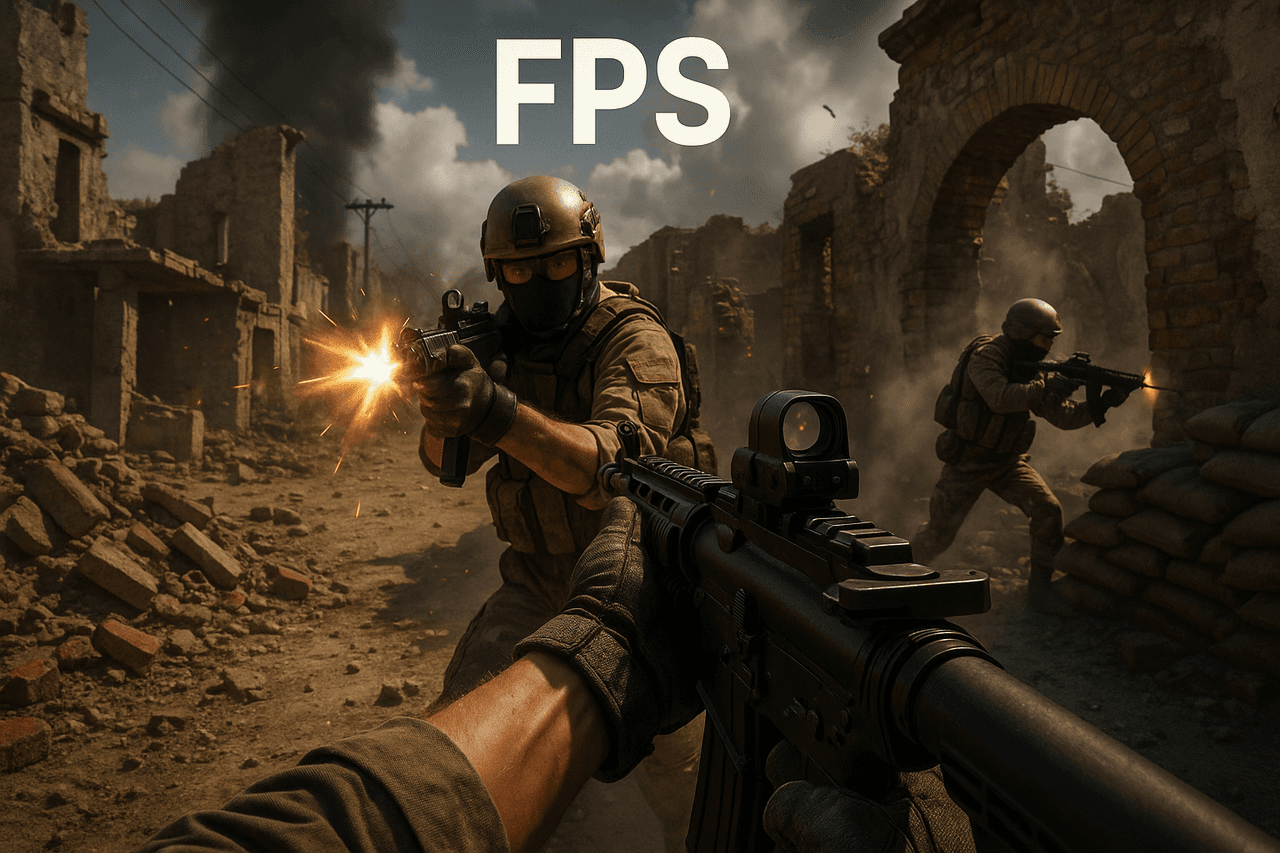
First Person Shooter Game
Type(s) | Video Game Genre | ||||||||
|---|---|---|---|---|---|---|---|---|---|
Abbreviation | FPS (First-Person Shooter) | ||||||||
Perspective | First-person (from the player's perspective) | ||||||||
First-Person Shooter (FPS) games are a digital game genre in which the player experiences the game world from the viewpoint of a character, typically centered around the use of firearms. With a history of approximately twenty years, this genre is represented by hundreds of commercial titles released across various platforms including computers, game consoles, and mobile devices.

First-Person Shooter (FPS) Game (Image Generated by Artificial Intelligence)
FPS games are based on the first-person perspective, where the player directly controls in-game interactions through an avatar. The player’s objective, typically represented by a human-like avatar, is to inflict damage on or neutralize other game characters or elements. In this genre, the player’s field of view aligns with that of the avatar, providing a more intense and personal experience.
The evolution of the FPS genre has been shaped by both technological advancements and the development of game design practices.
Although the FPS genre gained widespread popularity through id Software’s titles such as Wolfenstein 3D (1992) and Doom (1993), its history extends back to earlier periods. Games like Catacomb 3-D (1991), Maze War (1974), Akalabeth (1979), and Wizardry (1981) pioneered the first-person perspective by offering interactive experiences from this viewpoint. Additionally, early vehicle simulators such as Battlezone (1980) provided players with a three-dimensional interactive environment through a “cockpit view.”
The first-person experience was not limited to digital media; carnival shooting galleries such as Automatic Shooting Range (1895) and Shoot the Bear (1947) historically represented physical-world analogues of similar experiences.
The term “first-person shooter” became popular after the genre’s emergence but was not initially used by game developers. Early promotional materials emphasized concepts such as “3-D,” “perspective,” and “virtual reality.” During the mid-1990s, expressions like “Doom-clone” or “Doom-like” were common, but over time “first-person shooter” became the enduring term.
The FPS genre initially developed on IBM PC-compatible computers and remained dominant on this platform until the late 1990s. With the advent of the 2000s, home game consoles such as PlayStation, Xbox, GameCube, and Wii became the dominant platforms for FPS games. Modern mobile devices also began supporting the FPS genre notably between 2008 and 2009. Nevertheless, the PC platform continues to maintain its significance, particularly in regions such as Eastern Europe, due to its development environment and user base.

First-Person Shooter (FPS) Game on a Game Console (Pexels)
The core mechanics of FPS games aim to simulate a combat experience, emphasizing realism in both physical movement and weapon usage.
In most games, character movement is controlled using the “WASD” key layout, while camera control is handled via the mouse. This configuration is accepted as the standard control scheme for the genre.
Firearms used in FPS games are inspired by real-world models, with attributes such as ammunition capacity, reload time, and firing modes defined in data files. Bullet spread and hit probability are determined through mathematical models. Weapon systems generally rely on either “projectile” (bullet trajectory) or “hitscan” (instant hit) mechanics.
FPS games evaluate the player character’s physical and mental health separately:
When either health type reaches zero, the character is rendered inactive; this is interpreted not as death but as being incapacitated. The game does not necessarily end at this point; the player may continue with another character or activate a respawn mechanism.
Many FPS games adopt a minimalist graphical user interface (GUI) to enhance realism. Instead of persistent elements such as a mini-map, constant health indicator, or fixed reticle, players are expected to gather information through direct interaction—for example, pressing the “R” key to reload ammunition. Realistic visual cues such as “iron sights” are used for aiming.
In FPS games, representations of player avatars—including gender, race, and background—are shaped by historical context and societal trends. Research indicates that in a significant portion of such games (81%), male avatars are mandatory. This trend is especially pronounced in games with historical warfare themes.
Hitchens, Michael. “A Survey of First-person Shooters and their Avatars.” *Game Studies*, vol. 11, no. 3, 2011. Accessed June 11, 2025. https://gamestudies.org/1103/articles/michael_hitchens/
Miroshnichenko, Tima. “FPS Görsel.” Pexels. Accessed June 11, 2025. https://www.pexels.com/tr-tr/fotograf/adam-insanlar-karanlik-koyu-7046723/
Pinchbeck, Dan. “Story and Recall in First-Person Shooters.” *International Journal of Computer Games Technology.*, c. 2008, Article No. 783231. Accessed June 11, 2025. https://doi.org/10.1155/2008/783231
Therrien, Carl. “Inspecting Video Game Historiography Through Critical Lens: Etymology of the First-Person Shooter Genre.” *Game Studies*, c. 15, sy. 2, 2015. Accessed June 11, 2025. https://www.gamestudies.org/1502/articles/therrien

First Person Shooter Game
Type(s) | Video Game Genre | ||||||||
|---|---|---|---|---|---|---|---|---|---|
Abbreviation | FPS (First-Person Shooter) | ||||||||
Perspective | First-person (from the player's perspective) | ||||||||
No Discussion Added Yet
Start discussion for "First-Person Shooter (FPS) Games" article
Definition and Core Features
Historical Development
Origins
Evolution of the Term “First-Person Shooter”
Platforms
Gameplay Mechanics
Movement and Control
Weapon Mechanics
Health System
User Interface
Avatar Representations