


This article was automatically translated from the original Turkish version.
+1 More
Definition(s) | A high-firepower weapon capable of firing bullets in a serial and automatic manner | ||||||||
|---|---|---|---|---|---|---|---|---|---|
Invention | Invented by Hiram Maxim in 1884 | ||||||||
Purpose(s) | To enable armies to fire more quickly and effectively during combat | ||||||||
Importance | Changed the course of modern warfare; first used intensively in World War I | ||||||||
A machine gun is a firearm system capable of automatically firing hundreds of rounds per minute when the trigger is held down continuously, delivering a high rate of fire. Fundamentally classified as a firearm, this mechanism performs reloading, ejection of spent casings, and feeding of new rounds into the chamber in a continuous and sequential manner without requiring human intervention as long as the trigger is depressed. This process is achieved through the automatic actuation of the bolt and mechanism by the gas pressure generated upon firing or by a recoil-operated system.
This technical design represents a revolutionary stage in the evolution of firearms. The earliest firearms in human history were primitive systems such as cannons or muskets, manually loaded and capable of only a single shot. These weapons had limited effectiveness on the battlefield, primarily due to lengthy reloading times. The advent of the machine gun fundamentally transformed military tactics and combat psychology.
The origins of the machine gun extend back to mechanical devices capable of multiple shots. The “volley guns” used in 14th-century Europe and the rotating-cylinder firearms developed by James Puckle in the 18th century are considered the earliest examples of such systems. However, the first true machine gun with an automatic operating principle was developed by Hiram Maxim in 1884. Maxim created a cycle in which the bolt was automatically recocked and a new round was chambered after each shot, utilizing recoil energy. This invention endowed the machine gun with groundbreaking technical and tactical significance.
From World War I onward, the machine gun became a decisive factor on the battlefield. Previously dominant formations of cavalry or infantry began to fail in overcoming positions defended by even a single machine gun, which became the primary cause of trench warfare and massive human casualties. This weapon completely altered the strategic logic of conventional warfare; defense gained overwhelming superiority over the surprise and speed advantages of offense.
Today, machine guns are not merely firearms but also an evolving component of military technology. Their modular design and compatibility with integrated electronic sighting systems and unmanned platforms such as drones contribute to the redefinition of both warfare and security and defense strategies.
The development of the machine gun represents a revolutionary breakthrough in the evolution of firearm technology. This evolution has caused profound changes not only in the physical structure of weapons but also in military strategies and combat psychology. Below is presented the historical development of the machine gun with its key turning points.
Gatling Era (1860s)
The Gatling Gun, developed by Richard Gatling, operated via a hand-cranked mechanism with multiple barrels. Although not automatic, it mechanized the loading and firing process, establishing the principle of rapid repetition. This system became one of the foundational pillars of the machine gun as the first multi-barreled mechanical firing device.
Maxim Era (1884)
The Maxim machine gun, developed by Hiram Maxim and introduced in 1884, was the first effective weapon to achieve fully automatic fire using recoil energy. With its water-cooled barrel and belt-fed system, it represents the first example of modern machine gun design. Its use in colonial wars and World War I clearly demonstrated its lethality and strategic power.
World War I (1914–1918)
During this war, machine guns became symbolic of trench warfare. Models such as the Vickers, Spandau, and Chauchat emerged as defensive weapons replacing human manpower. During this period, machine guns were employed in fixed positions and caused mass destruction.
World War II and Portability (1939–1945)
Throughout the war, light and medium machine guns were developed alongside German models such as the MG34 and MG42. These weapons expanded the role of the machine gun in modern warfare through high rates of fire, durability, and mobility. They were effectively used in both defense and offense.
Cold War and Standardization (1945–1990)
During this period, ammunition and rifle systems were standardized across NATO and Warsaw Pact countries. Standards such as the 7.62x51 mm NATO and 7.62x54 mm Soviet cartridges emerged. Machine guns in both Western and Eastern blocs underwent technical advancement and transitioned toward modular designs.
Modern Era (1990 and Beyond)
Today, machine guns are equipped with lighter materials, electronic sighting systems, thermal imaging, and remote control capabilities. Models such as the 12.7 mm MT12-QCB, developed by Turkey’s Mechanical and Chemical Industry Corporation (MKE), exemplify high battlefield effectiveness. Furthermore, systems integrated with unmanned aerial vehicles have transformed the machine gun into a weapon of the digital age.
Technical Schools and Founders
- Richard Gatling: Inventor of the hand-cranked multi-barrel system, who initiated the principle of rapid repetition.
- Hiram Maxim: Founder of the recoil-operated automatic firearm mechanism, known as the father of the modern machine gun.
- John Moses Browning: Pioneer in developing gas-operated automatic systems, renowned for models such as the M1919 and M2.
- Hugo Schmeisser: Key figure behind lightweight machine gun designs such as the MP18 and MP40.
- Vasily Degtyaryov: Creator of the Soviet-style machine gun school, known for weapons such as the DP-28 and DShK.
- Vorgrimler and team (MG42): Redefined firepower with systems capable of firing over 1200 rounds per minute.
The machine gun did not merely appear as a weapon on the battlefield; it emerged as a strategic game-changer. First attracting attention through its use in colonial wars at the end of the 19th century, it underwent its fundamental transformation during World War I. Warfare strategies based on rapid mass maneuvers lost their validity due to the widespread deployment of machine guns, which enabled small numbers of soldiers to halt large formations with sustained, intense firepower.
During World War I, particularly in the context of entrenched warfare, machine guns stabilized front lines and rendered offensive advances nearly impossible. Documentation confirms that a single machine gun on the French and Belgian fronts, firing 400–600 rounds per minute, could stop hundreds of advancing soldiers. As a result, the war prolonged, attrition tactics came into play, and lasting psychological trauma was inflicted upon troops. In World War II, mobile and lightweight versions of these weapons were actively employed in both defensive and offensive units, playing a pivotal role in armored units and airborne operations.
During the Cold War, machine guns were standardized, and caliber compatibility became a strategic balancing factor between blocs such as NATO and the Warsaw Pact. During this period, machine guns achieved widespread integration into tanks, helicopters, and fixed-base defense systems.
Today, machine guns have transformed into modular, multi-role weapon systems shaped by high technology. Modern machine guns, equipped with lightweight alloy bodies, electronic sights, thermal cameras, and automated targeting systems, are deployed across ground forces, armored vehicles, unmanned aerial vehicles (UAVs), and naval platforms. NATO-standard 7.62 mm and 12.7 mm caliber weapons are preferred, and integrated components such as suppressors, night vision, and infrared sights respond to the demands of modern warfare.
In Türkiye, weapons such as the 12.7 mm MT12-QCB, developed by the Mechanical and Chemical Industry Corporation (MKE), are used both domestically and in export markets due to their high effective range, rapid firing capacity, and user-friendly design. In the future, these weapon systems are expected to operate in integration with artificial intelligence-assisted targeting systems and autonomous combat systems. The machine gun is no longer merely a weapon; it is one of the digital instruments of military strategy.

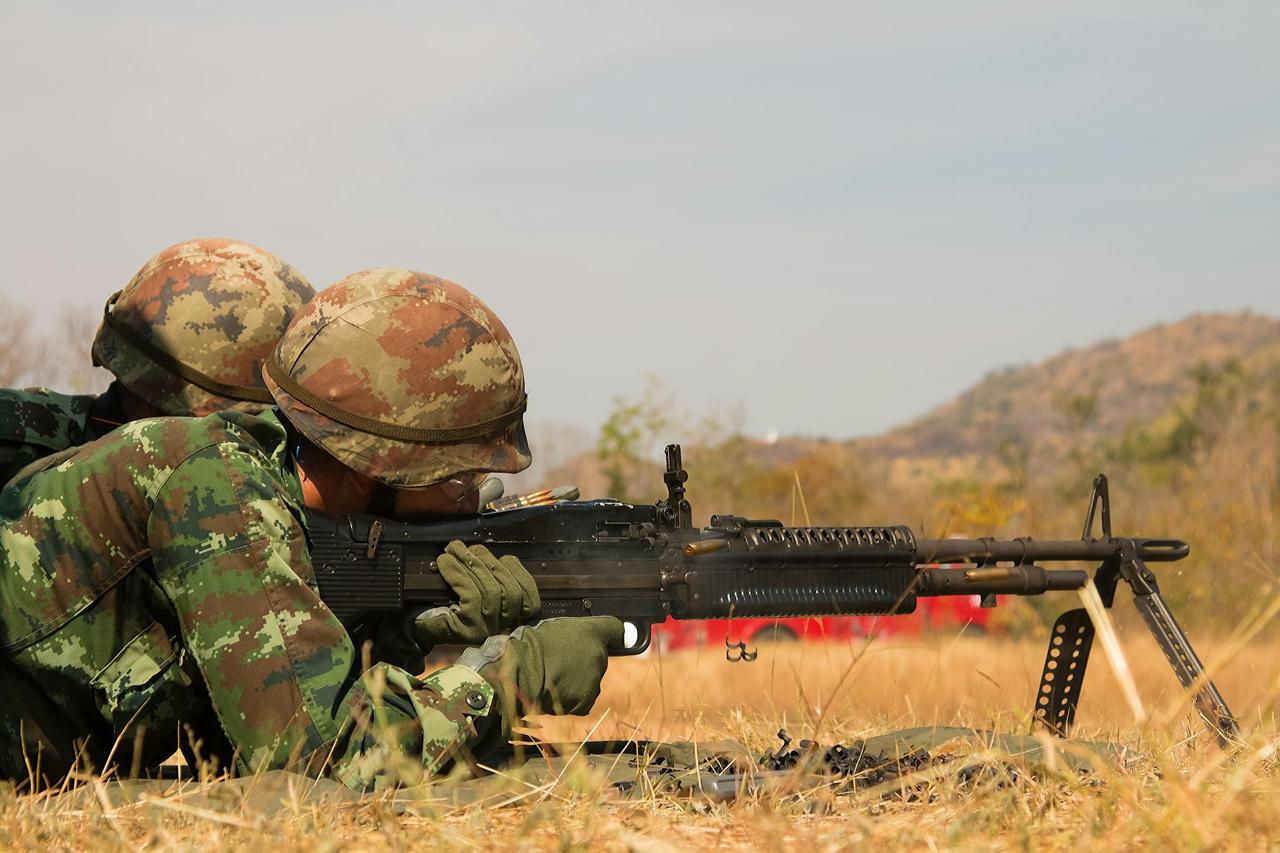
Machine Gun (pexels)
The invention and evolution of the machine gun fundamentally altered the nature of modern warfare. Hiram Maxim’s design marked the turning point for this weapon; significant technical and tactical advancements were achieved alongside World War II. Today’s machine guns still rely on the principles of these early designs but have evolved into lighter, more modular, and more effective systems.
Library of Congress. “Makineli Tüfek: Tarihi, Gelişimi ve Kullanımı.” *Araştırma Rehberi*. Accessed May 14, 2025. https://guides.loc.gov/machine-gun-its-history-development-and-use.
Makine ve Kimya Endüstrisi A.Ş. "12.7 mm Makinalı Tüfek (MT12-QCB)." MKE Resmî Web Sitesi. Accessed May 14, 2025. https://www.mke.gov.tr/Urunler/127-mm-Makinali-Tufek-MT12-QCB/1.
Sobieck, Ben. "Fark Nedir? Makineli Tüfek ve Hafif Makineli Tüfek." *Yazarın Silahlara Rehberi.* Accessed May 14, 2025. https://crimefictionbook.com/2015/10/01/whats-the-difference-machine-gun-vs-submachine-gun/.
Watson, Stephanie, and Tom Harris. "Makineli Tüfek Savaşta Nasıl Devrim Yarattı." *HowStuffWorks.* Accessed May 14, 2025. https://science.howstuffworks.com/machine-gun.htm.

Definition(s) | A high-firepower weapon capable of firing bullets in a serial and automatic manner | ||||||||
|---|---|---|---|---|---|---|---|---|---|
Invention | Invented by Hiram Maxim in 1884 | ||||||||
Purpose(s) | To enable armies to fire more quickly and effectively during combat | ||||||||
Importance | Changed the course of modern warfare; first used intensively in World War I | ||||||||
Development Process and Technical Schools of the Machine Gun
The Transformative Role of the Machine Gun on the Battlefield and Its Modern Evolution
Most Successful Machine Gun Models (Listed)