This article was automatically translated from the original Turkish version.
Scientific Name(s) | Chloris chloris | ||||||||
|---|---|---|---|---|---|---|---|---|---|
Family | Spinyfinches (Fringillidae) | ||||||||
Order | Passeriformes | ||||||||
Conservation Status | LC – Least Concern (IUCN) | ||||||||
Florya is a songbird species belonging to the finch family (Fringillidae), commonly found across Europe, North Africa, and Southwest Asia. In Türkiye, it is largely resident and can be observed year-round.
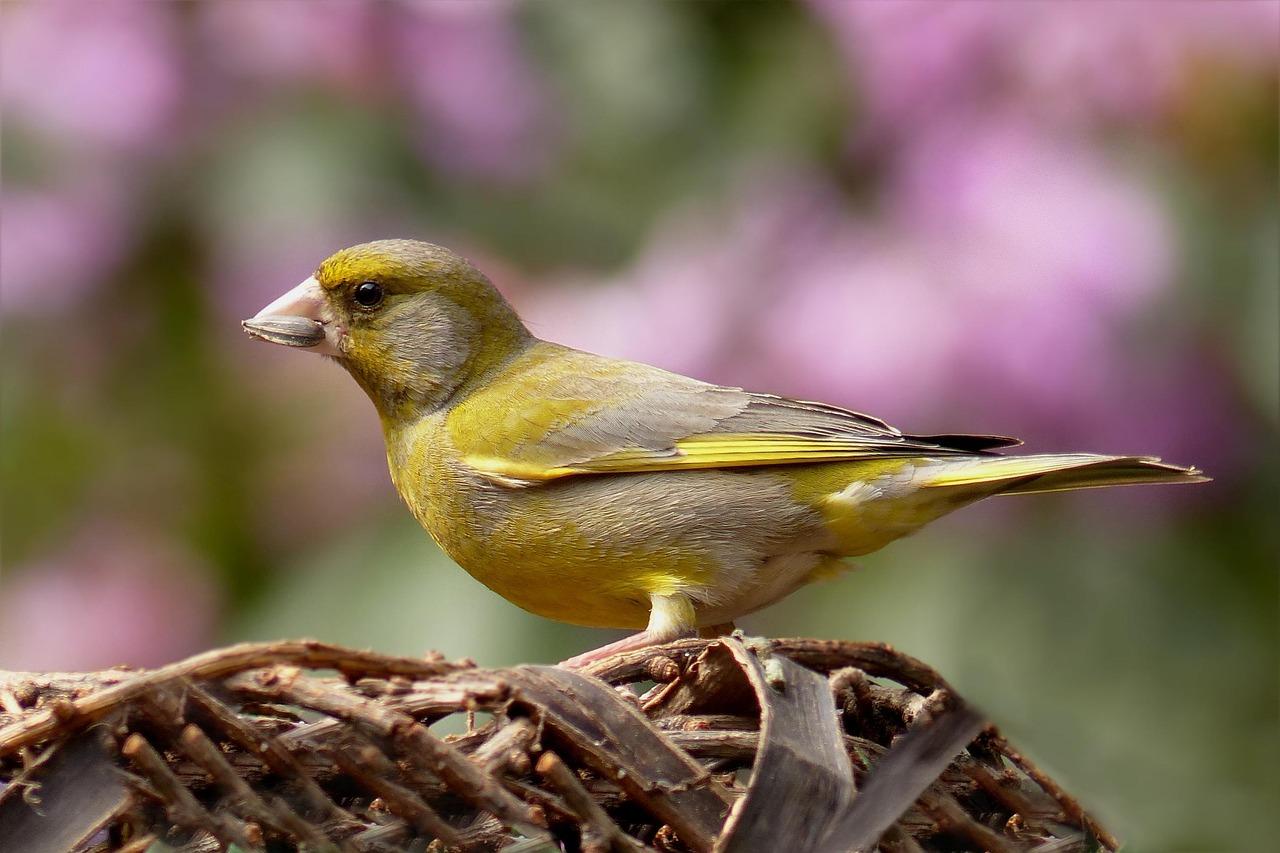
The Florya is a large, green-colored finch. The male has a large, conical beak that is pale pink in color. The head, shoulders, back, and rump display olive-green tones; the edges of the wing feathers, the front part of the wings, and the bases of the tail side feathers are yellow. The central part of the tail is dark grayish-green, while the sides are yellow. Females are paler in color, dominated by brown and grayish-green hues. Juveniles are streaked and can be distinguished by their yellow wing panel. Males are larger and more brightly colored than females.

Florya (pixabay)
The Florya’s song is melodic and warbling. Males, especially during the breeding season, perform display flights known as “butterfly flights,” involving fluttering wing movements. During mating season, males sing frequently from high branches.
It inhabits sparse woodlands, tree lines in agricultural areas, olive groves, orchards, parks, and gardens. In winter, it forms mixed flocks with other finch species.
The Florya is widespread across much of Europe, North Africa, and Southwest Asia. It has been reported as far as New Zealand. In Türkiye, it is common throughout the year, particularly resident in the western, central, and Black Sea regions. In northern and northeastern Anatolia and the Tuz Gölü Basin, it is recorded as a summer migrant or passage migrant. Although largely resident across most of Türkiye, some northern populations may migrate south during winter.
Its diet consists primarily of seeds, with a strong preference for sunflower seeds. It also feeds on fruits, plant buds, shoots, and insects. Insect larvae are particularly important in the diet of nestlings during their first days.
The breeding season typically begins in mid-April and lasts until August. The nest is built in shrubs, climbing plants, or medium-sized trees, usually at mid-height. It is constructed from dry grass, moss, and twigs, and lined internally with fibers, hairs, feathers, and wool.
The female lays four to six eggs, pale blue or cream-colored with reddish spots. Incubation lasts approximately 13 to 14 days. Nestlings are covered in grayish-white down at hatching; parents feed them insects during the first days, then switch to partially digested seeds. Young birds leave the nest between 13 and 18 days after hatching. The species typically raises two broods per year, sometimes three.
Due to its wide distribution and high population density, the Florya is listed as “Least Concern” (LC) on the IUCN Red List.
Ornito. "Florya." Ornito.org. Accessed August 16, 2025. https://ornito.org/Bird/Detail/181
Pixabay. "Florya Kuş – Yiyecek Arama, Bahçe JPG." Accessed August 16, 2025. https://pixabay.com/tr/photos/florya-ku%C5%9F-yiyecek-arama-bah%C3%A7e-818185/
Pixabay. “Florya, Kuş, Kloris kloris görseli JPG.” Accessed August 16, 2025. https://pixabay.com/tr/photos/florya-ku%C5%9F-kloris-kloris-hayvan-2368328/
İzkuş. “Florya.” *İzmir Kuş Cenneti.* Accessed August 16, 2025. https://izmirkuscenneti.gov.tr/2022/12/05/florya/

Scientific Name(s) | Chloris chloris | ||||||||
|---|---|---|---|---|---|---|---|---|---|
Family | Spinyfinches (Fringillidae) | ||||||||
Order | Passeriformes | ||||||||
Conservation Status | LC – Least Concern (IUCN) | ||||||||
No Discussion Added Yet
Start discussion for "Florya (Chloris chloris)" article
Behavior and Vocalization
Habitat
Distribution and Migration
Diet
Breeding
Population and Conservation Status