


This article was automatically translated from the original Turkish version.
+1 More
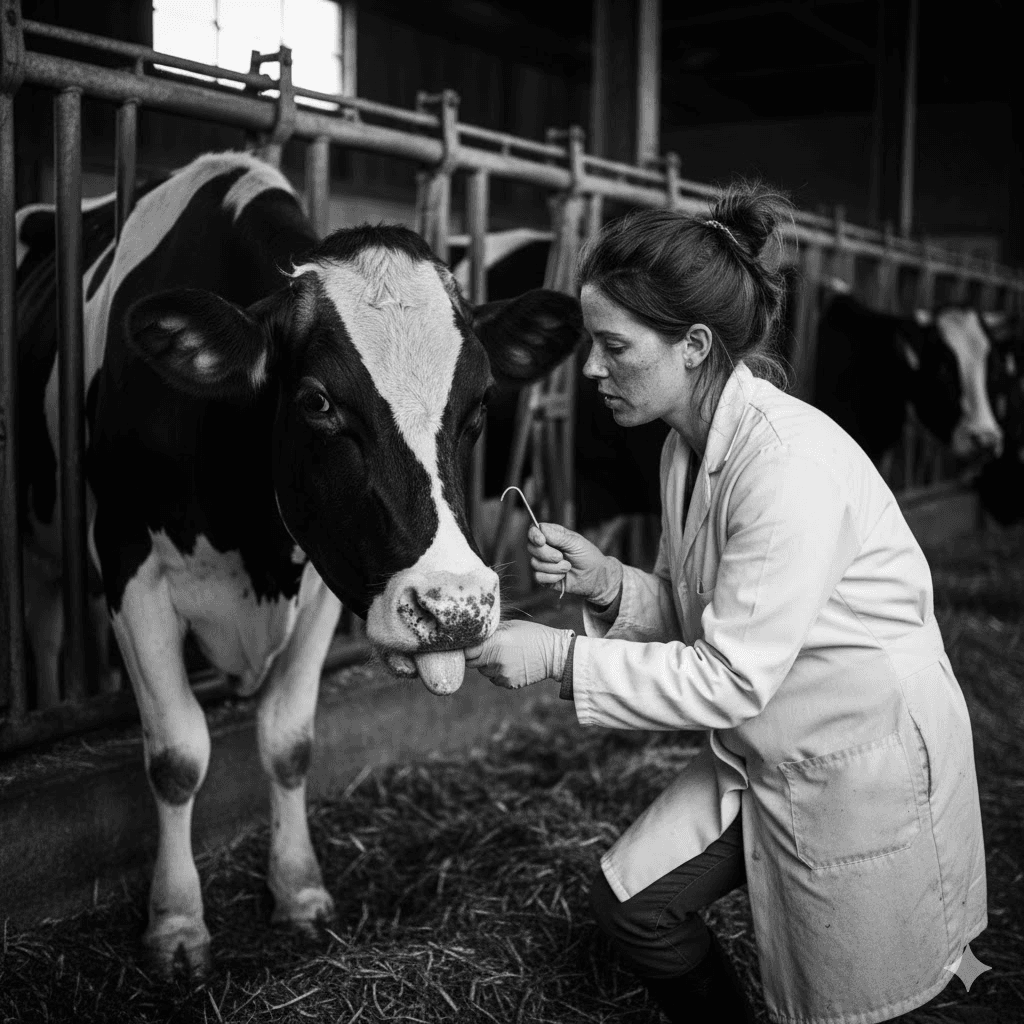
Generated with Artificial Intelligence
Foot-and-Mouth Disease in Even-Toed Ungulates
Actor | high mutation rate → new variants can arise. there is no cross-immunity between serotypes ASIA-1 SAT-3 SAT-2 SAT-1 C A serotypes: O subgenus Aphtovirus The family Picornaviridae | ||||||||
|---|---|---|---|---|---|---|---|---|---|
Foot-and-mouth disease is a highly contagious viral infection that affects cloven-hoofed animals, characterized by acute course and rapid spread. The morbidity rate is very high and can reach up to 100% in susceptible animal populations. Due to its economic losses, trade restrictions it triggers, and the high cost of control, it is a major animal health issue globally.
The causative agent is the foot-and-mouth disease virus, belonging to the Aphtovirus subgenus of the Picornaviridae family. There are seven distinct serotypes of the virus: O, A, C, SAT-1, SAT-2, SAT-3, and Asia-1. The absence of cross-immunity between these serotypes complicates disease control. Additionally, the high mutation rate of the virus leads to the continuous emergence of new variants.

Structural Model of Aphtovirus (Generated by Artificial Intelligence)
The foot-and-mouth disease virus exhibits variable resistance to environmental and physical conditions.
Heat sensitivity:
Environmental resistance:
The foot-and-mouth disease virus can spread through both direct and indirect routes.
Infected or incubating animals shed the virus via respiratory secretions, skin, excretions, milk, and semen.
Aerosol transmission via the respiratory route is the most important mode of spread.
Contaminated feed, equipment, transport vehicles, wild animals, birds, and wind can contribute to transmission.
Transmission to humans is rare and occurs only through contact with infected animals or their products.

Oral Lesions in Cattle with Foot-and-Mouth Disease (Generated by Artificial Intelligence)
Clinical signs vary depending on the animal species, virus strain, viral dose, and the animal’s immune status.

Oral Lesions in Sheep with Foot-and-Mouth Disease (Generated by Artificial Intelligence)
Definitive diagnosis is established through virological and serological methods. Differential diagnosis must consider infections causing lameness, mucosal erosion, increased salivation, nasal discharge, and mammary lesions.
The main strategies employed in controlling foot-and-mouth disease are:
Vaccination is the primary method in endemic regions; however, its effectiveness requires quarantine and control of animal movements. Upon detection, rapid isolation, disinfection, destruction of dead animals, and establishment of regional buffer zones are implemented.
Records of foot-and-mouth disease in Türkiye date back to 1914. After the major outbreak in 1957, national control programs were strengthened. Various serotypes including O1, A22, SAT-1, and Asia-1 have been identified in the country; currently, O1, A Iran, and Asia-1 strains are responsible for outbreaks.
Vaccination and quarantine are the main control measures; however, control is challenged by animal mobility and illegal imports.
Historically, foot-and-mouth disease has been widespread across Europe, Asia, Africa, and the Americas. Some countries have successfully eradicated the disease through effective vaccination and culling programs. In enzootic regions, the risk of outbreaks remains.
Warning: The content in this article is provided solely for general encyclopedic information. The information here should not be used for diagnosis, treatment, or medical advice. Always consult a veterinarian or qualified health professional before making any decisions regarding animal health. Neither the author nor KÜRE Encyclopedia assumes any responsibility for consequences arising from the use of this information for diagnostic or therapeutic purposes.
Bozukluhan, K., E. Atakisi, and O. Atakisi. "Sığırlarda Şap Hastalığının Klinik Seyri Sırasında Bazı Biyokimyasal Parametrelerin Değerlendirilmesi." *TR Dizin Veri Tabanı*. Last update: December 14, 2025. Accessed December 5, 2025. https://search.trdizin.gov.tr/tr/yayin/detay/228688
World Organisation for Animal Health (WOAH). "Technical Disease Card: Foot and Mouth Disease." Last updated: September 11, 2025. Accessed December 5, 2025. https://www.woah.org/en/disease/foot-and-mouth-disease/
“Şap Hastalığı Nedir?” Ankara Veteriner Hekimleri Odası, September 2023. Accessed December 5, 2025.
“Şap Hastalığı.” 2025. Ministry of Agriculture and Forestry. 2025. Accessed December 5, 2025. https://vetkontrol.tarimorman.gov.tr/bornova/Menu/76/Sap-Hastaligi/.

Generated with Artificial Intelligence
Foot-and-Mouth Disease in Even-Toed Ungulates
Actor | high mutation rate → new variants can arise. there is no cross-immunity between serotypes ASIA-1 SAT-3 SAT-2 SAT-1 C A serotypes: O subgenus Aphtovirus The family Picornaviridae | ||||||||
|---|---|---|---|---|---|---|---|---|---|
No Discussion Added Yet
Start discussion for "Foot-and-Mouth Disease in Cloven-Hoofed Animals" article
Causative Agent
Resistance Characteristics
Transmission Routes
Clinical Signs
In Cattle
In Sheep and Goats
Diagnosis
Control and Prevention Methods
Status of Foot-and-Mouth Disease in Türkiye
Global Status