This article was automatically translated from the original Turkish version.
+2 More
Producer(s) | Ford Otomotiv Şirketi | ||||||||
|---|---|---|---|---|---|---|---|---|---|
Model Name | Model T | ||||||||
Body Type | Four-door sedan; variants include two-door Model T and T-based pickup trucks | ||||||||
Engine(s) | Engine: 2.9L I4 (varies over the years) | ||||||||
Power | Approximately 20-22 HP | ||||||||
Operating Principle | Steam or gasoline engine | ||||||||
Fuel Type | Gasoline | ||||||||
Fuel Consumption | Approximately 20-30 mpg | ||||||||
Maximum Speed | Approximately 65-90 km/h | ||||||||
First Production | 1911 | ||||||||
Ford Model T is an automobile model that played a significant role in the widespread adoption of mass production techniques in the automotive industry and brought about transformative changes in vehicle manufacturing at the beginning of the 20th century. Introduced in 1908 and produced until 1927, this model represents one of the critical milestones in automotive history both in terms of engineering and production processes.
The Ford Model T was manufactured by Ford Motor Company between 1908 and 1927 and is one of the earliest examples of the systematic application of mass production techniques in the automotive industry. The first prototype was completed on 12 August 1908, and production began on 20 July 1908 at the Piquette Avenue factory in Detroit, Michigan. Production continued until 1927, resulting in approximately 15 million units manufactured in total.
The key innovation in the Model T’s mass production was the moving assembly line developed by Henry Ford. This method optimized the workflow during assembly, reducing the time required to produce a single vehicle from about 12 hours to 93 minutes. This production system lowered costs and fundamentally changed manufacturing standards across the automotive sector.
The magneto ignition system used in the Model T was preferred at the time as a low-voltage, mechanically compatible alternative. In this system, trembler coils generated the alternating current necessary to produce sparks. The magneto ignition contributed positively to engine durability and minimized maintenance costs. In the cooling system, the water pump present in early models was replaced in later production stages with a simpler, passive thermosiphon system. This change enhanced the system’s longevity and reduced operating costs.

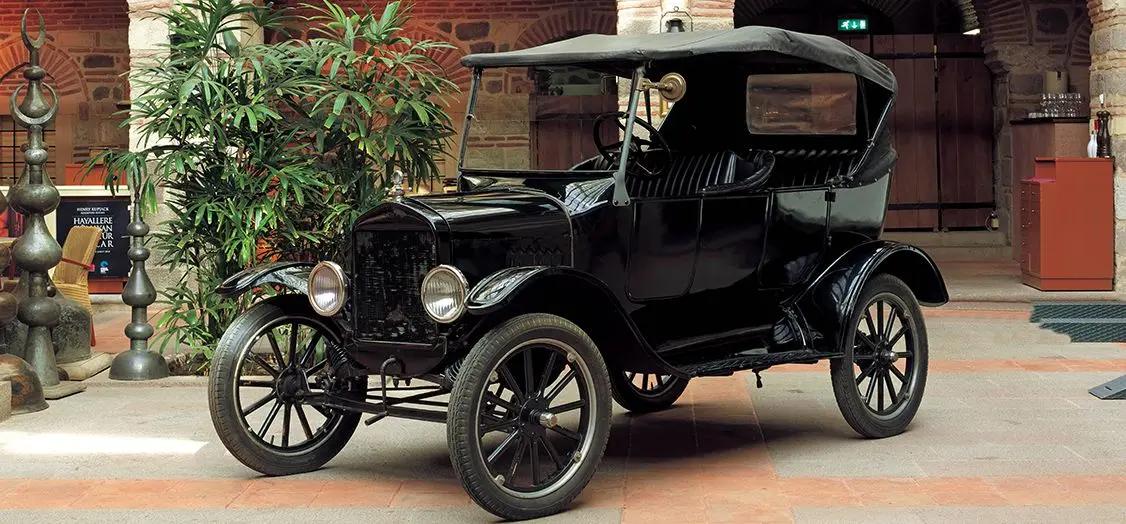
Ford Model T (Rahmi Koç Museums)
The production process of the Model T is widely regarded as the starting point for the widespread adoption of mass production methodologies in the automotive industry and beyond. Ford’s moving assembly line increased labor efficiency while reducing vehicle costs, making automobiles accessible to the middle-class consumer. Production standardization, modular component use, and assembly techniques based on labor division transformed the structure of industrial manufacturing. These developments were subsequently adopted not only in the automotive sector but across many other manufacturing industries.
The Ford Model T is regarded as a fundamental reference in the evolution of industrial production and automotive technology. Its cost-effectiveness through mass production techniques and broad consumer accessibility laid the groundwork for the widespread adoption of automobiles as mass transit vehicles. The Model T’s fuel flexibility and mechanical simplicity demonstrated its adaptability to the technological constraints of its era. Contemporary automotive historians and engineering assessments consistently highlight that the Model T’s production and design features played a critical role in shaping industrial standards.
Ford Motor Company. “About Ford.” Ford.com. Accessed July 19, 2025. https://corporate.ford.com/about.html.
Ford Motor Company. “About Model T.” Ford.com. Accessed July 19, 2025. https://corporate.ford.com/articles/history/the-model-t.html.
Ford Motor Company. “History of Ford.” Ford.com. Accessed July 19, 2025. https://corporate.ford.com/about/history.html.
Kimes, Beverly Rae. *Standard Catalog of American Cars 1805–1942.* Iola, WI: Krause Publications, 1996. https://archive.org/details/standardcatalogo0000kime.
Lacey, Robert. *Ford: The Men and the Machine.* New York: Little, Brown and Company, 1986. https://archive.org/details/fordmenmachine0000unse_c7d4/page/n15/mode/2up.
Lewis, David L. *The Public Image of Henry Ford: An American Folk Hero and His Company.* Detroit: Wayne State University Press, 1976. https://archive.org/details/publicimageofhen0000lewi_q8o6.
Rahmi M.Koç Müzesi. "Ford Model T." RMK Museum Ankara. Accessed July 28, 2025. https://www.rmk-museum.org.tr/ankara/en/collection/road-transportation/ford-model-t.


Producer(s) | Ford Otomotiv Şirketi | ||||||||
|---|---|---|---|---|---|---|---|---|---|
Model Name | Model T | ||||||||
Body Type | Four-door sedan; variants include two-door Model T and T-based pickup trucks | ||||||||
Engine(s) | Engine: 2.9L I4 (varies over the years) | ||||||||
Power | Approximately 20-22 HP | ||||||||
Operating Principle | Steam or gasoline engine | ||||||||
Fuel Type | Gasoline | ||||||||
Fuel Consumption | Approximately 20-30 mpg | ||||||||
Maximum Speed | Approximately 65-90 km/h | ||||||||
First Production | 1911 | ||||||||
Historical Development and Production Process
Design and Engineering Features
Production Techniques and Industrial Impact
Historical and Technological Significance