This article was automatically translated from the original Turkish version.
+2 More
Fourth-generation Molten Salt Reactors (MSR) are an advanced class of reactors that use a mixture of molten salts as either the primary coolant or the fuel carrier in nuclear fission energy production. As one of the six advanced reactor technologies identified by the Generation IV International Forum (GIF), MSRs are distinguished from conventional light water reactors by their potential for high thermal efficiency, passive safety systems, and conversion of nuclear waste. In these systems, the fuel is typically dissolved in fluoride or chloride-based salt mixtures circulating through a graphite-moderated core.
The fundamental philosophy of MSR technology is based on replacing high-pressure water with liquid salts that operate at near-atmospheric pressure and have very high boiling points. This eliminates the need for a pressure vessel, providing a structural advantage in accident prevention. Additionally, being the most efficient reactor type for implementing the thorium fuel cycle (Th-232), this technology positions itself strategically in terms of energy sustainability.
The origins of molten salt reactors trace back to the Aircraft Reactor Experiment (ARE) conducted in the late 1940s and early 1950s in the United States. Led by Alvin Weinberg at Oak Ridge National Laboratory (ORNL), these initial efforts were designed for nuclear-powered bombers, but the data gathered led to the development of the Molten Salt Reactor Experiment (MSRE) for civilian power generation.
The MSRE, successfully operated between 1965 and 1969, provided critical data on reactor criticality, fuel chemical stability, and corrosion resistance. However, in the 1970s, MSR research was suspended in favor of more mature technologies—light water reactors (LWRs), widely used in military submarine programs, and liquid metal fast breeder reactors (LMFBRs). From the 2000s onward, rising energy demands and concerns over nuclear safety have renewed interest in MSR technology due to its passive safety features.
The operating principle of molten salt reactors is based on circulating the fuel in liquid form rather than as solid pellets. The fuel (uranium, plutonium, or thorium) is mixed with carrier salts such as lithium fluoride (LiF) and beryllium fluoride (BeF2) and maintained in liquid state at temperatures between 500°C and 700°C.
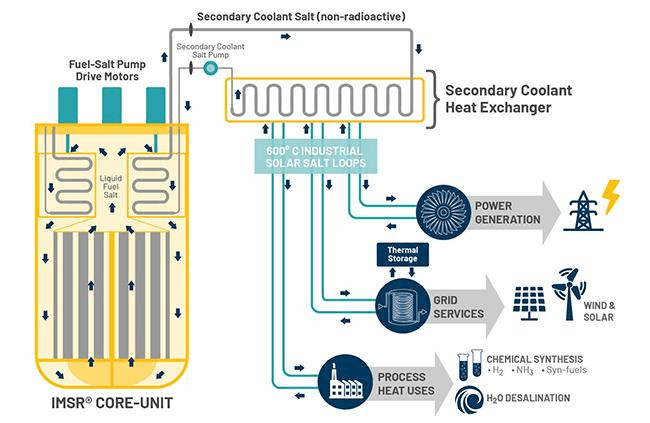
The salt heated by fission reactions in the core is pumped to a primary heat exchanger (heat transfer unit). Here, the heat is transferred to a non-radioactive secondary salt circuit. The heat from the secondary circuit is then directed to steam turbines for power generation or to Brayton cycle gas turbines for higher efficiency.

Figure 1: Schematic diagram illustrating the operating principle and heat transfer cycle of a Molten Salt Reactor (MSR).(Generation IV International Forum (GIF))
The most defining feature of MSR designs is a passive safety system known as the freeze plug. A salt plug, kept solid by active cooling at the bottom of the reactor, melts when cooling stops due to power loss or overheating. Gravity then causes the liquid fuel to drain into emergency tanks located beneath the reactor, which are geometrically designed to prevent criticality. This process shuts down the reaction without requiring human intervention or active electronic systems.
Molten salt reactors are classified according to neutron spectrum (thermal or fast) and the physical state of the fuel (dissolved in salt or separate).
While MSR technology offers significant advantages in thermodynamics and safety, it presents serious challenges in materials science.
Molten salts are extremely corrosive at high temperatures. To ensure that reactor components (pipes, pumps, heat exchangers) can withstand this environment for decades, specialized nickel-based alloys such as Hastelloy-N are required. Additionally, material embrittlement under neutron bombardment and the potential for tritium gas leakage remain current engineering challenges to be resolved.
Jérôme Serp, Michel Allibert, Ondřej Beneš, Sylvie Delpech, Olga Feynberg, Véronique Ghetta, Daniel Heuer, David Holcomb, Victor Ignatiev, Jan Leen Kloosterman, Lelio Luzzi, Elsa Merle-Lucotte, Jan Uhlíř, Ritsuo Yoshioka, Dai Zhimin. "The molten salt reactor (MSR) in generation IV: Overview and perspectives." *Progress in Nuclear Energy* 77 (2014): 308-319. Accessed January 29, 2026. https://doi.org/10.1016/j.pnucene.2014.02.014
LeBlanc, David. "Molten salt reactors: A new beginning for an old idea." *Nuclear Engineering and Design* 240, no. 6 (2010): 1644-1656. Accessed January 29, 2026. https://www.sciencedirect.com/science/article/pii/S0029549310000191?via%3Dihub
Rosenthal, M. W., P. N. Haubenreich, and R. B. Briggs. The Development Status of Molten-Salt Breeder Reactors. Oak Ridge National Laboratory, ORNL-4812, 1972. Accessed January 29, 2026. https://moltensalt.org/references/static/downloads/pdf/ORNL-4812.pdf
World Nuclear Association. "Molten Salt Reactors." Last updated November 2025. Accessed January 29, 2026. https://world-nuclear.org/information-library/nuclear-power-reactors/other/molten-salt-reactors
Yürümez, Mürselat. "Erimiş Tuz Reaktörleri'nin (MSR) Tarihsel Gelişimi, Teknolojik İlerlemeleri ve Gelecek Perspektifleri." *Anatolia Science and Technology Journal*, October 2025. Accessed January 29, 2026. https://zenodo.org/records/17427516

No Discussion Added Yet
Start discussion for "Fourth Generation Molten Salt Reactors" article
Historical Development and Origins
Operating Principle and Design Architecture
Core and Cooling System
Passive Safety Mechanisms
Classification and Major Types
Advantages and Engineering Challenges
Thermodynamic and Environmental Advantages
Materials and Corrosion Issues