


This article was automatically translated from the original Turkish version.

In the data age, the concept of freedom has acquired a complexity unprecedented in human history. Freedom can no longer be reduced merely to individual will or the boundaries of political systems; because in the digital world, an invisible force shapes human behavior, preferences, and thoughts: data.
Every click, every swipe, every online action becomes part of vast data networks. These data are not merely statistical information; they are digital traces representing an individual’s identity, habits, fears, and desires. Therefore, in the modern world, freedom is increasingly becoming a phenomenon that is “measured by data,” “guided by data,” and “defined by data.”
Digitalization initially promised freedom. When the internet emerged as a communication tool transcending boundaries, it was seen as a harbinger of a new era in which access to information would be democratized and individuals could make their voices heard. Yet today, that promise of freedom has been replaced by surveillance, manipulation, and algorithmic control. While users believe they are gaining access to information, they have instead become part of a system in which their behavioral data are continuously monitored by massive corporations and states.
This situation resembles the rebirth of philosopher Michel Foucault’s “panopticon” model in the digital age. According to Foucault, power operates through a system in which individuals are under surveillance without being aware of it; because they do not know whether they are being watched, they regulate their own behavior. Today, this principle manifests in every domain, from social media algorithms to facial recognition systems. While humans believe they are free while living under invisible data surveillance, their freedom is in fact confined within boundaries defined by the system itself.
Artificial intelligence systems analyze human behavior to make predictions; these predictions then begin to shape future behavior. Thus, free will begins to function only within the limits predicted by modeling algorithms. In Shoshana Zuboff’s terms, this is the direct consequence of “surveillance capitalism”: the individual is no longer merely a consumer but has become a source of economic value through data production.
However, the issue is not merely economic; it has ethical, political, and even existential dimensions. While individuals believe they are making their own decisions, they are in fact choosing among options presented by algorithms. This situation compels us to fundamentally question the nature of freedom. Is true freedom the absence of external pressure, or is it the reclamation of control over one’s own data?
The concept of “Freedom in the Data Age” is shaped precisely around this question.
Today, freedom is no longer merely a political right; it is a technological battleground. How user data are collected, processed, and directed determines the extent to which individuals can define themselves. Because in the digital world, the question “Who am I?” is often intertwined with “How does the system see me?”
In this context, the most fundamental responsibility of the modern individual is to become a conscious digital being. Freedom is no longer merely about making choices; it is about understanding which options are presented to us. In this age shaped by algorithms, freedom has transformed from a passive right into an active form of awareness.
The economic structure of the modern world is built on a system in which data is not merely information but capital. Shoshana Zuboff’s concept of “surveillance capitalism” is the clearest expression of this transformation: the human being is no longer merely a user or consumer but also a data producer. Every step we take, every post we like, every word we write is collected, analyzed, and repurposed for profit by an invisible market.
In this process, human freedom becomes trapped within the parameters of commercial algorithms without awareness. Systems that determine the ranking of Google search results or which content is prioritized in our social media feeds shape not only our access to information but also our perception of reality. The user appears free because they can connect to the internet at any time and choose any content they wish. Yet most of these choices are the result of previously modeled behavioral patterns.
Byung-Chul Han, in his book The Transparency Society, interprets the digital age’s discourse on freedom as “voluntary surveillance.”
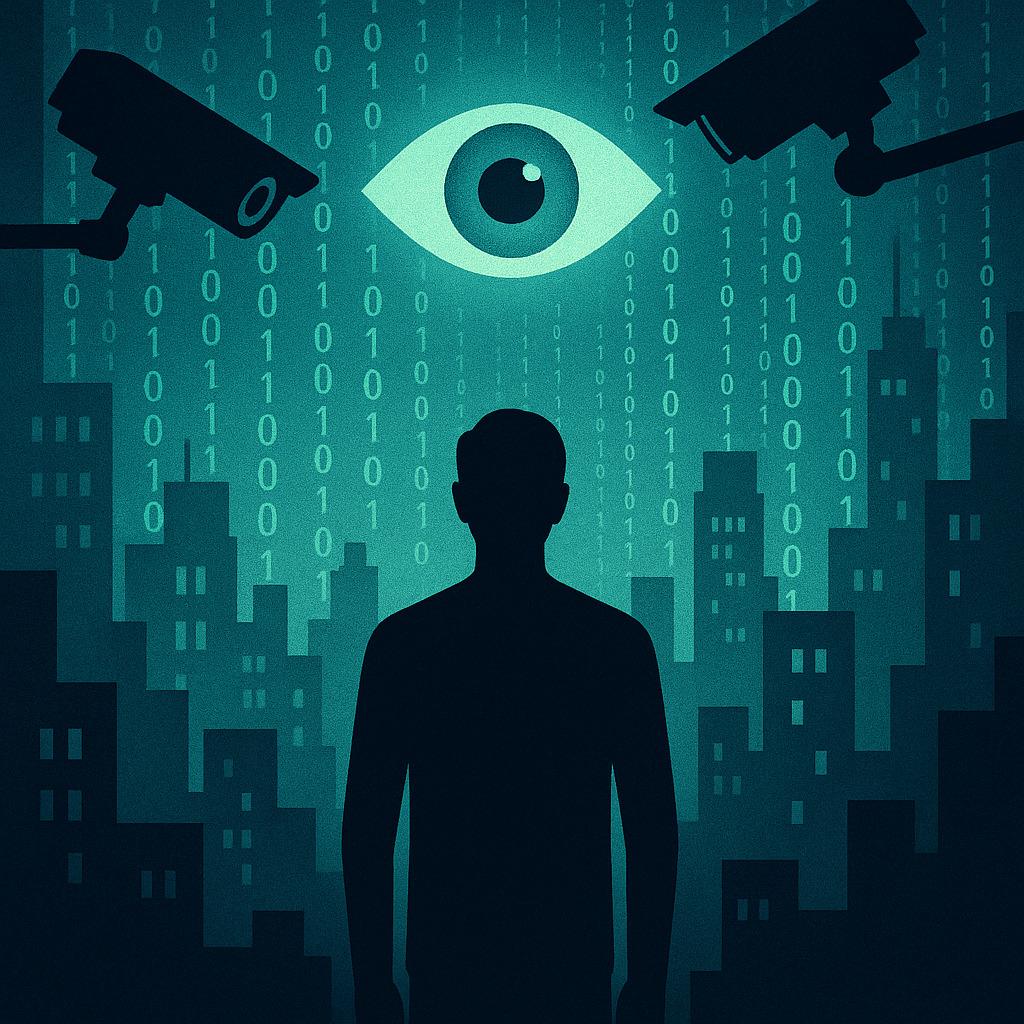
Image generated by artificial intelligence.
While people perceive constant visibility on social media as a form of expressive freedom, they actively participate in their own surveillance processes. This paradoxical situation transforms freedom from within: the individual becomes both the object and the subject of surveillance.
Surveillance capitalism has become decisive not only in advertising but also in state security policies. Big data is the fundamental power of intelligence agencies, corporations, and even political campaigns. The process from the 2016 U.S. elections to the Cambridge Analytica scandal clearly revealed how data can be transformed into a tool of manipulation. While individuals believe they are voting with free will, their decisions are influenced by algorithmic predictions.
Michel Foucault’s concept of the panopticon takes on a new form here. Surveillance is no longer hidden behind high walls; it is concealed in our smartphone screens, app permissions, and cookie policies. The disciplinary society has given way to a society of control, in which individuals have become voluntary data donors.
At this point, freedom no longer means merely “not being watched”; it means being able to perceive surveillance. In the information age, awareness is the new form of freedom.
In Zuboff’s words, “data capitalism does not merely predict human behavior; it shapes it.” This process of shaping reconstructs the human inner world not only economically but also culturally and psychologically.
Surveillance capitalism transforms the individual’s internal freedom through external control mechanisms. Today, when a user chooses among recommendations presented by algorithms, they are moving within the system’s invisible boundaries. These boundaries are not directly coercive; rather, they are presented under the guise of “comfort” and “personalization.” Precisely for this reason, modern surveillance is the most effective form of pressure—it is willingly accepted.
The invisible rulers of modern society are no longer humans but algorithms. Mechanisms that determine our credit scores, hiring processes, social media feeds, and even who sees which news are often automated decision systems. A common feature of these systems is their analysis of human behavior through past data to make predictions about the future. Yet these predictions inadvertently narrow the scope of free will.
Cathy O’Neil, in her book Weapons of Math Destruction, calls these mechanisms “mathematical weapons of mass destruction.” Because algorithms that appear neutral on the surface actually reproduce past biases. A model that determines a person’s credit score also determines which opportunities they can access. Thus, the idea of “neutral data” becomes in reality the digital form of inequality.
Virginia Eubanks, in Automating Inequality, demonstrates how algorithmic control in areas ranging from state welfare systems to education policies systematically disadvantages the poor. These examples clearly reveal that technology is not neutral. Every algorithm is a product of a specific worldview, economic interest, and political preference.
At this point, “freedom” is no longer merely the ability of a human to make their own decisions; it is also the capacity to understand how decisions are produced. Luciano Floridi, in his book The Fourth Revolution, argues that in the information ecosystem, humans are no longer passive recipients but active “infosphere entities.” This transforms the meaning of freedom fundamentally: freedom is the ability to be a conscious subject within digital systems.
Yet this new form of freedom is fragile. Because the fundamental principle of the algorithmic order is not transparency but secrecy. We do not know how algorithms work; we only see their outcomes. We have no right to question the logic behind decisions. Therefore, algorithmic authority is stronger than classical authority—it is invisible.
In Byung-Chul Han’s words, modern power no longer imposes prohibitions; it encourages data production. Individuals, through constant sharing, unknowingly sustain algorithmic control. While people believe they are free, the system directs their behavior; “likes” and “recommendations” become a form of digital leash.
Evgeny Morozov, in his book The Net Delusion, explains how the discourse of internet freedom conceals this paradox. According to him, the digital realm appears to give voice to individuals while in reality making them continuously traceable. This situation demonstrates that the concept of freedom must be redefined in the age of artificial intelligence.
Now, the “free individual” is not merely someone who makes decisions about themselves but someone who recognizes how decision-making processes are manipulated.
Conscious awareness is the new form of freedom in the algorithmic age.
Once, identity was how a person told their own story. Today, identity is often composed of numbers stored in databases, profiles constructed by algorithms, and digital traces. The answer to the question “Who am I?” has become intertwined with “How does the system define me?” This situation affects the deepest dimension of individual freedom: privacy.
Privacy is the silent dimension of freedom. It means an individual can possess their inner world and be protected from constant external interference. Yet in the digital age, privacy has almost become a luxury. Users often voluntarily share personal information: they leave location services enabled, save browsing histories, and grant apps “access permissions.” These small choices collectively form a vast surveillance network.
Byung-Chul Han defines the modern digital individual as a “subject of transparency.” This subject perceives constant visibility, sharing, and self-display as natural forms of expression. Yet this visibility also brings with it a continuous pressure to perform. The person turns their identity into a “data product.” Likes, comments, and follower counts have become new metrics for measuring an individual’s digital value.
The distinction between real identity and digital identity is increasingly blurred.
Luciano Floridi’s concept of the “infosphere” regains importance here. According to Floridi, the human being now exists at the boundary between the physical and digital worlds—a “knowledge organism.” This organism’s identity is continuously reconstructed through constant data exchange. Therefore, in the digital age, privacy is not merely a right to secrecy but has become the foundation of the right to freedom. Losing control over personal data means losing a part of one’s identity.
Foucault’s concept of surveillance has here internalized itself. Individuals now continuously produce data to demonstrate who they are. This shows that privacy is eroded not only by external threats but also by internal desires. The human being becomes both observer and observed within the digital world.
Surveillance capitalism creates a system in which privacy is transformed into economic value. Personal data becomes a “commodity” circulating among advertising companies, political consulting firms, and financial institutions. Its most critical feature is that individuals produce it without awareness. While users present their life data to systems, they trade their freedom for “convenience.”
In this context, the most fundamental question of the digital age is this: Is freedom possible without privacy? Can an individual truly make their own decisions in a world where they are constantly measured, evaluated, and classified? The answer is clear: freedom only gains meaning alongside privacy.
The absence of personal space is not merely the loss of secrecy; it is the erosion of selfhood.
Therefore, the free individual of the digital age is not merely a data producer but someone who exercises sovereignty over their data. True freedom is not invisibility; it is conscious visibility. That is, the individual must know which information they share, with whom, and what consequences it may have.
Without this awareness, freedom remains merely an illusion.
The freedom offered by technology is often a subtly disguised form of addiction. Smartphones, social media apps, and digital platforms are designed to target the deepest motivations of the human mind. Every notification, every like, every share activates the brain’s reward center. These digital rewards, which generate short-term feelings of satisfaction, gradually turn into habits and then into addiction. While users believe they are choosing freely, they are in fact part of a behavioral cycle directed by algorithms.
This phenomenon is closely linked to the concept of the “attention economy,” which integrates principles of behavioral psychology into the digital order. Attention is the most valuable resource of this new age; because how much time we spend on which content determines the system’s economic model. Advertising algorithms are more profitable the longer they can capture human attention. Thus, modern technology is designed not to liberate users but to keep them on screen.
At this point, freedom becomes not merely physical or political but a cognitive struggle. An individual who cannot manage their mind becomes vulnerable to external manipulation when they lose control over their attention. Byung-Chul Han defines the digital age’s individual as a “self-exploiting subject.” Humans appear to work, share, and produce freely; yet this production becomes a cycle that sustains the system’s continuity.
The person consumes their own attention through their own labor.
This phenomenon elevates the concept of “freedom” to a psychological depth. True freedom is not merely the right to choose; it is the awareness of the mechanisms behind choices. When an individual does not understand why they choose something, the choice no longer belongs to them. This lack of awareness drags the human being into the most dangerous form of digital slavery: voluntary slavery.
Jaron Lanier, in his book Ten Arguments for Deleting Your Social Media Accounts Right Now, criticizes this situation harshly. According to him, social media exploits users’ attention as an economic resource; individuals, without awareness, surrender their freedom under the guise of “content creation.” In this process, the person becomes not an employee of the system but its data. In the digital world, the means of production is no longer human labor but time and attention.
Mental addiction is stronger than physical chains because when individuals are unaware of their own constraints, they feel no need to resist. Thus, digital slavery is the most silent authority of the modern age. Humans become part of the system willingly; they organize their behavior according to the system’s expectations. The social media algorithm’s concept of “trend” is the cultural face of this mechanism: something is discussed because it is trending, and it is considered important because it is discussed.
In this context, the concept of the “conscious user” represents the ideal of freedom in the digital age. The conscious user does not escape the system; they understand how it functions. They recognize which apps exploit their attention and which content manipulates their emotions. They take responsibility for protecting their time, mind, and data. True freedom lies not in disconnecting from the digital world but in understanding the digital world.
The greatest paradox of the digital age is that humans must redefine themselves in the face of systems they invented. While technology expands human capabilities, it simultaneously traps individuals in an invisible network of dependency. At this point, freedom no longer retains its old meaning; because individuals must free themselves not only from external pressures but also from internal algorithms. Freedom has become not merely a political right but a form of digital consciousness.
This consciousness begins with “ethical awareness.” Every way of using technology represents a value choice. When downloading an app, checking a consent box, or using an artificial intelligence tool, a ethical choice is made. Luciano Floridi introduces the concept of “digital ethics” precisely for this reason. According to him, in the information age, morality must encompass not only human-to-human relationships but also human-technology relationships. Because technological decisions directly affect the boundaries of individual freedom.
Digital ethics rests on three fundamental principles: transparency, accountability, and conscious participation. Transparency means the right to know how algorithms work, which data are collected, and how they are evaluated. Accountability questions who is responsible for the outcomes produced by a system. Conscious participation means the individual maintains awareness in their interaction with technology. These three principles are the new foundations of freedom; because in the information age, “not knowing” is itself a form of dependency.
In this context, the awareness of digital citizenship comes to the forefront. The conscious digital citizen is not merely a consumer of information but also an ethical user.
They question the consequences of data sharing, audit sources, and adopt a critical stance toward manipulative content. This attitude is an act that liberates not only the individual but also the social digital ecosystem. Because technology is not neutral; it is shaped by the intentions of those who use it. Therefore, digital freedom cannot be completed without a collective level of awareness.
In Shoshana Zuboff’s words, “if the destiny of technology is not in human hands, neither is freedom.” This warning is a call for humans to reclaim their subjectivity in the face of technology. In the age of artificial intelligence, big data, and automation, humanity’s task is not to reject these systems but to redirect them for human benefit. Freedom is no longer a form of resistance; it is a form of digital responsibility.
The development of digital ethics also symbolizes the evolution of individual freedom. Previously, freedom was defined as the space where the state did not impose limits. Today, freedom is defined through the right to know who processes data and for what purpose algorithms are designed. Without access to this knowledge, freedom remains merely a theoretical claim.
In this context, freedom in the digital age is no longer merely the “right to self-expression”; it is the right to self-management over data. The control an individual has over their data is a measure of their sovereignty over their own identity. Therefore, the free person of our age is one who uses technology and questions it. Awareness, consciousness, and ethical responsibility are the new foundations of freedom in the data age.
Throughout history, humanity has continuously redefined the concept of freedom. At one time, freedom was resistance against nature and authority.
Then it gained meaning through struggles for equal rights within social structures. Today, freedom is being tested again, this time against the digital systems humans themselves have created. Now, freedom is not merely a political right; it is a state of existential awareness.
In the data age, the human being has become a being that is both observer and observed, producer and produced. This two-way relationship makes freedom more complex. On one hand, access to information, communication, and expressive freedom increases; on the other hand, this freedom has become an experience measured and directed within data flows. The human being, amid the seemingly limitless possibilities of the digital world, is responsible for safeguarding their own boundaries.
Therefore, the freedom of the future is possible only through technological awareness. Artificial intelligence, algorithms, and the data economy can make human life easier; yet these technologies can also take over human decisions about themselves. Freedom does not lie in surrendering to the conveniences offered by technology but in understanding its logic. In the information age, the free individual is one who can interpret their own data, question the structure of technology, and make conscious choices.
In the future, societies will define freedom not only through political systems but also through data policies. The transparency of a country’s digital infrastructure will determine the freedom level of its citizens. The right to data, the right to privacy, and algorithmic accountability will take their place among fundamental human rights alongside freedom of expression and freedom of thought.
At the center of this transformation is again the human being. Because no matter how advanced technology becomes, it is consciousness that will interpret it. Unconscious use of technology can transform even the most advanced systems into a tool of surveillance. But a conscious approach can turn technology into an instrument of freedom.
Therefore, in the data age, freedom is no longer an external status but an internal form of awareness. The truly free individual is one who manages their attention, protects their data, and takes responsibility for their technological choices. As this awareness develops, the human being of the digital age will become not merely a producer of information but a being who constructs consciousness through information.
Humanity will remain free as long as it controls technology. But if technology begins to define humanity, freedom will remain only a memory. Therefore, in the data age, freedom is not merely a right but a human responsibility.
Accessed November 21, 2025. https://www.sup.org/books/theory-and-philosophy/transparency-society
Byung-Chul Han. The Transparency Society. Stanford: Stanford University Press, 2015.
Cathy O’Neil. Weapons of Math Destruction: How Big Data Increases Inequality and Threatens Democracy. New York: Crown, 2016. Accessed November 21, 2025.
Evgeny Morozov. The Net Delusion: The Dark Side of Internet Freedom. New York: PublicAffairs, 2011. Accessed November 21, 2025.
Luciano Floridi. The Fourth Revolution: How the Infosphere Is Reshaping Human Reality. Oxford: Oxford University Press, 2014. Accessed November 21, 2025.
Michel Foucault. Discipline and Punish: The Birth of the Prison. New York: Vintage Books, 1995. Accessed November 21, 2025.
Shoshana Zuboff. The Age of Surveillance Capitalism: The Fight for a Human Future at the New Frontier of Power. New York: PublicAffairs, 2019. Accessed November 21, 2025.
Virginia Eubanks. Automating Inequality: How High-Tech Tools Profile, Police, and Punish the Poor. New York: St. Martin’s Press, 2018. Accessed November 21, 2025.
Surveillance Capitalism and Algorithmic Control
Algorithmic Authority: The Departure of Decision-Making from Human Hands
Digital Identity and the Erosion of Privacy
Conscious User or Digital Slave?
A New Understanding of Freedom: The Birth of Digital Ethics
Evaluation: Freedom, Data, and the Future of Humanity