


This article was automatically translated from the original Turkish version.
+1 More
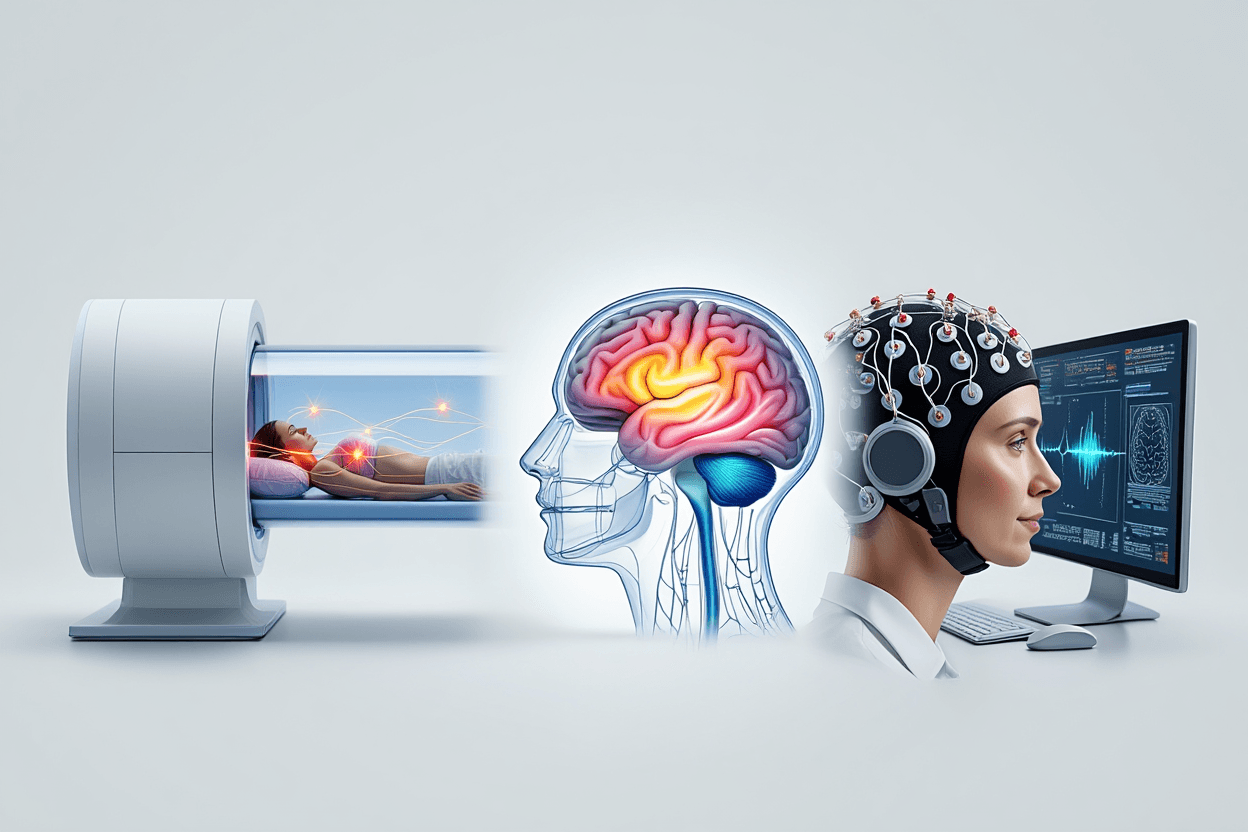
Functional Imaging (Generated with Artificial Intelligence)
Method Type | Non-invasive Neuroimaging | ||||||||
|---|---|---|---|---|---|---|---|---|---|
Main Application Area(s) | Surgical Planning Cognitive Research Neurological Disease Diagnosis | ||||||||
Average Duration | 30-60 minutes | ||||||||
Functional imaging is a branch of imaging that aims to examine not only the anatomical structure of organs and tissues but also their physiological and pathophysiological processes. Going beyond traditional morphological methods, it enables the monitoring of metabolic and biochemical events occurring at the cellular and tissue levels. This approach plays a crucial role in clinical diagnosis by detecting functional abnormalities at early stages and in research by enhancing understanding of normal and diseased processes.
The historical development of functional imaging is largely based on nuclear medicine techniques. Particularly, radiopharmaceuticals used in methods such as positron emission tomography (PET) and single-photon emission computed tomography (SPECT) have made it possible to directly observe metabolic processes in organs and tissues. These techniques have added a new dimension to diagnosis by providing data on metabolic activity, blood flow, and receptor binding that structural imaging methods cannot offer.
Today, functional imaging is no longer limited to nuclear medicine. Structural imaging methods such as magnetic resonance (MR), computed tomography (CT), and ultrasound (US) have begun to be used at the functional level due to advances in rapid imaging technologies and the development of specialized contrast agents. These developments allow for the simultaneous evaluation of anatomical information alongside physiological processes.
One of the most widely used and prominent techniques in functional imaging, especially in scientific studies, is functional magnetic resonance imaging (fMRI). fMRI is a fundamental method that significantly contributes to understanding the functional organization of the brain, particularly in the fields of neuroscience and psychiatry.
Functional magnetic resonance imaging is an advanced neuroimaging technique that measures brain activity in a non-invasive manner. Its high spatial resolution, lack of ionizing radiation, and repeatability have contributed to its widespread adoption in both clinical and research settings. The three-dimensional activation maps obtained through fMRI reveal which brain regions are active during specific tasks and provide valuable insights into the spatial organization of brain functions.
The foundation of fMRI is the Blood Oxygen Level Dependent (BOLD) effect. When neurons become active, their energy demands increase, leading to greater oxygen consumption. To meet this physiological demand, blood flow rich in oxygen is directed toward the affected region.
The magnetic properties of hemoglobin in the blood vary depending on its oxygenation state: oxygen-carrying hemoglobin (oxyhemoglobin) is diamagnetic, while hemoglobin that has released oxygen to tissues (deoxyhemoglobin) is paramagnetic. Paramagnetism causes minor distortions in the magnetic field of the MR scanner, leading to signal attenuation. During neuronal activity, the increase in oxygen-rich blood reduces the concentration of deoxyhemoglobin. This enhances magnetic field homogeneity and strengthens the signal. The fMRI scanner detects these subtle signal changes to identify activated brain regions. The temporal relationship between neuronal activity and the BOLD signal change is known as the hemodynamic response function. The timing and amplitude of this response are used to map functional brain regions.
An fMRI study consists of four main stages: hypothesis formulation, experimental paradigm development, data acquisition, and analysis.
Preparation Stage: Prior to scanning, a detailed assessment is conducted to ensure participant safety. The presence of materials that may interact with the magnetic field, such as cardiac pacemakers, metal prostheses, or aneurysm clips, is checked. All metallic objects on the participant are removed, and the participant is informed about the procedure and provides written consent.
Scanning Stage: The participant lies supine on the movable table of the MR scanner. Special devices and cushions are used to immobilize the head. The participant is positioned within the scanner’s tunnel-shaped magnetic field, and imaging begins. During scanning, the participant is presented with visual, auditory, motor, or cognitive tasks according to the experimental design. For example, reading a text, viewing a specific image, or performing finger movements induces activation in corresponding brain regions.
Data Analysis: After scanning, the acquired data undergo initial processing. Preprocessing steps such as motion correction, slice timing correction, and spatial normalization are applied, and the data are aligned with high-resolution anatomical MR images. Statistical methods are used to identify task-related activation regions, which are then visualized as color-coded maps.
This process contributes to uncovering functional brain connectivity, aiding in disease diagnosis, and supporting neuroscience research.
PET is another widely used method in functional imaging. In this technique, a low-dose radioactive tracer (radiopharmaceutical) is administered into the body. The tracer is typically labeled with glucose-like molecules and is taken up more extensively by metabolically active tissues. The scanner detects gamma rays produced when positrons emitted by the tracer interact with electrons in the tissues, generating three-dimensional maps of metabolic activity. PET is particularly used in oncology, neurology, and cardiology to assess metabolism, blood flow, and receptor distribution.
SPECT is a method similar to PET that utilizes radiopharmaceuticals. However, SPECT employs radionuclides that emit single photons. The scanner collects signals from multiple angles using gamma cameras and constructs three-dimensional functional images with computer assistance. Although it has lower resolution than PET, SPECT is frequently preferred in clinical practice due to its wider availability and lower cost. It is commonly used for evaluating myocardial perfusion, diagnosing neurodegenerative diseases, and studying cerebral blood flow.
Functional ultrasound is a next-generation technique that has emerged in recent years and is gaining attention in brain research. In this method, high-frequency ultrasound waves are used to measure changes in blood flow within brain tissue. The technique is based on the hemodynamic response, similar to BOLD fMRI, but offers significantly higher temporal resolution. It also has advantages such as portability, relatively low cost, and the absence of ionizing radiation. fUS is primarily used in neuroscience research with animal models, and clinical applications are currently under investigation.
Functional imaging methods including fMRI, PET, SPECT, and functional ultrasound are used in various clinical and research contexts.
fMRI is used in surgical planning, evaluation of neurological disorders, and investigation of psychiatric conditions. It is applied in studying cognitive processes such as memory, attention, learning, language, and emotional processing.
PET is especially prevalent in oncology, neurology, and cardiology. It is used to assess tumor metabolic activity, localize epileptic foci prior to surgery, evaluate myocardial viability, and enable early diagnosis of neurodegenerative diseases such as Alzheimer’s.
PET is particularly valuable for studying neurotransmitter systems. The distribution and receptor density of neurotransmitters such as dopamine, serotonin, or GABA can be imaged using PET. In this regard, it plays a critical role in psychiatric and neuropharmacological research.
SPECT is preferred for examining cerebral blood flow, localizing epileptic foci, and assessing perfusion in the cardiovascular system. It can also assist in differentiating types of dementia. By enabling brain perfusion studies, it provides insights into the relationship between cognitive functions and blood flow.
As a next-generation technique, fUS is primarily used in neurological research. Studies in animal models focus on cerebral circulation and hemodynamic responses, while in humans, its portability offers potential for use in intensive care units and operating rooms.
Due to its high temporal resolution, fUS is particularly favored in experimental neuroscience for understanding mechanisms of attention and arousal. Additionally, its non-invasive nature is accelerating its application in human research studies.
Advantages: Non-invasive, does not involve ionizing radiation, provides high spatial resolution.
Limitations: Low temporal resolution, expensive, cannot be used in individuals with metallic implants.
Advantages: Directly measures metabolic activity, enables investigation of neurotransmitter systems, effective in early diagnosis of cancer and neurological disorders.
Limitations: Involves ionizing radiation, requires expensive radiopharmaceuticals, has lower spatial resolution compared to fMRI.
Advantages: More widely available and less expensive than PET, has a broad range of applications with various radiopharmaceuticals.
Limitations: Has lower temporal and spatial resolution compared to PET and fMRI, still involves ionizing radiation.
Advantages: Provides high temporal resolution, can be applied at the bedside due to portability, does not involve ionizing radiation, and is low-cost.
Limitations: Clinical applications in humans are still limited, imaging deep brain regions presents technical challenges, and it remains in the experimental stage.
Klöppel, Stefan. “Brain Morphometry and Functional Imaging Techniques in Dementia: Methods, Findings and Relevance in Forensic Neurology,” *Current Opinion in Neurology* 22 (2009): 612–16. https://doi.org/10.1097/WCO.0b013e328332ba0f.
Logothetis, Nikos K., Joachim Pauls, Mark Augath, et al., “Neurophysiological Investigation of the Basis of the fMRI Signal,” *Nature* 412 (2001): 150–57. https://doi.org/10.1038/35084005.
Mace, Edouard, Mickael Montaldo, Benjamin-Félix Osmanski, Ido Cohen, Mathias Fink, and Mickael Tanter. "Functional Ultrasound Imaging of the Brain: Theory and Basic Principles." *IEEE Transactions on Ultrasonics, Ferroelectrics, and Frequency Control* 60, no. 3 (2013): 492–506. https://doi.org/10.1109/TUFFC.2013.2592.
Ogawa, S., T. M. Lee, A. R. Kay, and D. W. Tank, “Brain Magnetic Resonance Imaging with Contrast Dependent on Blood Oxygenation,” *Proceedings of the National Academy of Sciences of the United States of America* 87, no. 24 (1990): 9868–72. https://doi.org/10.1073/pnas.87.24.9868.
Phelps, Michael E. “PET: The Merging of Biology and Imaging into Molecular Imaging,” *Journal of Nuclear Medicine* 41, no. 4 (2000): 661–81. https://jnm.snmjournals.org/content/41/4/661.
Raichle, Marcus E., and Mark A. Mintun, “Brain Work and Brain Imaging,” *Annual Review of Neuroscience* 29 (2006): 449–76. https://doi.org/10.1146/annurev.neuro.29.051605.112819.

Functional Imaging (Generated with Artificial Intelligence)
Method Type | Non-invasive Neuroimaging | ||||||||
|---|---|---|---|---|---|---|---|---|---|
Main Application Area(s) | Surgical Planning Cognitive Research Neurological Disease Diagnosis | ||||||||
Average Duration | 30-60 minutes | ||||||||
Functional Magnetic Resonance Imaging (fMRI)
Working Principle: BOLD Signal
fMRI Acquisition Process and Experimental Design
Positron Emission Tomography (PET)
Single-Photon Emission Computed Tomography (SPECT)
Functional Ultrasound (fUS)
Applications
Functional Magnetic Resonance Imaging (fMRI)
Positron Emission Tomography (PET)
Single-Photon Emission Computed Tomography (SPECT)
Functional Ultrasound (fUS)
Advantages and Limitations
fMRI
PET
SPECT
fUS