


This article was automatically translated from the original Turkish version.
+3 More
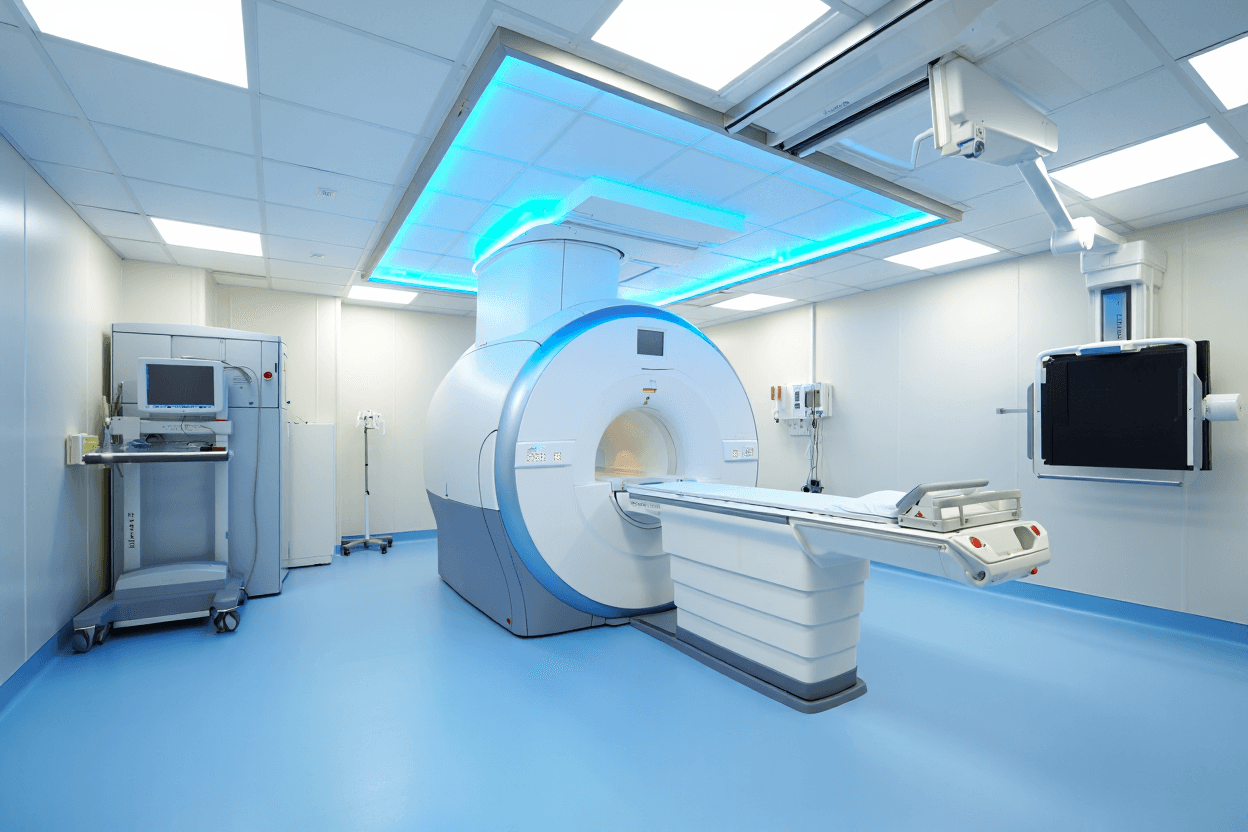
Medical Imaging Systems
Main Principle | Visualization of the body's internal structures using various physical methods | ||||||||
|---|---|---|---|---|---|---|---|---|---|
Core Technologies | X-rays, Magnetic Fields, Sound Waves, Radioactive Substances | ||||||||
Users of Ionizing Radiation | Radiography, Fluoroscopy, Computed Tomography, Nuclear Medicine | ||||||||
Non-Users of Ionizing Radiation | Magnetic Resonance Imaging, Ultrasonography | ||||||||
Application Area(s) | Diagnosis Interventional Procedures Monitoring Treatment Planning | ||||||||
Relevant Medical Specialty | Radiology, Nuclear Medicine | ||||||||
Medical imaging systems are a collection of methods that visualize the internal structures of the human body using various technologies for the purposes of diagnosing, monitoring, or treating diseases. These technologies provide different types of information regarding possible illnesses, injuries, or the effectiveness of applied treatments. The impact of medical imaging in healthcare is increasingly growing, enabling earlier detection of diseases and more effective treatments. These systems are generally categorized into major types such as radiography, computed tomography, magnetic resonance imaging, ultrasound, and nuclear medicine. Each method is based on distinct physical principles and offers specific advantages for particular clinical applications.
Radiography is a medical imaging technique that uses X-rays to obtain static images of the body’s internal structures, particularly bones, and is commonly known as “X-ray.” It was the first imaging technique developed in modern medicine. In this method, X-rays pass through body tissues and reach a radiographic film or digital detector placed on the opposite side. Dense structures such as bones absorb more X-rays and appear white in the image, while less dense soft tissues appear in darker tones. Radiography is widely used to diagnose bone fractures, cracks, lung diseases, and dental problems.
Fluoroscopy is a technique that uses X-rays to observe moving structures or processes within the body in real time. If radiography is likened to taking a photograph, fluoroscopy can be compared to recording a live video. In this method, X-rays passing through the body strike a fluoroscopic screen, which converts the rays into visible light to produce instantaneous images. It is typically performed in conjunction with contrast agents. These agents stain normally invisible structures, allowing for detailed examination. Fluoroscopy is used in fields such as detecting abnormalities in the esophagus, stomach, and intestines; angiographic procedures for visualizing blood vessels; and orthopedic surgeries. Various types of radiography equipment include X-ray machines, angiography systems, C-arm fluoroscopy units, and mobile X-ray devices.
Computed Tomography (CT or CAT scan) is an advanced technique that uses X-rays to generate cross-sectional images of a specific region of the body. The device rotates around the patient, acquiring numerous two-dimensional images, which are then processed by a computer to produce detailed three-dimensional cross-sections. This allows for more precise diagnosis of diseases affecting organs, bones, and soft tissues. Advances in multi-slice CT technology have increased scanning speed and reduced slice thickness. Entire body scans can now be completed within a single breath-hold (approximately 15–20 seconds). During the examination, the patient must remain still while lying on the CT table.
In some cases, contrast agents are used to enhance image quality. For example, in abdominal CT scans, oral contrast solution improves the visualization of the intestines. Intravenously injected contrast agents help assess the condition of blood vessels, the vascularization of masses, and the prominence of certain pathological structures. With this method, moving structures such as the heart and coronary arteries can be examined without the need for conventional angiography, enabling detection of vessel blockages.
Magnetic Resonance Imaging (MRI) is a technique that produces detailed anatomical images of the body using a strong magnetic field and radio waves, without ionizing radiation (such as X-rays). Due to this feature, it is considered one of the safest imaging methods. MRI provides high-resolution images, particularly for the brain, spinal cord, joints, and other soft tissues, clearly distinguishing between healthy and diseased tissues. No pain is felt during the procedure, and there is generally no need for medications that may cause allergic reactions.
Because it does not involve radiation, MRI can be safely used in pregnant women and infants, except during the first trimester of pregnancy unless absolutely necessary. Additionally, with the aid of MRI-compatible anesthesia equipment, imaging can be performed on patients with claustrophobia, young children, or those unable to remain still. Thanks to specialized technologies such as Total Imaging Matrix (TIM), the entire body—from head to toe (approximately 205 cm)—can be scanned in a single session. MRI also enables advanced examinations such as angiographic, spectroscopic, functional, and perfusion-diffusion studies.
Ultrasound is a diagnostic method that uses high-frequency sound waves—inaudible to the human ear—to visualize internal organs in real time. This technique does not involve radiation, making it the preferred choice for pregnant women, infants, and children. The device’s component, called a “transducer,” is moved across the area of the body being examined. Sound waves emitted by the transducer reflect differently off various organs and tissues. These reflected waves are detected again by the transducer and processed by a computer to generate moving images on a screen. Abnormal structures such as tumors or cysts, which reflect sound waves differently from normal tissue, can be easily identified.
Ultrasound examinations are performed by radiologists trained in this field, and diagnoses are made while observing the moving images on the screen. Echocardiography is a specialized type of ultrasound used to evaluate the structural and functional status of the heart. Doppler Ultrasound is used to assess blood flow in vessels, helping detect problems such as blockages or narrowing.
Nuclear Medicine is a medical specialty that images the functional status of organs and tissues using biologically active compounds labeled with radioactive elements (radiopharmaceuticals). Its fundamental difference from other imaging methods is that it provides physiological and metabolic information rather than anatomical detail. The primary imaging devices in this field are SPECT and PET.
A gamma camera is a device that detects gamma rays emitted from radiopharmaceuticals administered to the body. This technology forms the basis of Single Photon Emission Computed Tomography (SPECT) and Positron Emission Tomography (PET) scans. SPECT operates on the principle of rotating one or more gamma cameras around the patient to acquire images from multiple angles, which are then combined to create three-dimensional functional maps. PET images areas of the body where radioactive agents—administered intravenously and metabolically active—accumulate. It is particularly used to detect cancerous tissues, determine their spread, and evaluate response to treatment. PET scanners are frequently combined with Computed Tomography (CT) to form hybrid systems known as PET-CT. These systems integrate the functional information provided by PET with the detailed anatomical information from CT, enabling more precise diagnoses.
Medical imaging systems continue to evolve through ongoing technological innovations. These advancements not only improve diagnostic accuracy but also aim to enhance the experience of healthcare professionals using the equipment. Modern devices optimize the workflow of technicians and physicians by offering easier, more comfortable, and safer operation. For instance, mobile radiography systems (such as the MobiEye 700) feature compact, flexible designs that allow single-handed maneuverability, facilitating bedside use. Ergonomic designs provide adjustable heights to accommodate users of different body sizes, improving comfort. Innovations in user interfaces—including touchscreens, customizable control panels, and voice control features (such as iVocal)—simplify device operation, save time, and reduce the risk of cross-infection. This human-centered design philosophy enables healthcare providers to perform their duties more efficiently and deliver better care to patients.
ASELSAN. "Tıbbi Görüntüleme Sistemleri." Accessed July 7, 2025. https://www.aselsan.com/saglik/tr/cozumler/3/tibbi-goruntuleme-sistemleri.
Anadolu Sağlık Merkezi. "Radyoloji Cihazları." Accessed July 7, 2025. https://www.anadolusaglik.org/medikal-teknoloji/radyoloji-cihazlari.
Boas, F. Edward, and Dominik Fleischmann. “CT Artifacts: Causes and Reduction Techniques.” *Imaging in Medicine* 4, no. 2 (2012): 229–240. https://www.researchgate.net/publication/266013254_CT_artifacts_Causes_and_reduction_techniques.
Bushberg, Jerrold T., J. Anthony Seibert, Edwin M. Leidholdt Jr., and John M. Boone. The Essential Physics of Medical Imaging. 3rd ed. Philadelphia: Lippincott Williams & Wilkins, 2012.
Life of Medical. "Tıbbi Görüntüleme Sistemleri - Life of Medical." Accessed July 7, 2025. https://lifeofmedical.com/tibbi-goruntuleme-sistemleri/.
Prince, Jerry L., and Jonathan M. Links. Medical Imaging Signals and Systems. 2nd ed. Pearson, 2015.
Seeram, Euclid. Computed Tomography: Physical Principles, Clinical Applications, and Quality Control. 4th ed. St. Louis: Elsevier, 2015
Siemens Healthineers Türkiye. "Tıbbi Görüntüleme." Accessed July 7, 2025. https://www.siemens-healthineers.com/tr/medical-imaging.
Webb, Andrew. Introduction to Biomedical Imaging. 2nd ed. Hoboken: Wiley-IEEE Press, 2017.
World Health Organization. Medical Imaging: Radiation Protection in Diagnostic and Interventional Radiology. Geneva: World Health Organization, 2022.

Medical Imaging Systems
Main Principle | Visualization of the body's internal structures using various physical methods | ||||||||
|---|---|---|---|---|---|---|---|---|---|
Core Technologies | X-rays, Magnetic Fields, Sound Waves, Radioactive Substances | ||||||||
Users of Ionizing Radiation | Radiography, Fluoroscopy, Computed Tomography, Nuclear Medicine | ||||||||
Non-Users of Ionizing Radiation | Magnetic Resonance Imaging, Ultrasonography | ||||||||
Application Area(s) | Diagnosis Interventional Procedures Monitoring Treatment Planning | ||||||||
Relevant Medical Specialty | Radiology, Nuclear Medicine | ||||||||
No Discussion Added Yet
Start discussion for "Medical Imaging Systems" article
Radiography and Fluoroscopy
Computed Tomography (CT)
Magnetic Resonance Imaging (MRI)
Ultrasound (US)
Nuclear Medicine Imaging
Technological Advancements and User Experience