

This article was automatically translated from the original Turkish version.
Type of Geographical İndication | Mahreç Sign | ||||||||
|---|---|---|---|---|---|---|---|---|---|
Registration Number | 928 | ||||||||
Registration Date | 19.10.2021 | ||||||||
Product / Product Group(s) | Meals and soups | ||||||||
Province(s) | Gaziantep | ||||||||
Applicant/Registrant(s) | Gaziantep Development Foundation | ||||||||
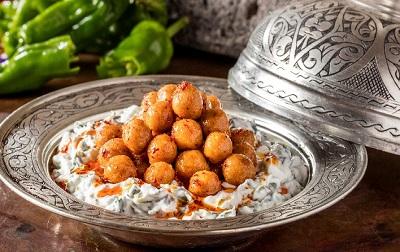
Gaziantep Arap köftesi is a traditional dish specific to Gaziantep cuisine, prepared by kneading fine bulgur and lean minced meat into walnut-sized balls, boiling them, and then frying them in pure oil. Protected under Industrial Property Law No. 6769 as a certified geographical indication, this product was registered on 19 October 2021 and is defined as producible only within the boundaries of Gaziantep province. The registration application was submitted by the Gaziantep Development Foundation, and the product’s reputation is directly linked to its local production technique.
Gaziantep Arap köftesi consists of walnut-sized meatballs made from fine bulgur (simit), lean beef or lamb mince, spices, and onion. The meatballs are first boiled in water and then fried in pure oil. Optionally, garlic yogurt, chopped parsley, or tomato paste may be added on top. When served with a garlic yogurt dip made from parsley, purslane, or Swiss chard, the dish is known as “Cacıklı Gaziantep Arap Köftesi”.
The distinctive feature of this dish lies in its unique Gaziantep cooking method. Boiling the meatballs in water before frying them in pure oil produces a characteristic texture and flavor. This technique has a deep-rooted history in Gaziantep cuisine and is documented in various cookbooks and scholarly publications.
The main ingredients used in preparing Gaziantep Arap köftesi are lean lamb or beef mince, fine bulgur (simit) suitable for meatballs, onion, salt, black pepper, red pepper, and pure oil for frying. Optionally, garlic, parsley, or tomato or pepper paste may be added. For the cacıklı version, greens such as parsley, purslane, or beet leaves are combined with garlic and strained yogurt.
The preparation begins by kneading the bulgur with spices and grated onion. Warm water is gradually added until the bulgur softens. The minced meat is then incorporated, and kneading continues until a cohesive, non-crumbly dough is formed. From this dough, walnut-sized meatballs are shaped.
The shaped meatballs are boiled in salted water over heat. Once boiling is complete, they are drained using a colander. They are then fried in pure oil, turning them until evenly cooked. This step imparts a distinctive crispness to the outer surface and a balanced softness to the interior texture.
During serving, garlic yogurt, chopped parsley, or tomato paste may be added optionally. If preparing the cacıklı version, the cacık—made by mixing chopped greens, garlic, and strained yogurt—is served alongside the meatballs. This presentation adds both a refreshing flavor and visual variety to the dish.
Due to the specialized local techniques required, the production of Gaziantep Arap köftesi can only be carried out within the boundaries of Gaziantep province. This geographical link is mandatory to preserve the product’s uniqueness and cultural value.
The production and use of the geographical indication are monitored by a supervisory body composed of representatives from the Gaziantep Provincial Directorate of Agriculture and Forestry, Gaziantep Metropolitan Municipality, and the Gaziantep Chamber of Tradesmen and Craftsmen, under the coordination of the Gaziantep Development Foundation. Inspections are conducted at least once annually and may also be carried out in response to complaints or suspicions. Expert support may be obtained from public and private institutions during the inspection process.
Turk Patent and Trademark Office. "Gaziantep Arap Köftesi / Antep Arap Köftesi." Geographical Indications Portal. Accessed October 20, 2025. https://ci.turkpatent.gov.tr/cografi-isaretler/detay/2162.
Turkish Patent and Trademark Office. "Coğrafi İşaret Sicil Belgesi No: 928: Gaziantep Arap Köftesi / Antep Arap Köftesi." Accessed October 20, 2025. https://ci.turkpatent.gov.tr/Files/GeographicalSigns/a6944bb1-6621-4ab2-b42a-9ae30618a355.pdf.

Type of Geographical İndication | Mahreç Sign | ||||||||
|---|---|---|---|---|---|---|---|---|---|
Registration Number | 928 | ||||||||
Registration Date | 19.10.2021 | ||||||||
Product / Product Group(s) | Meals and soups | ||||||||
Province(s) | Gaziantep | ||||||||
Applicant/Registrant(s) | Gaziantep Development Foundation | ||||||||
No Discussion Added Yet
Start discussion for "Gaziantep Arab Meatball" article
Definition and Distinctive Characteristics
Preparation Method
Geographical Boundary and Production Conditions
Monitoring Mechanism