
This article was automatically translated from the original Turkish version.
Type of Geographical İndication | Traffic Sign | ||||||||
|---|---|---|---|---|---|---|---|---|---|
Registration Number | 791 | ||||||||
Registration Date | 01.07.2021 | ||||||||
Product / Product Group(s) | Meals and soups | ||||||||
Province(s) | Gaziantep | ||||||||
Applicant/Registrant(s) | Gaziantep Development Foundation | ||||||||
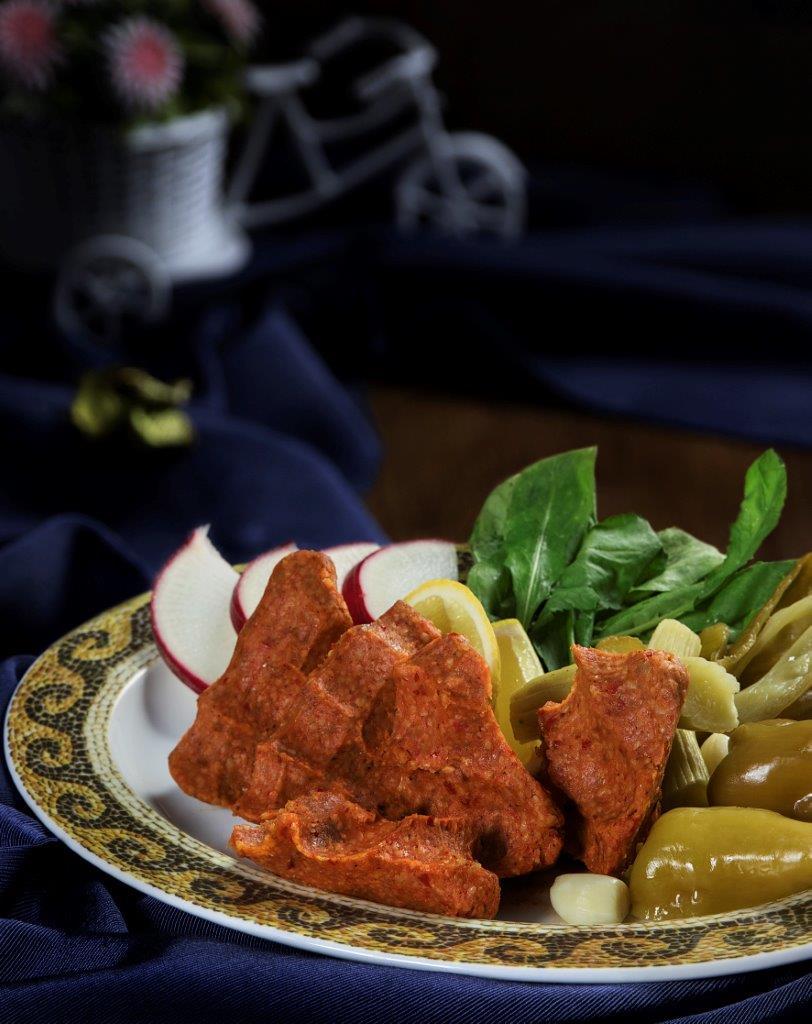
Gaziantep yağlı köfte is a meatless raw meatball variety unique to Gaziantep cuisine, protected under industrial property rights as a certified trademark pursuant to Law No. 6769. This product, registered on 1 July 2021, is a traditional delicacy that must be produced within the boundaries of Gaziantep province.
Gaziantep yağlı köfte is prepared by kneading fine bulgur (simit), pure oil or butter, red pepper flakes, red pepper paste, and various auxiliary ingredients. The most distinctive feature of this meatball variety is the addition of melted oil to the mixture after the kneading process is complete. This step is carried out using a technique requiring skill and determines the product’s characteristic texture.
Simit, an essential component of the dish, holds a prominent place in Gaziantep cuisine. The product is frequently prepared and consumed during local picnics known as “sahre,” on special occasions, and at gatherings. This meatball, intrinsically linked to its geographical origin, reflects the cultural and gastronomic identity of Gaziantep.
The primary ingredient in the production of Gaziantep yağlı köfte is fine bulgur (simit). During preparation, the simit is placed in a kneading tray together with pepper and tomato paste, red pepper flakes, finely chopped dried onion, and garlic. Peeled and finely chopped tomatoes are gradually added to this mixture and kneaded for approximately 25–30 minutes. During off-season periods when fresh tomatoes are unavailable, the simit is lightly moistened with hot water to soften it.
Once kneading is complete, melted pure oil or butter is added to the mixture and further kneaded for 4–5 minutes to achieve the desired consistency. This stage is a critical and skill-dependent step that defines the product’s distinguishing quality. The meatball is shaped by pressing it firmly with the fingers to leave a fingerprint impression and then placed on plates.
Finely chopped parsley may optionally be added beneath, on top of, or inside the meatball during serving. To enhance shine, a small amount of warmed olive oil may be drizzled over the mixture before pressing. This production process, combining ingredient compatibility with traditional techniques, yields one of the signature flavors of Gaziantep cuisine.
The production of Gaziantep yağlı köfte must take place within the boundaries of Gaziantep province. The product’s history is rooted in the region, and its preparation requires local craftsmanship and technical expertise. Consequently, its reputation and uniqueness are directly tied to its geographical origin.
The monitoring of Gaziantep yağlı köfte is carried out by a five-member board coordinated by the Gaziantep Development Foundation. This board includes expert representatives from the Gaziantep Provincial Directorate of Agriculture and Forestry, Gaziantep Metropolitan Municipality, Gaziantep Chamber of Tradesmen and Craftsmen, and the Gastronomy Department of Gaziantep University. Inspections are conducted at least once annually; additional inspections may be carried out at any time in response to complaints or as needed.
During the inspection process, the suitability of ingredients is first assessed to ensure compliance with the traditional recipe. Adherence to the established production method is then examined, including observation of key technical steps such as kneading, oil addition, and shaping. The final product is evaluated for conformance to established standards, with particular attention paid to its consistency, shape, and presentation. Finally, the correct use of the trademark emblem bearing the designation “Gaziantep Yağlı Köfte / Antep Yağlı Köfte” on the product or its packaging is verified.
The monitoring authority may, when necessary, obtain expert support from public or private institutions or procure services. The registering body holds the legal authority to pursue protective measures for the product.
Turkish Patent and Trademark Office. "Gaziantep Yağlı Köfte / Antep Yağlı Köfte Mahreç İşareti Tescil Belgesi." Turkish Patent and Trademark Office. Accessed October 19, 2025. https://ci.turkpatent.gov.tr/Files/GeographicalSigns/3ad359a5-9690-4e8e-86a8-5a188474683b.pdf.
Turkish Patent and Trademark Office. "Gaziantep Yağlı Köfte / Antep Yağlı Köfte." Geographical Indications Portal. Turkish Patent and Trademark Office. Accessed October 19, 2025. https://ci.turkpatent.gov.tr/cografi-isaretler/detay/2265.

Type of Geographical İndication | Traffic Sign | ||||||||
|---|---|---|---|---|---|---|---|---|---|
Registration Number | 791 | ||||||||
Registration Date | 01.07.2021 | ||||||||
Product / Product Group(s) | Meals and soups | ||||||||
Province(s) | Gaziantep | ||||||||
Applicant/Registrant(s) | Gaziantep Development Foundation | ||||||||
No Discussion Added Yet
Start discussion for "Gaziantep Meatballs in Oil" article
Definition and Distinguishing Characteristics
Production Method
Geographical Boundary and Production Conditions
Monitoring Mechanism