


This article was automatically translated from the original Turkish version.
+1 More
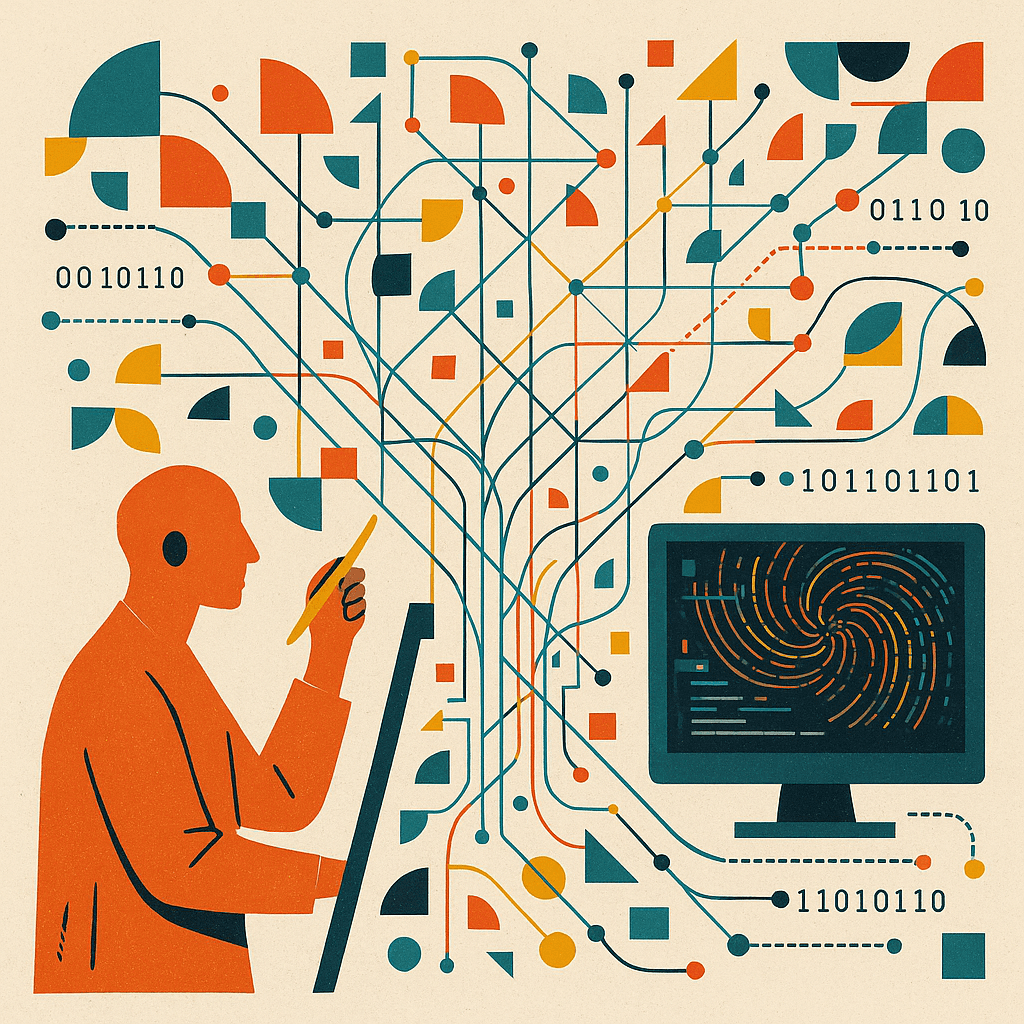
Generative Art
Fundamental Components | Algorithms, rule-based systems, randomness | ||||||||
|---|---|---|---|---|---|---|---|---|---|
Technologies Used | Artificial intelligence, machine learning, programming languages | ||||||||
Programming Languages | Processing, p5.js, Python, JavaScript | ||||||||
Related Field(s) | Digital art mathematics computer science new media art | ||||||||
Generative art is an artistic approach that encompasses autonomous or semi-autonomous production methods in which creation is directed not by the artist but by a specific system or algorithm. This mode of production generates works that are reproducible yet yield different outcomes in each instance, through predefined rules, parametric configurations, or random mechanisms. The term “generative” is etymologically derived from the Latin verb *generare*, meaning “to produce,” and is associated in art with concepts such as artificial production, replication, and generation of forms.
Generative art requires the design of a system that operates independently of direct human intervention. In this sense, it is not merely a tool or technique but is regarded as a structural approach that transforms the relationship between the artist, the artwork, and the process of production.
The development of generative art is linked to the reflection of industrial automation ideas into art following the Industrial Revolution. However, the emergence of generative art in its modern sense accelerated with the advent of computer-assisted art production in the 1960s. During this period, artists such as Georg Nees, Frieder Nake, Harold Cohen, and Vera Molnar created early generative works using algorithmic systems. Cohen’s software AARON is recognized as one of the first artificial intelligence systems capable of generating visual artworks without human intervention.

Generative Art Image (Unsplash)
Historically, generative art is also connected to techniques and theories used in various periods of art history, such as chance, automatism, and repetition. Dadaist collages based on chance, Surrealist automatic writing techniques, and John Cage’s compositions grounded in randomness are regarded as historical precursors to the generative approach.
Theoretically, generative art challenges the traditional notion of the artwork as a fixed, singular, and complete object; instead, it embraces an aesthetic framework centered on process, becoming, and systems. Within this framework, a generative artwork possesses a form that is continuously evolving, multiplying, and reconfiguring, both technically and conceptually.
Generative art incorporates diverse methods including artificial intelligence, randomness, genetic algorithms, fractal systems, data-driven software, and parametric design. These systems are typically designed using computer programming languages such as Processing, Python, Max/MSP, and JavaScript, enabling the generation of algorithmic patterns, animated visuals, interactive installations, or sound compositions.
In artificial intelligence-supported systems, the production process relies not only on algorithms but also on decisions made by models trained on machine learning and data sets. Techniques such as GANs (Generative Adversarial Networks) integrate learning processes into algorithmic production, enabling the creation of more sophisticated and stylized artworks.
Data visualization is another significant application area. Generative systems are integrated with real-time data—such as weather conditions, social media interactions, or user movements—to produce works that respond to or transform data into artistic forms.
The aesthetic structure of generative art does not correspond to the traditional concept of a finished, singular, and original artwork. The artwork has a reproducible, variable, and dynamic nature. The artist’s role is less that of a direct producer and more that of a designer of the structural system within which production occurs.

Generative Art Image (Unpash)
In this context, the uniqueness of the artwork is defined not by the artist’s individual skill but by the depth of the system’s design and the power of its algorithmic structure. Some aesthetic decisions are encoded within the system, while others are determined by random or data-dependent variables during the production process.
This relationship reopens classical debates about the artist’s creative agency, necessitating a shared responsibility for production and a collective or systemic understanding of creativity.
Generative art is applied across a wide range of fields beyond visual arts, including architecture, music, graphic design, cinema, media arts, data science, and sociotechnological systems. In architecture, parametric design approaches are used to create structures that reshape themselves in response to environmental data. In graphic design, visual systems are developed that produce different forms with each print or digital presentation.
In music, algorithmic composition is one of the earliest applications of generative systems. By integrating chance and rule-based variations into the compositional process, musical structures can be generated without human intervention. In new media art, works that change in response to viewer interaction exemplify the interactive nature of generative art.
Al, Burçin. “Generatif Sanat Kavramı ve Görsel Sanatlarda Sayısal Yaratıcılık.” *Tasarım Enformatik* 1, no. 2 (2020): 78–90. Accessed July 25, 2025. https://dergipark.org.tr/en/download/article-file/964617.
Al, Burçin. “Generatif Sanat Kavramı ve Görsel Sanatlarda Sayısal Yaratıcılık.” *Tasarım Enformatiği* 2, no. 1 (March 2020): 78–91. Accessed July 25, 2025. .
Erişti, Suzan Duygu Bedir. “Dijital Görsel Kültüre Dayalı Yaratıcı Pedagojik Yaklaşımlar.” *ERKİN Uluslararası Sanat ve Tasarım Araştırmaları Dergisi* 1, no. 1 (November 2023): 49–60. Accessed July 25, 2025. https://dergipark.org.tr/tr/download/article-file/3515877.
Koparan, Yasemin, Mitat Kandemir, and Tekin Bayra, eds. *Sosyal Bilimler Araştırmaları 4*. Antalya: Akademik Platform Yayınları, 2024. pp. 49–84. Date Published December 13, 2024. Accessed July 25, 2025. https://d1wqtxts1xzle7.cloudfront.net/120852692/Antalya_sadece_ben_sosyal_bilimler_arastirmalari_4_kitabi_1_-libre.pdf.
Rodriguez-Sanchez, Alejandro E. “Siyah Beyaz Kare Şekilli Nesnenin Fotoğrafı.” Unsplash. Accessed July 25, 2025. https://unsplash.com/photos/a-black-and-white-photo-of-a-square-shaped-object-fARzF9gM4vQ.
TRİ. "Mavi ve Kahverengi Yuvarlak Tavan." Unsplash. Accessed July 25, 2025. https://unsplash.com/photos/blue-and-brown-round-ceiling-gtxZzDYOzcQ.

Generative Art
Fundamental Components | Algorithms, rule-based systems, randomness | ||||||||
|---|---|---|---|---|---|---|---|---|---|
Technologies Used | Artificial intelligence, machine learning, programming languages | ||||||||
Programming Languages | Processing, p5.js, Python, JavaScript | ||||||||
Related Field(s) | Digital art mathematics computer science new media art | ||||||||
Historical Development and Theoretical Foundations
Methods and Technical Applications
Aesthetic Structure and the Artist-Algorithm Relationship
Interdisciplinary Applications