


This article was automatically translated from the original Turkish version.
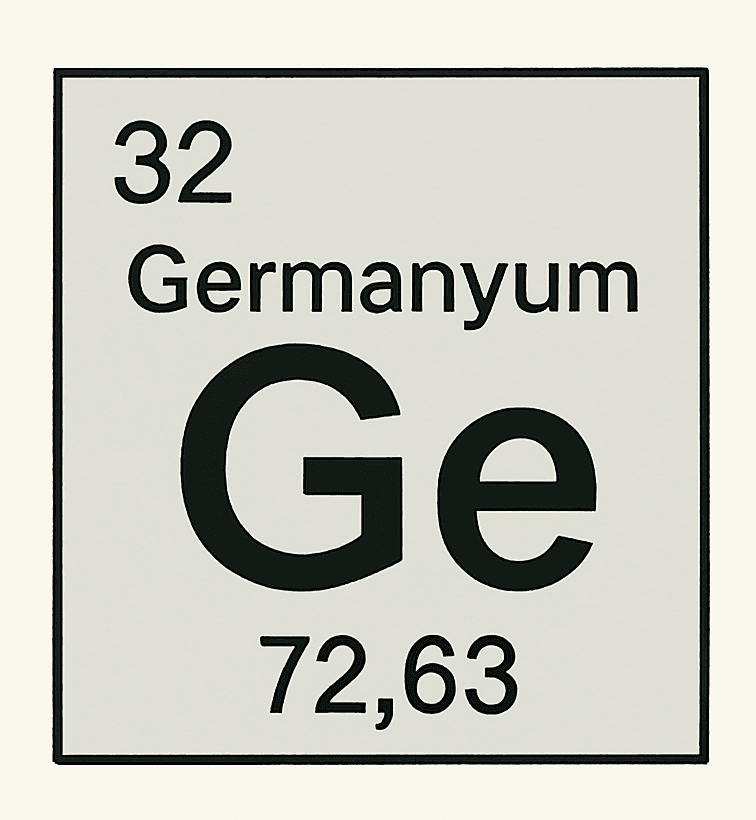
Germanium (Ge) (Generated by Artificial Intelligence.)
Atomic Mass | 72.63 g/mol | ||||||||
|---|---|---|---|---|---|---|---|---|---|
Group / Period | 14 / 4 | ||||||||
Melting Point | 938.25 °C | ||||||||
Boiling Point | 2833 °C | ||||||||
Density | 5.323 g/cm³ | ||||||||
Electronegativity (Pauling) | 2.01 | ||||||||
Electron Configuration | [Ar] 3d¹⁰ 4s² 4p² | ||||||||
Area(s) of Use | Semiconductors Optoelectronics Fiber Optic | ||||||||
Germanium (Ge) is a metalloid located in group 14 of the periodic table with an atomic number of 32. This element has a bright gray appearance and has gained significant importance in electronic and optoelectronic technologies due to its semiconductor properties. Germanium exhibits chemical similarities to silicon and tin and is one of the rare elements found in nature, typically occurring in trace amounts within sulfide minerals.
Germanium was discovered in 1886 by the German chemist Clemens Winkler during the analysis of the mineral argyrodite (Ag₈GeS₆) found in Freiberg. This discovery confirmed the existence of the element previously predicted by Dmitri Mendeleev as “eka-silicon.” Winkler named the new element “germanium” after the Latin name for Germany, “Germania.”
Germanium belongs to the metalloid class and exhibits both metallic and nonmetallic properties. It is located in the fourth period and group 14 of the periodic table. Its electron configuration is [Ar] 3d¹⁰ 4s² 4p². At room temperature, germanium is a solid with a diamond cubic crystal structure. Its atomic mass is approximately 72.63 g/mol and its density is 5.323 g/cm³.
Germanium is a brittle solid with a shiny surface. Its melting point is 938.25 °C and its boiling point is 2833 °C. Although its electrical conductivity is low, it exhibits semiconductor behavior under specific conditions. Germanium dioxide (GeO₂) has a high refractive index and is used in optical devices. Compounds such as germanium tetrachloride (GeCl₄) play a role in purification processes.
The electronegativity of germanium on the Pauling scale is 2.01, indicating it is a moderately electronegative element. It reacts with oxygen at high temperatures to form germanium dioxide. Its electron affinity is 118.9 kJ/mol and its first ionization energy is 762.2 kJ/mol. Germanium dissolves in strong acids such as hydrofluoric acid but is more resistant to dilute acids.
Germanium has five naturally occurring stable isotopes: Ge-70, Ge-72, Ge-73, Ge-74 and Ge-76. Among these, Ge-74 is the most abundant. Germanium isotopes have various applications in nuclear physics and semiconductor technology. Radioactive isotopes are produced in laboratory settings and used in limited research areas.
Germanium is typically found in trace amounts within sulfide minerals. It is often detected as an impurity in zinc ores such as sphalerite (ZnS). Commercially, germanium is obtained through the processing of such minerals. Compounds such as germanium dioxide (GeO₂) and germanium tetrachloride (GeCl₄) are used in purification and semiconductor production processes. Additionally, organic compounds such as diphenylgermanium chalcogenides have been synthesized.
Germanium has no essential biological role in living organisms. However, certain organic germanium compounds, such as Ge-132, have been studied in alternative medicine for their effects on the immune system. Although germanium’s toxic effects are limited, some of its compounds have been found to exhibit antibacterial properties. In particular, nano-sized germanium coatings have proven effective against bacteria such as Staphylococcus aureus and Escherichia coli.
Due to its semiconductor properties, germanium is used in the production of transistors, diodes and infrared optical devices. Germanium-doped glass is preferred in fiber optic systems to optimize light transmission. Germanium dioxide, owing to its high refractive index, is used in wide-angle camera lenses and microscope objectives. Germanium compounds are also employed in night vision systems, spectrometric instruments and solar panels.

Applications of the Germanium Element (generated by artificial intelligence.)
Germanium is also a notable element in nanotechnology applications. Nano-scale germanium coatings have been applied to flexible substrates such as polyethylene terephthalate (PET) to produce antibacterial surfaces. Such coatings can inhibit microbial adhesion by reducing surface roughness. The crystalline orientation and purity of germanium have been confirmed through XRD and EDX analyses.
Germanium-doped tungsten oxide (WOₓ) films have been used to create light-sensitive structures. These structures are evaluated for use in electronic components such as photodiodes. Germanium’s high atomic number increases the probability of gamma ray interactions, making it preferred in spectroscopic applications.
Filella, Montserrat, and Juan Carlos Rodríguez-Murillo. “Germanium in the Environment: Current Knowledge and Identification of Gaps.” *Soil & Environmental Health* 3, no. 2 (2025): 100132. Accessed August 16, 2025. https://www.sciencedirect.com/science/article/pii/S2949919425000056
National Center for Biotechnology Information. "Germanium." *PubChem*. Accessed August 16, 2025. https://pubchem.ncbi.nlm.nih.gov/compound/germanium
Pat, Zerrin. “ORGANİK ALT TAŞLAR ÜZERİNE DEPOLANMIŞ GERMANYUM NANO TABAKASININ YÜZEY VE ANTİBAKTERİYEL ÖZELLİKLERİNİN İNCELENMESİ”. *Uludağ Üniversitesi Mühendislik Fakültesi Dergisi* 21, no. 2 (2016): 73–84. Accessed August 16, 2025. https://dergipark.org.tr/tr/pub/uumfd/article/270048
TÜBİTAK Bilim Genç. "Germanyum." Bilim Genç. Accessed August 16, 2025. https://bilimgenc.tubitak.gov.tr/periyodik-tablo/germanyum

Germanium (Ge) (Generated by Artificial Intelligence.)
Atomic Mass | 72.63 g/mol | ||||||||
|---|---|---|---|---|---|---|---|---|---|
Group / Period | 14 / 4 | ||||||||
Melting Point | 938.25 °C | ||||||||
Boiling Point | 2833 °C | ||||||||
Density | 5.323 g/cm³ | ||||||||
Electronegativity (Pauling) | 2.01 | ||||||||
Electron Configuration | [Ar] 3d¹⁰ 4s² 4p² | ||||||||
Area(s) of Use | Semiconductors Optoelectronics Fiber Optic | ||||||||
Discovery
Classification and Fundamental Properties
Physical and Chemical Properties
Electronegativity and Reactivity
Isotopes
Natural Occurrence and Compounds
Biological Role and Importance to Living Organisms
Applications
Germanium in Nanotechnology
Photoelectric Properties of Germanium