


This article was automatically translated from the original Turkish version.
Dev Kalamar
Type(s) | Architeuthis dux | ||||||||
|---|---|---|---|---|---|---|---|---|---|
Class | Cephalopoda | ||||||||
Average Length | 10-13 metres (including arms) | ||||||||
Habitat | Deep ocean waters (200-1000 m) | ||||||||
Diet(s) | Fish other molluscs | ||||||||
Reproduction(s) | Spawning larval development | ||||||||
Ecological Role | Apex predator in deep sea ecosystems | ||||||||
Giant Squid (Architeuthis dux) is a marine mollusk that inhabits deep oceans and is among the largest squid species in the world. Often conflated with legends and mythological narratives this species has been increasingly illuminated by scientific research with its biological characteristics ecology and genetic structure examined in detail. The giant squid is regarded as an important species for understanding biological diversity and marine ecosystems.

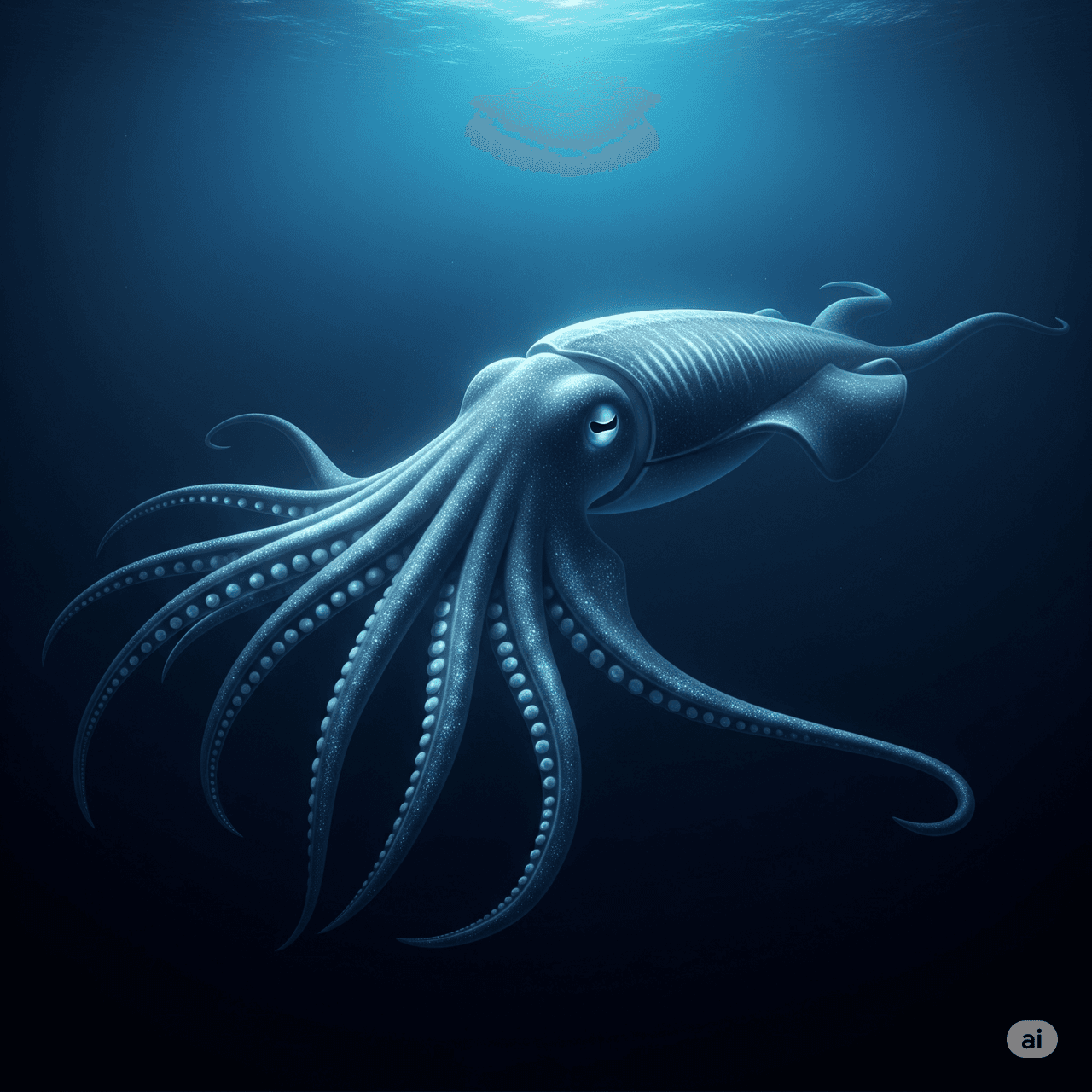
Giant Squid (Generated by Artificial Intelligence.)
Architeuthis dux holds a unique position among marine animals in terms of size. Although its size varies among individuals it can reach lengths exceeding 10 to 13 meters when measured including its arms. Its body structure follows the typical squid form: a soft flexible mantle eight short arms and two long feeding arms. These elongated arms are functional for capturing and holding prey. The body is highly elastic and muscular a feature suited for rapid movement and efficient predation.
Recent genomic sequencing efforts have produced a comprehensive map of the genetic structure of Architeuthis dux. This research provides significant insights into the species evolutionary history adaptations and survival strategies in deep marine environments. Genomic analyses shed light on the complex biological processes of the species and open doors to potential biotechnological applications.
The giant squid inhabits particularly deep and cold ocean waters. It has a wide distribution ranging from around the Iberian Peninsula to the Indian Ocean. In these depths it is typically found between 200 and 1000 meters where it has adapted to life away from sunlight. Due to the depth and inaccessibility of its habitat direct observations are limited but knowledge has increased through recordings made by marine biologists using various tools and through the examination of stranded dead specimens.
Architeuthis dux is a carnivorous species that primarily feeds on various fish and other marine mollusks. Isotopic analyses of its feeding strategies and diet composition demonstrate that it occupies a top predator position in the ecosystem. As a critical link in the food chain the giant squid serves as an essential intermediary in energy flow within deep-sea ecosystems.
Analyses of metal and metalloid concentrations in the tissues of this species indicate that Architeuthis dux is an important model for studying the biological impacts of chemical pollution in marine environments. Studies conducted in Iberian waters have revealed the presence of elements such as lead cadmium and arsenic in its body tissues. These data help in understanding the effects of heavy metal pollution on biological organisms in marine ecosystems.
Information about the life cycle and reproductive behavior of the giant squid remains limited but existing findings suggest that its egg-laying and developmental processes are adapted to deep-sea conditions. Eggs are typically laid in large clusters and larvae begin developing in surface waters. Research into the lifespan and growth rate of adult individuals is ongoing.
Examination of dead Architeuthis dux specimens provides valuable data on the species biological traits and its interactions with environmental conditions. Dead giant squids sink to the seafloor and serve as important nutrient sources for deep-sea ecosystems. This process is critically important for maintaining the continuity of energy cycles in deep-sea environments.
Observing the giant squid in its natural habitat is extremely difficult due to the extreme depths at which it lives. However increasing knowledge about the species has been gained through advances in submersible technology and the efforts of marine biologists. Methods such as examination of dead specimens collection of genetic samples and stable isotope analyses have provided comprehensive data on the biology and ecology of the species.
Bustamante, P., González, A., Rocha, F., Miramand, P., and Guerra, A. "Metal And Metalloid Concentrations In The Giant Squid Architeuthis Dux From Iberian Waters." Marine Environmental Research, 66 (2) (2008): 278–287. https://doi.org/10.1016/j.marenvres.2008.04.003
Cherel, Y. "New Records Of The Giant Squid Architeuthis Dux In The Southern Indian Ocean." Journal of the Marine Biological Association of the United Kingdom, 83(6), (2003): 1295–1296. https://doi.org/10.1017/s0025315403008695
Da Fonseca, R. R., Couto, A., Machado, A. M., Brejova, B., Albertin, C. B., Silva, F., Gardner, P., Baril, T., Hayward, A., Campos, A., Ribeiro, Â. M., Barrio-Hernandez, I., Hoving, H., Tafur-Jimenez, R., Chu, C., Frazão, B., Petersen, B., Peñaloza, F., Musacchia, F., . . . Gilbert, M. T. P. "A Draft Genome Sequence Of The Elusive Giant Squid, Architeuthis Dux." *GigaScience*, 9 (1) (2020): 1-12. https://doi.org/10.1093/gigascience/giz152
Guerra, Á., Rodríguez-Navarro, A. B., González, Á. F., Romanek, C. S., Álvarez-Lloret, P., and Pierce, G. J. "Life-History Traits Of The Giant Squid Architeuthis Dux Revealed From Stable Isotope Signatures Recorded In Beaks." *ICES Journal of Marine Science*, 67, no. 7 (2010): 1425–1431. https://doi.org/10.1093/icesjms/fsq091
Leite, L., Campbell, D., Versiani, L., Nunes, J. a. C. C., and Thiele, T. "First Report Of A Dead Giant Squid (Architeuthis Dux) From An Operating Seismic Vessel." *Marine Biodiversity Records*, 9 (1). (2016). https://doi.org/10.1186/s41200-016-0028-3
Regueira, M., Belcari, P., and Guerra, A. "What Does The Giant Squid Architeuthis Dux Eat?" *Hydrobiologia*, 725(1) (2013): 49–55. https://doi.org/10.1007/s10750-013-1662-y

Dev Kalamar
Type(s) | Architeuthis dux | ||||||||
|---|---|---|---|---|---|---|---|---|---|
Class | Cephalopoda | ||||||||
Average Length | 10-13 metres (including arms) | ||||||||
Habitat | Deep ocean waters (200-1000 m) | ||||||||
Diet(s) | Fish other molluscs | ||||||||
Reproduction(s) | Spawning larval development | ||||||||
Ecological Role | Apex predator in deep sea ecosystems | ||||||||
No Discussion Added Yet
Start discussion for "Giant Squid (Architeuthis dux)" article
Morphology and Physical Characteristics
Genetic and Molecular Studies
Habitat and Distribution
Diet and Ecological Role
Metal and Metalloid Accumulation
Life Cycle and Reproduction
Death and Impact on Natural Resources
Observations and Research Techniques