

This article was automatically translated from the original Turkish version.
+2 More
Location | Türkiye Mersin Aydıncık | ||||||||
|---|---|---|---|---|---|---|---|---|---|
Length(s) | 555m | ||||||||
Thickness | 115m | ||||||||
Sections | Damlataş Hall Lake Hall Entrance | ||||||||
Status | Nature Monument | ||||||||
Year Opened to Visitors | 2014 | ||||||||
Aynalıgöl Cave is a significant natural formation located 7.5 kilometers east-southeast of the Aydıncık district in Mersin Province, between Sancak Cape and Kurtini Stream. Access to the cave is possible both from the sea and from land. Although the cave is commonly known among locals as Aynalıgöl due to its large internal lake, it is also referred to as Gilindire Cave because of its proximity to the ancient city of Gilindire (Kelenderis).

Aynalıgöl-Gilindere Cave
The cave is situated within the southern part of the Central Taurus Karst Belt, in a subsidence or marine submergence zone. It developed within Cambrian-aged limestones and dolomitic limestones approximately 600 million years old, forming along faults with varying orientations. Gilindire Cave is a multi-phase and multi-origin cave, notable for being the largest cave in the region with features that characterize the sea level changes during the geological evolution of the Mediterranean.
The total length of the cave is 555 meters with a thickness of 115 meters, of which 45 meters lie below sea level. The cave consists of three interconnected but chronologically distinct sections: an active lake chamber, a fossilized entrance, and a dripstone chamber. The oldest formation is the dripstone chamber.
The lake chamber, formed along a prominent fault, is the youngest and most active part of the cave, resulting from sea level drops of up to 90 meters during the Last Glacial Period. The cave entrance is located 46 meters above current sea level.
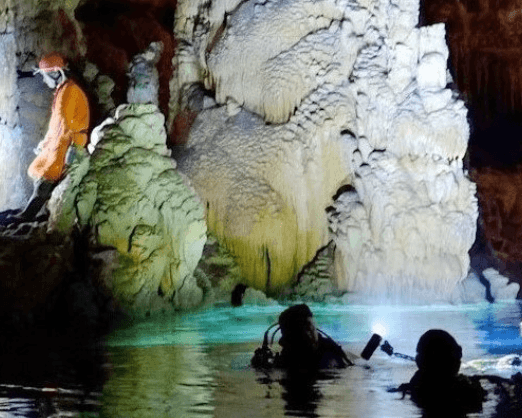
The main gallery of the cave reaches widths of up to 100 meters and ceiling heights of 18 meters. Nearly every surface within the main gallery is covered with various dripstone formations including stalactites, stalagmites, columns, walls, and curtains. The deepest point of the lake at the cave’s end lies at 47 meters below sea level.

Aynalıgöl-Gilindere Cave (AA)
Aynalıgöl Cave is regarded as the sole record site preserving evidence of the most recent climate change. Structures located below sea level have been determined to have formed prior to global climate change (the Ice Age) and to contain all hydrological and atmospheric data related to that period. This unique characteristic has led earth scientists to classify it as a natural laboratory. The cave has a warm and humid atmosphere. Due to its narrow and low entrance, air exchange with the outside is limited, resulting in minimal variation in internal climate conditions between summer and winter.
Although no prominent biological community has been identified within the cave, bats inhabit certain sections of the main gallery. Additionally, cave spiders and millipedes have been observed in various parts of the cave. The bays surrounding the cave serve as a habitat for the Mediterranean Monk Seal, and this area is designated as a first-degree natural protected site.

Aynalıgöl-Gilindere Cave (AA)
It is commonly rumored that Aynalıgöl Cave was accidentally discovered by a shepherd, although this account is not confirmed. According to the story, the shepherd followed a hedgehog into a rock crevice where the animal had disappeared and thus discovered the cave.
After its discovery, the cave was officially registered in 2013 under the National Parks Law as the "Gilindire Cave Natural Monument" and placed under protection by the Ministry of Forest and Water Affairs. Opened to visitors in 2014, the cave has become an important natural attraction due to its tourism potential. Ceramic artifacts dating to the Late Neolithic period, which suggest the cave was used as a freshwater source in antiquity, further indicate human interaction with the site in ancient times.
Anadolu Ajansı. "Buzul döneminden izler taşıyan Gilindire Mağarası yenilenen cephesiyle sezona hazır." Accessed June 21, 2025. https://www.aa.com.tr/tr/pg/foto-galeri/buzul-doneminden-izler-tasiyan-gilindire-magarasi-yenilenen-cehresiyle-sezona-hazir/146
Anadolu Ajansı. *Buzul dönemine Gilindire Mağarası ile yolculuk*. Accessed June 21, 2025. https://www.aa.com.tr/tr/yasam/buzul-donemine-gilindire-magarasi-ile-yolculuk/1118084
Aydıncık Belediyesi. *Aydıncık Aynalıgöl*. Accessed June 21, 2025. http://www.aydincik.gov.tr/aydincik-aynaligol
Mersin İl Kültür ve Turizm Müdürlüğü. "Mağaralar." Accessed June 21, 2025. https://mersin.ktb.gov.tr/TR-73460/magaralar.html
Türkiye Turizm Ansiklopedisi. "Aynalıgöl Mağarası Gilindere." Accessed June 21, 2025. https://turkiyeturizmansiklopedisi.com/aynaligol-magarasi-gilindere

Location | Türkiye Mersin Aydıncık | ||||||||
|---|---|---|---|---|---|---|---|---|---|
Length(s) | 555m | ||||||||
Thickness | 115m | ||||||||
Sections | Damlataş Hall Lake Hall Entrance | ||||||||
Status | Nature Monument | ||||||||
Year Opened to Visitors | 2014 | ||||||||
No Discussion Added Yet
Start discussion for "Gilindere (Aynalıgöl) Cave" article
Geological Structure and Formation
Climate and Hydrological Features
Biological Diversity
Discovery and Opening for Tourism