

This article was automatically translated from the original Turkish version.
Name(s) | Golden Fleece Order Ordre de la Toison d'Or | ||||||||
|---|---|---|---|---|---|---|---|---|---|
Type(s) | Chivalric order Political order | ||||||||
Founder(s) | Philip the Good | ||||||||
Founding Date | 10 January 1429/1430 | ||||||||
Membership Size (Early Period) | 24 | ||||||||
Membership Criteria | Loyalty to oaths and statutes Good reputation Nobility | ||||||||
Governance | Rey de Armas (Herald) Treasurer Greffier (Scribe) Chancellor (Seal Keeper) Grand Master | ||||||||
Symbols | Suspended ram's fleece Medal Collar | ||||||||
Order of the Golden Fleece (Ordre de la Toison d’Or), was founded by Duke Philip the Good of Burgundy on 10 January 1429/1430 in Bruges. The founding date coincides with a period when Burgundy’s political power was rising and court life was becoming distinctly organized. The order is based on written rules regulating loyalty among nobles; membership conditions, meeting procedures, and oath-taking rituals are defined within this framework.

Symbol of the Order of the Golden Fleece – Australia (MET Museum)
The order’s name and emblem is the “Golden Fleece.” The symbol is associated in sources with both the myth of Jason from antiquity and the biblical story of Gideon’s fleece. The order’s insignia consists of a chain (collar) with a medallion shaped like a fleece suspended from it; the chain features flint and steel motifs. Admission, oath-taking, and the bestowal of the insignia follow a specific ceremonial sequence; these practices were carried out alongside court weddings, official entries, banquets, and funeral rites.

Example of the Order of the Golden Fleece Symbol from England (R. H. Thompson)
After its foundation, the order continued to function as a narrow membership structure bringing together noble groups around the Burgundian court.【1】 From 1478 onward it was incorporated into the Habsburg dynasty and eventually split into two branches: Spanish and Austrian. Nevertheless, a continuous material culture developed in terms of insignia types, chains, and treasury objects. Examples preserved today in various collections and museums provide tangible evidence of the order’s ceremonial system and its place in court life.
The Order of the Knights of the Golden Fleece was established on 10 January 1429/1430 during a period when the Burgundian political structure was expanding, court organization was becoming more pronounced, and the dynasty’s representative tools were diversifying. The founding in Bruges reflected not only the close ties between Burgundian territories and their centers of trade and craftsmanship but also provided a suitable environment for making court ceremonies visible within the urban space. In this context, the court functioned not merely as the dynasty’s residence but also as a center where legal texts were drafted, noble circles gathered, and ceremonies were performed.

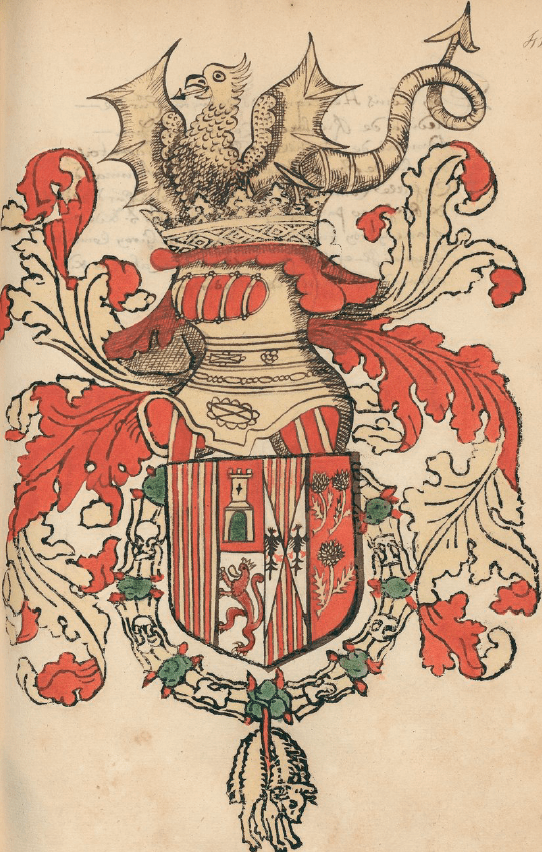
Example of a Habsburg Noble Family’s Coat of Arms with the Golden Fleece (Statutes of the Order of the Golden Fleece
Two primary objectives underpinned the order’s creation.【2】 First, to regulate loyalty relationships by binding a select group within the nobility to a common oath and written rules; second, to strengthen the dynasty’s representational authority through a system of insignia and symbols compatible with court ceremonies. Limiting the number of members, defining precise procedures for filling vacancies, and documenting detailed rules for the use of the insignia transformed the order into a structured entity with defined standards. Thus, the order both made prestige and loyalty visible within the court environment and enabled nobles from different regions to gather under a common set of rules.
The order’s name and emblem is the “Golden Fleece” (Fr. Toison d’Or, Lat. Vellus Aureum). In founding narratives, the symbol is linked to the fleece that Jason retrieved from Colchis in antiquity. In the same century, particularly within religious discourse at court, the symbol is also interpreted as referring to Gideon’s fleece in the Bible. Thus, while the name remained unchanged, its explanation was grounded in two distinct narratives.
The core element of the insignia is a ram’s fleece suspended from a chain (collar). The chain’s links feature flint and steel motifs; the sparks produced by their combination are depicted as flames in early examples. The fleece figure is typically rendered whole, with head, horns, and hooves clearly defined to convey the appearance of a “suspended ram’s fleece.” In some examples produced during the early modern period, the fleece’s formal features varied according to local workshop traditions; however, the overall unity of chain and fleece and the flint-steel arrangement remained constant.

Example of the Order of the Golden Fleece Symbol from England (R. H. Thompson)
In language usage, “Golden Fleece” refers both to the order itself and to the insignia.【3】 In court records, the chain is referred to as the “collar” (collier), and the suspended element as the “toison” or “beranek.” Ceremonial descriptions treat the donning of the insignia, the weight of the chain, and its mode of transport as separate entries; distinctions between daily use and major feasts or official ceremonies are clearly noted.
The symbolic system ensured the order’s visual recognizability. The collective display of the chain during court ceremonies served as a public marker of membership; within dynastic iconography, the combination of flint, steel, and fleece regularly appeared in manuscripts, medallions, and inventory records.
Early statutes defined the order’s fundamental operations through written rules. The texts clearly list procedures for membership admission, oath-taking, meeting arrangements, duties, and sanctions.
1. Membership conditions: Candidates must be of noble birth, enjoy good reputation, and demonstrate religious and moral commitment. The number of vacancies is limited; each appointment requires the sovereign’s approval. The candidate’s background and conduct within court circles are taken into account.
2. Oath and obligations: Upon admission, the candidate pledges to uphold the honor of the order, maintain solidarity with fellow members, and abide by the statutes. The oath is administered together with the bestowal of the insignia and forms the centerpiece of the admission ceremony.
3. Meetings (chapters): Meetings are held at regular intervals, often aligned with the court calendar. Agendas include new memberships, disciplinary matters, procedures for transporting the insignia, and decisions regarding ceremonial protocols. Decisions are shaped through collective consultation and finalized by the sovereign’s approval.
4. Insignia and usage rules: The chain (collar) and the fleece-shaped medallion are worn only on designated ceremonial days. The chain features flint and steel motifs. Detailed regulations regarding daily use, ceremonial donning during official processions, and methods of transport and preservation are specified in the statutes.
5. Discipline and sanctions: Regulations provide for sanctions of varying degrees and consequences, including warnings, temporary suspension, and expulsion. Behaviors that damage the order’s reputation, violations of ceremonial rules, and unresolved disputes among members are explicitly defined.
6. Duties and officials: Within the structure headed by the sovereign, officials are assigned responsibilities for correspondence, record-keeping, armorial and genealogical registers, and ceremonial organization. These units manage tasks such as preparing admission files, recording meeting decisions, and safeguarding the insignia.
These regulations standardized all practices of the order, from membership to ceremony, ensuring that implementations across different locations and times adhered to the same principles.
The order’s membership consists of a limited number of knights. Each vacancy is filled by a new appointment, maintaining a fixed total number. The sovereign’s approval is essential in the appointment process; candidates’ backgrounds, noble lineage, and conduct within court circles are carefully evaluated.
Members’ primary obligations are grouped under three headings.
First, to comply with the statutes and participate in the order’s ceremonies.
Second, to wear the insignia on designated days and events, exactly as prescribed in the statutes.
Third, to act according to established procedures in resolving disputes among members.
Sanctions ranging from warnings to expulsion are applied for violations of the rules.

Example of the Order of the Golden Fleece Symbol from England (R. H. Thompson)
Membership is closely tied to the court and dynasty.【4】 The admission of nobles from different regions helped maintain contact between the dynasty and elite groups across its domains. Those admitted are summoned to order meetings; attendance, oaths, and decision-making processes are conducted within this framework. The insignia serves as the visible sign of membership and is worn collectively during official ceremonies.
In the early period, court administrative units responsible for correspondence and record-keeping maintained lists of members, recorded vacancies, and prepared admission documents. This system ensured that appointments and attendance were conducted according to consistent principles.
Due to its integration with the court and its acceptance of nobles as members, the order possessed a far more regular meeting schedule, record-keeping system, and ceremonial framework than other contemporary orders.
1. Meetings (chapters): Order meetings are held on dates aligned with the sovereign’s calendar and court location. Agendas include filling vacancies, attendance and oaths, disciplinary matters, procedures for transporting the insignia, and decisions on ceremonial protocols. Decisions are shaped through internal deliberation and confirmed by the sovereign’s approval. Attendance and absence are recorded.
2. Admission ceremony: The ceremony begins with the candidate’s introduction. The candidate swears to uphold the statutes and protect the honor of the order. The chain (collar) and fleece-shaped medallion are then bestowed. Prayers and brief addresses may occur during the ceremony. After admission, the new member’s name and admission conditions are entered into the register.
3. Annual cycle and key days: The insignia is worn collectively on major feast days and other days of importance to the court. Distinctions are maintained between daily use and high ceremonies; the manner of wearing the chain, its compatibility with attire, and its mode of transport are separately regulated in ceremonial instructions.
4. Ceremonial officials and division of labor: Officials include a scribe (grefier) for correspondence and records, a chancellor for seals and documents, and armorial officers for genealogical records and ceremonial precedence. Preparations for seating order, addresses, and insignia bestowal during admissions and public processions are carried out by these officials.
5. Enforcement of discipline and protocol: Violations of ceremonial rules may result in warnings, temporary deprivation, or expulsion. Unauthorized or inappropriate wearing of the insignia, unjustified absence from meetings, and disruptions to ceremonial flow caused by member disputes are specifically recorded.
6. Venue and arrangement: Chapters are held in appropriate halls of the court residence; admission ceremonies take place in designated ceremonial spaces. Seating arrangements, entry and admission order, and display of the insignia are predetermined. Large ceremonies may be accompanied by court music, processions, and other elements; however, the core stages of admission (introduction, oath, insignia bestowal) remain fixed.
These practices ensured that meetings and admissions conducted at different times and court centers followed the same principles, enabling harmony between membership procedures and ceremonial flow.
During the reign of Philip the Good, the order became an established institution within the court ceremonial framework. The limited number of members was maintained; vacancies were filled regularly at scheduled meetings. The sequence of admission ceremonies, the wording of the oath, the manner of bestowing the insignia, and the collective carrying of the chain during public processions were all defined in written texts and implemented consistently across different court centers.

Example of a Habsburg Noble Family’s Coat of Arms with the Golden Fleece (Statutes of the Order of the Golden Fleece)
Court administrative units managed tasks such as recording admissions and attendance, safeguarding the insignia, and compiling meeting decisions.【5】 Responsibilities for genealogical records, ceremonial precedence, and protocol were distributed among officials. Thus, membership files, attendance records, and ceremonial preparations became integrated into a unified workflow.
The chain and fleece medallion, emblematic of the order, were regularly used in court life; they were carried collectively during major feasts, weddings, official entries, and funeral rites. The flint and steel elements of the chain, along with flame depictions, formed a consistent visual motif in manuscripts and inventories. The geographical distribution of members helped sustain contact with noble circles within Burgundian domains; appointments were aligned with the dynasty’s political agenda.
From the late 1460s onward, the order’s visibility and procedural uniformity increased. Rules concerning court security, ceremonial order, and precedence were more strictly enforced; details regarding the flow of admission ceremonies, the carrying of the chain, and meeting discipline were meticulously applied. Specific days for collective wearing of the insignia were designated; attendance and excuse notifications were systematically recorded.
Court appointments became more clearly linked to the preparation and execution of ceremonies. The preparation of admission dossiers, the reading of the oath, the bestowal of the chain, and the placement of members followed a standardized procedure. The collective display of the chain and fleece medallion during major feasts and state ceremonies highlighted the membership as a public symbol.

Example of a Habsburg Noble Family’s Coat of Arms with the Golden Fleece (Statutes of the Order of the Golden Fleece)
During this period, with the increase in the number of court guard units and the reorganization of interior spaces, entry and seating arrangements for admissions and meetings became more clearly defined.【6】 Processional and musical elements accompanying ceremonies were arranged so as not to overshadow the core stages of admission (introduction, oath, insignia bestowal).
By 1477, the order had achieved a mature institutional framework within the Burgundian court, grounded in its written rules and established ceremonial practices, thereby establishing a foundation of continuity for the subsequent Habsburg era.
The sovereign heads the order and, as “Grand Master,” holds final authority over all admissions, meetings, and disciplinary decisions. Supporting this core leadership are a chancellor responsible for correspondence and seals, a scribe (grefier) who maintains records of decisions and attendance, a treasurer who oversees the custody of the insignia and accounts for expenditures, and armorial officers who supervise genealogical records and ceremonial precedence.
The “Rey de Armas,” or insignia and armorial officer, performs duties such as ensuring correct recording of members’ titles, enforcing ceremonial precedence, and compiling preparatory notes for genealogical verification of new candidates. This cadre is assisted by officials managing the flow of admission days, the custodian of the insignia chests responsible for delivery of the chain and medallion, and internal service units ensuring order during oaths and attendance.
Meetings are convened by the sovereign at suitable court locations. The agenda includes filling vacancies, attendance, disciplinary matters, and confirmation of ceremonial procedures. During admission sessions, the candidate is first introduced; then the oath is taken and the chain with fleece-shaped medallion is bestowed. Each stage of the admission is recorded by the scribe with date and location; excuses for absent members are noted in attendance registers.
Disciplinary measures range from warnings to temporary suspension and expulsion; the language of decisions is clear and standardized. Distinctions between daily use and major ceremonies (on which days and how the chain is worn, attire, seating, and entry order) are specified in written instructions and serve as references for future implementations.
Chains, medallions, and associated ceremonial objects are stored in designated chests within the court; delivery and return procedures are documented through custody records. Insignia to be used on admission and meeting days are inspected in advance; repairs or replacements for missing or damaged parts are recorded. Preparation of ceremonial venues (seating arrangements, procession routes, display of insignia) follows written schematics.
Expenditures are recorded under relevant budget items; costs for admissions and major feasts are tracked in separate accounts. Thus, the material cycle of the insignia and the logistics of ceremonial execution are integrated into a unified administrative system.
This structure ensures that meetings and admissions conducted at different times and locations follow the same principles, establishing consistent functioning between membership procedures, ceremonial practices, and the circulation of the insignia.
The order’s ceremonies are based on the sequential performance of admission and oath-taking stages. The candidate is first introduced, with a brief presentation of their background and demeanor. They then swear to uphold the statutes, protect the honor of the order, and demonstrate solidarity with fellow members. The oath is recited while the ceremonial space follows predetermined seating and order arrangements. After the oath, the chain (collar) and fleece-shaped medallion are bestowed; this bestowal marks the visible climax of the ceremony. Prayers and brief addresses may be included; however, the core steps of admission (introduction–oath–insignia) remain fixed. Upon completion, the new member’s name, date, and location are entered into attendance and decision registers.
The chain and fleece medallion are the fundamental elements defining the order’s visual identity. The chain features flint and steel motifs; their combination, producing sparks, is depicted as flames in early examples. The fleece figure is rendered as a complete suspended ram’s fleece, with head, horns, and hooves clearly detailed. Distinctions are maintained between daily use and high ceremonies. In daily protocol, the chain is worn in a simple form; during major feasts, weddings, official entries, and funeral rites, it is worn collectively within a ceremonial framework. On these occasions, members’ attire, entry order, and seating are predetermined; custodians and relevant officials are present to ensure the display and preservation of the chains.

Example of the Order of the Golden Fleece Symbol from England (R. H. Thompson)
Chapter meetings form the framework for ceremonies other than admissions.【7】 These gatherings cover approval of new memberships, confirmation of disciplinary and protocol rules, updates on insignia transport, and organization of correspondence and record-keeping. Decisions are made under the sovereign’s presidency; attendance and excuse records are meticulously maintained. Ceremonial officials include the chancellor (seals and official correspondence), the scribe (decisions and attendance), armorial officers (genealogy and precedence), the chest custodian (insignia custody), and internal service staff (flow and order). Thus, admissions, commemorations, and processions are conducted within a unified operational framework.
In large court ceremonies, the order’s emblems become part of dynastic representation. The collective carrying of the chain during official entries and processions serves as a public marker of membership. In weddings and funerals, the chain emphasizes themes of unity and commemoration. Music, processional elements, and visual displays are employed in ceremonies; however, they do not overshadow the core stages of admission. This repeatability is ensured by written instructions and fixed order rules; implementations across different court centers follow the same essential guidelines.
With the extinction of the Burgundian dynasty, the order passed into the Habsburg sphere. The transition was carried out without disrupting the insignia or ceremonial system; the chain, fleece medallion, and flint-steel arrangement were preserved and transferred to new court centers. Admission and chapter practices continued, initially using the Burgundian record and protocol language, then gradually adapting to Habsburg administrative customs. Thus, decisions on membership, oaths, and insignia bestowal continued as part of a rhythm integrated into the court calendar.
The Habsburg era is marked by geographical expansion and ceremonial circulation. The Spanish Habsburgs’ traditional influence over the order strengthened, while Habsburg courts in Central Europe became centers for conducting admissions and insignia bestowals. Members could be admitted directly in centers such as Madrid or Brussels when feasible; when travel was impractical, ceremonies were held in cities near the imperial court. Central European examples show that the admission ritual was adapted locally with minor modifications but without altering its core sequence.

Example of a Habsburg Noble Family’s Coat of Arms with the Golden Fleece (Statutes of the Order of the Golden Fleece)
Over time, two branches emerged: the Spanish branch and the Austrian branch.【8】 This division produced different court calendars and priorities in terms of Grand Mastership and protocol; however, continuity was maintained in the insignia’s form, the core of admission, and the language of the written statutes. Both branches established special chests and record systems within court treasuries for the custody of the chain and medallion; delivery, return, repair, and inventory procedures were conducted alongside preparations for admission days. Thus, the material circulation of the insignia and the execution of the admission ritual became unified within a single administrative framework.
In Habsburg courts, the relationship between the order’s ceremonies and court protocol became even more visible. The collective carrying of the order’s chain during major feasts, official entries, and dynastic weddings transformed membership into a clear symbol within the imperial hierarchy.
The institutional consequence of the division into two branches was the planning of membership distribution according to distinct court environments. Members admitted into the Spanish branch were primarily drawn from the diplomatic and military service circles of the Iberian court; those admitted into the Austrian branch were more closely tied to Central European noble networks. The order’s emblems occupied prominent positions among the selected treasures of both branches’ court treasuries.
The profile of the order’s members expanded from the core nobility of Burgundy to encompass the aristocracy of Iberia and Central Europe during the Habsburg period. The limited number of members, the practice of filling each vacancy with a single appointment, and the evaluation of candidates based on service to the court and noble lineage ensured a controlled and selective geographical expansion. This selectivity produced a distribution favoring dynasties with direct ties to court centers, high state officials, and influential families within the empire and kingdoms.
During the Habsburg era, admission ceremonies were conducted in different centers depending on transportation and security conditions. Candidates were admitted directly in Spain or other European courts when feasible; when travel was impractical, ceremonies were held in cities near the imperial court. This flexibility allowed the core sequence of admission to be preserved while enabling the order to be more systematically integrated into Central European noble networks.

Example of a Habsburg Noble Family’s Coat of Arms with the Golden Fleece (Statutes of the Order of the Golden Fleece)
Contact with the British Isles gained visibility through direct membership appointments and dynastic marriages.【9】 These connections demonstrated that the order was not confined to continental Europe; its insignia and chain became part of the protocol language exchanged between dynasties. Over the long term, the recognition of the order’s emblem (the suspended fleece) in diverse contexts laid the groundwork for its appearance in similar forms in civic arms, guild insignia, and other symbols. This spread indicates that the ceremonial chain, as a distinct visual line, contributed to the continuity of its iconographic recognition.
Common patterns emerge in the selection of members. These include military and diplomatic commanders who distinguished themselves; nobles who held high court offices; heads of established regional houses; and individuals with kinship ties to the dynasty. When examining the grounds for admission, loyalty to the court, success in warfare and negotiation, and administrative roles ensuring regional stability emerge as key criteria. This profile transformed the order from merely a “circle of honor” into a cohesive network sustaining the dynasty’s governance and representation.
The statutes of the foundation and early period were written in a clear, formulaic language that defines the order’s functioning. The texts list membership admission conditions, oath formulas, meeting procedures, disciplinary rules, and insignia usage regulations in sequential articles. The language conforms to the conventions of late medieval court correspondence. Formal verb forms, standardized expressions in oaths and proclamations, and graduated conditional structures in sanctions are employed to ensure consistent application of the same rules across different places and times.
The manuscript tradition follows two main channels. First, the primary compilations prepared by the court scribes and authenticated with seals and signatures. Second, later additions and repetitions. Supplementary texts include records of new admission days, summaries of meeting agendas, disciplinary decisions, and minor corrections regarding insignia transport. Copies may exhibit different handwriting styles and page layouts depending on shifts in court centers; however, the sequence of articles and headings are preserved to ensure readability.

Example of a Habsburg Noble Family’s Coat of Arms with the Golden Fleece (Statutes of the Order of the Golden Fleece)
Three diplomatic features stand out.【10】 First, the statutes function not as a “founding declaration” but as an “operational manual”; they define procedures rather than institutional identity. Second, additions and amendments are made without damaging the main text, through marginal notes, supplementary articles, or concluding “confirmation” paragraphs; thus, continuity is preserved while allowing for updates. Third, the record and seal system ensures that the text serves not only as an account but also as evidence. Dates, locations, witness information, and seal details are carefully documented, especially in articles concerning admissions and discipline.
The terminology of the texts combines ceremonial details with administrative expressions. Ceremonial phrases such as the oath to be recited during admission, the bestowal of the chain, and the order of attendance are closely linked with administrative terms such as attendance registers, custody records, chest preservation, and excuse declarations. This proximity demonstrates that ceremony and administration are integral parts of a single operational system. Descriptions of the insignia fix the fleece’s form, the chain’s links, and the flint-steel arrangement in concise yet precise terms.
Some members of the order played active roles in its foundation, development, and decline. These individuals were not merely members but also influential figures in its administration, securing critical positions in the order’s history.
1. Philip the Good (Duke of Burgundy): Founder of the order and final authority over all admissions and chapter proceedings as “Grand Master.” He played a decisive role in establishing the court ceremonial language and visual standards of the insignia.
2. Charles the Bold (Duke of Burgundy): Played a key role in tightening ceremonial discipline during the late Burgundian period, clarifying days for collective chain-wearing, and standardizing the admission process. Court security and spatial arrangements became more rigid during this era.
3. Johann Ferdinand von Porcia: A prominent figure in the Habsburg court as majordomo and president of the secret council; he significantly influenced the alignment of ritual flow with court protocol.
4. Bernhard Ignaz von Martinitz: As Supreme Burgrave of the Kingdom of Bohemia, he was one of the order’s respected representatives in the Central European court environment; he symbolizes the continuity of contact between regional nobility and the court.
5. Annibale Gonzaga: A high-ranking commander in Habsburg service; he exemplifies the typical grounds for admission based on military merit and loyalty to the court.
6. Vratislav (Pernštejn/Pernstein): An early member of Bohemian origin; he represents the inclusion of Central European aristocracy into the order’s network during the 16th century.
7. Joachim von Neuhaus – William Rosenberg – Leonhard Harrach: Noble lineages prominent during the period when the ceremonial language and geography of admission expanded into Central Europe; they were selected based on concentrated grounds in diplomacy, court service, and regional influence.
8. Hans von Khevenhüller – Sigismund Báthory: Reflect the selective distribution of membership within the imperial circle and Eastern Central European aristocracy; they gained visibility through military and diplomatic roles.
9. Johann Adolf von Schwarzenberg: A Habsburg official closely associated with the administration of Spanish Netherlands; he is cited as an example of admissions conducted in centers such as Brussels, illustrating the principle of spatial flexibility while preserving the core ritual.
While other members of the order held significant influence, the individuals listed above were selected for their substantial impact on the historical trajectory of the order. The names and stories of other members can be accessed through archival records.
Austrian Academy of Sciences, Institute for Medieval Research (IMAFO). “Order of the Golden Fleece under Maximilian I (1477–1486).” Österreichische Akademie der Wissenschaften (OeAW) – IMAFO. Accessed September 27, 2025. https://www.oeaw.ac.at/en/imafo/forschung/editionsunternehmen-quellenforschung-mir/einzelprojekte/die-protokollbuecher-des-ordens-vom-goldenen-vlies/order-of-the-golden-fleece-under-maximilian-i.
Bibliothèque nationale de France (BnF). Ordre de la Toison d’or : statuts et ordonnances de Philippe le Bon, duc de Bourgogne (A Découvrir). Gallica, ark:/12148/btv1b530239561. Accessed September 27, 2025. https://gallica.bnf.fr/ark:/12148/btv1b530239561.image.
Metropolitan Museum of Art. “Order of the Golden Fleece, Austria, from the World’s Decorations Series (N44) for Allen & Ginter Cigarettes.” The Metropolitan Museum of Art. Accessed September 27, 2025. https://www.metmuseum.org/art/collection/search/422156.
Mutschlechner, Martin. “The Golden Fleece.” The World of the Habsburgs. Schönbrunn Group. Accessed September 27, 2025. https://www.habsburger.net/en/chapter/golden-fleece.
Ordre de la Toison d’Or. La Toison d’Or, ou Recueil des Statuts de l’Ordre de la Toison d’Or. Cologne: Chez Pierre Sweitzer, 1689. Google Books. Accessed September 27, 2025. https://books.google.de/books/about/La_Toison_d_Or_ou_Recueil_des_Statuts_de.html?id=c7RAAAAAcAAJ.
Ordre de la Toison d’or: Statuts et ordonnances de Philippe le Bon, duc de Bourgogne. 15th century (1401–1500). Bibliothèque nationale de France, Département des Manuscrits, ms. Français 5741; ark:/12148/btv1b90606854. Gallica. Accessed September 27, 2025. https://gallica.bnf.fr/ark:/12148/btv1b90606854. For the catalog record, see http://archivesetmanuscrits.bnf.fr/ark:/12148/cc58689m.
Paravicini, Werner. “The Court of the Dukes of Burgundy: A Model for Europe?” In Princes, Patronage, and the Nobility: The Court at the Beginning of the Modern Age c. 1450–1650, edited by Ronald G. Asch and Adolf M. Birke, 69–102. Oxford: Oxford University Press, 1991. Accessed September 27, 2025. https://perspectivia.net/servlets/MCRFileNodeServlet/pnet_derivate_00004631/paravicini_dukes.pdf.
Paviot, Jacques. “Statuts inédits de l’ordre de la Toison d’or.” Bulletin de la Société nationale des Antiquaires de France 2002 (1999): 79–80. Accessed September 27, 2025. https://www.persee.fr/doc/bsnaf_0081-1181_2002_num_1999_1_10335.
Stolička, Ondřej Lee. “The Ritual of the Golden Fleece in Prague 1657.” Opera Historica 23, no. 2 (2022). Accessed September 27, 2025. https://opera-historica.com/pdfs/oph/2022/02/08.pdf.
Thompson, R. H. “The Golden Fleece in Britain.” British Numismatic Journal 79 (2009): 199–212. Accessed September 27, 2025. https://www.britnumsoc.org/publications/Digital%20BNJ/pdfs/2009_BNJ_79_8.pdf.
Wiener-Schatzkammer.at (City Tours GmbH). "Imperial Treasury Museum Vienna: Treasure of the Order of the Golden Fleece." Wiener Schatzkammer – Imperial Treasury Museum Vienna. Accessed September 27, 2025. https://www.wiener-schatzkammer.at/golden-fleece-order.html.
[1]
R. H. Thompson, “The Golden Fleece in Britain,” British Numismatic Journal 79 (2009), s. 208.
[2]
Bibliothèque nationale de France (BnF), Ordre de la Toison d’or : statuts et ordonnances de Philippe le Bon, duc de Bourgogne (A Découvrir), Gallica, ark:/12148/btv1b530239561, s. 462.
[3]
R. H. Thompson. (a.g.e), s. 200.
[4]
R. H. Thompson. (a.g.e), s. 203.
[5]
Bibliothèque nationale de France. (a.g.e), s. 464.
[6]
Bibliothèque nationale de France. (a.g.e), s. 460.
[7]
R. H. Thompson. (a.g.e), s. 204.
[8]
Bibliothèque nationale de France. (a.g.e), s. 463.
[9]
Bibliothèque nationale de France. (a.g.e), s. 459.
[10]
Bibliothèque nationale de France. (a.g.e), s. 447.

Name(s) | Golden Fleece Order Ordre de la Toison d'Or | ||||||||
|---|---|---|---|---|---|---|---|---|---|
Type(s) | Chivalric order Political order | ||||||||
Founder(s) | Philip the Good | ||||||||
Founding Date | 10 January 1429/1430 | ||||||||
Membership Size (Early Period) | 24 | ||||||||
Membership Criteria | Loyalty to oaths and statutes Good reputation Nobility | ||||||||
Governance | Rey de Armas (Herald) Treasurer Greffier (Scribe) Chancellor (Seal Keeper) Grand Master | ||||||||
Symbols | Suspended ram's fleece Medal Collar | ||||||||
Foundation and Early Period (1429/1430–1477)
Context and Purpose of Foundation
Symbol and Nomenclature
Statutes and Regulations
Membership Structure
Chapters and Ceremonial Practices
Development in the Mid-15th Century
Transition to the Reign of Charles the Bold
Institutional Structure and Functioning
Administrative Bodies and Responsibilities
Meetings, Admissions, and Record System
Material Organization, Custody, and Finance
Ceremonies, Rituals, and Symbolism
Habsburg Transition and Dual Structure (After 1478)
Geographical Spread, Networks, and Members
Legal Texts: Language, Manuscript Tradition, and Diplomatic Features
Significant Members in the History of the Order