


This article was automatically translated from the original Turkish version.
The Ottoman State Coat of Arms (Arma-i Osmani), is the coat of arms adopted by the Ottoman Empire as its official state symbol in the 19th century and attained its final form on 17 April 1882. The coat of arms was designed to unify the multi-ethnic structure of the empire, reflect a modern state identity, and emphasize its official authority. It was also used as an alamet-i farika (mark) on commercial products, but this usage was strictly regulated by the state. The coat of arms held a significant place in the ideology of Sultan Abdülhamid II’s reign. It was not merely a decorative element but was conceived as a strategy of legitimacy both domestically and internationally. The use of the coat of arms in palaces, official documents, school buildings, and even public spaces reinforced the empire’s visual identity.
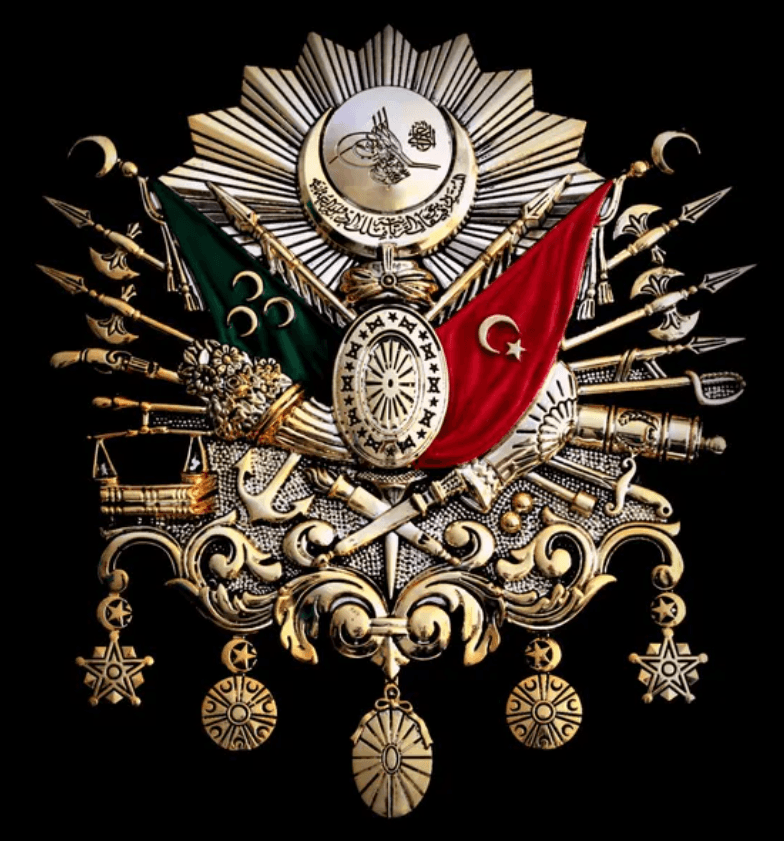
The Ottoman State Coat of Arms (Depositphotos)
Although the Ottoman state had no tradition of Western-style heraldry, traditional symbols such as the gun, seal, and tughra represented the sovereignty of the state and the ruler. The growing importance placed on coats of arms by European states in the 18th and 19th centuries prompted the Ottomans to develop their own symbolic emblem. Especially after the Tanzimat reforms, modernization efforts compelled the state to adopt symbols compatible with Western diplomatic protocols.
The inclusion of the Ottoman state in the European system of states through the 1856 Treaty of Paris intensified this need. At the request of Queen Victoria of England, Sir Charles Young designed a coat of arms for Sultan Abdülmecid to be hung in St George’s Chapel at Windsor Castle. This became the first Ottoman coat of arms created in a Western style. However, contemporary sources indicate that this design had no deep roots in the Ottoman Empire’s own administrative and cultural traditions and was instead a response to European protocol requirements.
During the reign of Abdülhamid II (1876–1909), the coat of arms was re-examined within the framework of adapting to Western state forms, and its final form was officially adopted on 17 April 1882. During this period, the coat of arms was designed as a complex composition representing the sultanate, the Ottoman dynasty, the Islamic faith, and the empire’s vision of modernization. Abdülhamid II believed that the coat of arms would strengthen the bond between the state and society and present monarchy as an institutional authority rather than a personal one. Used in provinces, government buildings, schools, hospitals, barracks, and diplomatic missions, the coat of arms became a symbol of a “shared identity” reflecting both traditional and modern elements of the empire.
The coat of arms attained its final form during the reign of Abdülhamid II (1876–1909) on 17 April 1882 and was widely used across a broad spectrum, from official documents to public buildings. It was prominently displayed in schools, hospitals, and barracks to strengthen the state-society bond and symbolize modernization efforts.
From the time of Abdülhamid II onward, the coat of arms was used across a wide range of official contexts. It appeared on document headers, land registry and census books, official seals, entrances to educational institutions, and facades of public buildings. This usage served both the Ottoman Empire’s effort to project a modern state image internationally and its aim to reinforce central authority domestically.
In the second half of the 19th century, the proliferation of industrial goods and commercial brands brought the use of state symbols on consumer products as alâmet-i farika to the forefront. The Arma-i Osmanî and the Hümâyun Tuğra were placed on product labels, packaging, and advertisements, especially by manufacturers seeking to emphasize high quality or official status. However, this usage remained under state control. The 1871 Regulation on Alâmet-i Farika and its updated provisions of 1888 prohibited unauthorized use of state symbols and required commercial trademarks to conform to moral and legal standards.
In response to increasing unauthorized use in the early 20th century, regulations issued in 1902 tightened restrictions on the commercial use of the coat of arms and the tughra. The state confiscated goods bearing unauthorized symbols or banned their export to prevent prestige loss. These measures are regarded as evidence of the Ottoman Empire’s development of trademark protection law and its awareness of safeguarding the symbols of state authority.
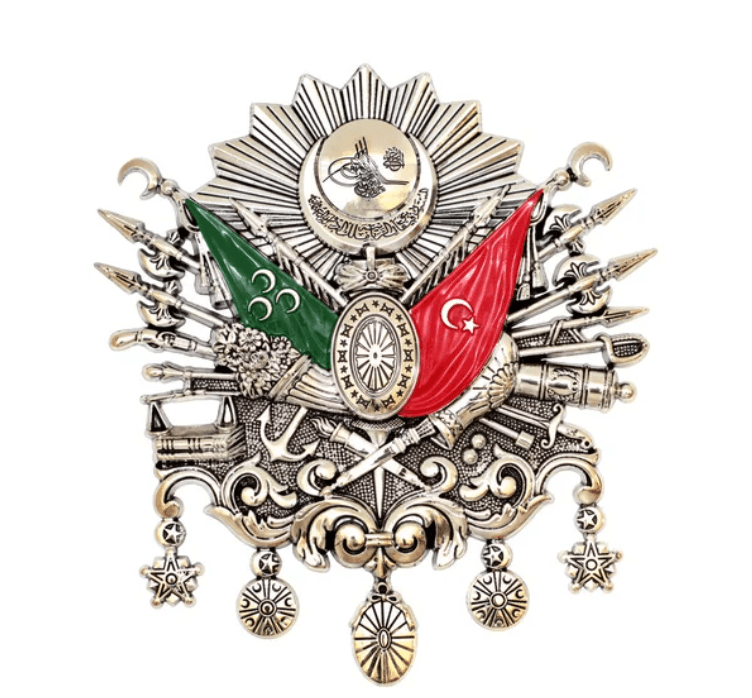
The Ottoman State Coat of Arms (Depositphotos)
Tughra (The Sultan’s Signature) (1): Represents the highest authority of the state and the dynasty as the sovereign’s seal. It is placed surrounded by sun rays, implying the sultan as an “enlightening” figure. Positioned at the top and center of the composition, it occupies the apex of the hierarchical structure.
Shield (2): The central shield is encircled by twelve stars, symbolizing the multi-ethnic structure of the empire or the centrality of the universe.
Fez with Tassel (Osman Gazi’s Headgear) (3): Refers to the “authentic” roots of Ottoman history in contrast to the European crown symbol. It represents the integration of Osman Gazi, the founding figure, into the dynastic tradition. It symbolizes Osman Gazi and the authority of the sultan.
Red Banner (4): Represents the sultanate and the Ottoman state.
Green Banner (5): Symbolizes the caliphate and Islam. Their diagonal placement implies elements of struggle and balance.
Weapons and Military Equipment (6): Traditional and modern weapons are interwoven:
They emphasize both martial valor and the process of modernization. Swords, cannons, rifles, and bows and arrows—traditional and modern military equipment—express the strength of the Ottoman army.
Balance (7): Symbolizes the impartial functioning of the legal system. It is incorporated into the coat of arms composition as the visual representation of both Sharia and Nizami (modern) law.
Books (8): Two thick volumes; one represents Sharia, the other laws. Positioned beneath the balance, they signify the foundation of the legal system.
Horn of Plenty and Flower Bouquet (9): Symbols of peace and prosperity. They symbolize the social generosity of the Ottoman state and reflect its unifying and benevolent nature.
Anchor (10): Represents the navy and maritime forces. It emphasizes Ottoman naval power and seafaring tradition.
Mehter Trumpet (11): Associated with the declaration of war, national fervor, and traditional military music. It is one of the symbols that define the composition’s rhythm.
Orders such as Şefkat (12), Osmanî (13), İftihar (14), Mecidi (15), and İmtiyaz (16) are arranged along the lower part of the coat of arms. They visualize the state’s award system and bureaucratic structure.
Torch (17): Symbol of education and progress.
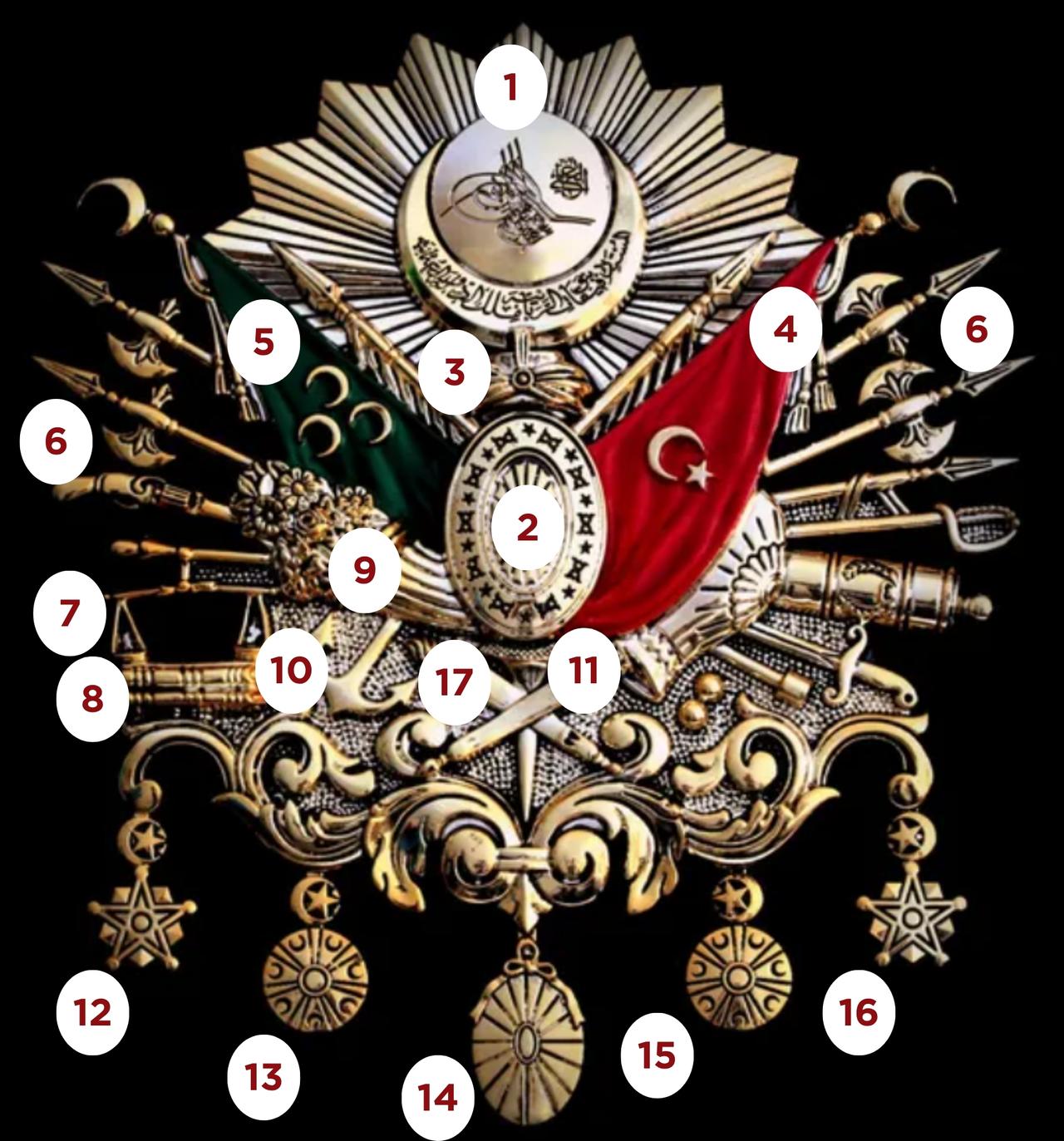
Numbered Symbols of the Ottoman State Coat of Arms (Depositphotos)
With the proclamation of the Republic, a significant portion of the Ottoman state’s political, legal, and cultural heritage was either eliminated or transformed within the framework of the new regime’s identity construction. In this context, the Arma-i Osmanî was viewed as a symbol of monarchy, dynastic rule, and imperial ideology and was entirely removed from official state symbolism.
In the late 1920s, when the minting of gold and coinage became a matter of public discussion, proposals emerged to design a new coat of arms for the Republic, but these efforts proved fruitless. The coat of arms competition conducted between 1925 and 1928, in which Namık İsmail Bey’s design won first prize, adopted a stance that completely excluded Ottoman heritage from Republican symbolism. Although Namık İsmail’s design combined Turkish mythology and modernization themes, it was not accepted by the Council of Ministers or Mustafa Kemal Atatürk.
During this period, distancing from the Ottoman coat of arms was not merely an ideological preference but also the result of an effort to create a “non-dynastic” symbol consistent with the modern state concept. The Republican administration banned the use of Ottoman official symbols; bas-reliefs of the Arma-i Osmanî on public buildings were chiseled away or covered with plaster. Thus, the Ottoman coat of arms was consciously erased from official memory, and the Republic constructed its own symbolic order through the flag, the crescent and star, and official logos.
The Ottoman State Coat of Arms (PTT A.Ş.)
During the first half-century of the Republic, the Arma-i Osmanî was largely removed from official and public spaces. From the 1980s onward, it regained visibility due to the strengthening of the Turk-Islamic synthesis discourse and rising nostalgia for the Ottoman past. This revival was accelerated as conservative political circles and the tourism sector began using the “Ottoman aesthetic” as a branding element.
In 1999, during the 700th anniversary celebrations of the founding of the Ottoman state, the coat of arms reappeared symbolically on flags, ship pennants, tourist products, and certain official events. During this period, the coat of arms functioned both as part of cultural heritage and as a visual instrument of national historical emphasis. However, this revival often relied more on popular historical narratives than on historical accuracy or contextual fidelity.
Example Applications:
Akay, Tolga. "Osmanlı Devleti’nde Arma-i Osmânî ve Tuğrâ-yi Hümâyûn’un Alâmet-i Farika Olarak Kullanımı." *Kafkas Üniversitesi Sosyal Bilimler Enstitü Dergisi* 1, no. 9 (2012): 1–15. Accessed August 2, 2025. https://dergipark.org.tr/tr/pub/sbedergi/issue/11258/134536.
Eldem, Edhem. "Geç Osmanlı Döneminden Günümüze İntikal Eden Bir Kitsch Nümunesi: Arma-i Osmani." *Toplumsal Tarih*, no. 192 (2009). Accessed August 2, 2025. https://www.academia.edu/7822761/Ge%C3%A7_Osmanl%C4%B1_D%C3%B6neminden_G%C3%BCn%C3%BCm%C3%BCze_%C4%B0ntikal_Eden_Bir_Kitsch_N%C3%BCmunesi_Arma_i_Osmani.
Ilıcak Yücel, Nezire Gamze. "Kültürel Hafızanın Hatırlama Figürleri: Osmanlı İmparatorluğu ve Türkiye Cumhuriyeti’nde Armalar." *Folklor/Edebiyat* 31, no. 123 (2025): 693–716. Accessed August 2, 2025. https://dergipark.org.tr/tr/pub/fe/issue/94062/1754773.
PTT A.Ş. "Osmanlı Devlet Arması." YouTube video, 9 April 2020. Accessed August 2, 2025. https://www.youtube.com/watch?v=y8dkJeEJd48.

No Discussion Added Yet
Start discussion for "Ottoman State Emblem" article
Historical Development
Official and Commercial Use
Symbols in the Coat of Arms Composition
Banners
Orders and Medals
Perception and Rejection in the Republican Era
The Modern Journey of the Arma-i Osmanî