


This article was automatically translated from the original Turkish version.
+2 More
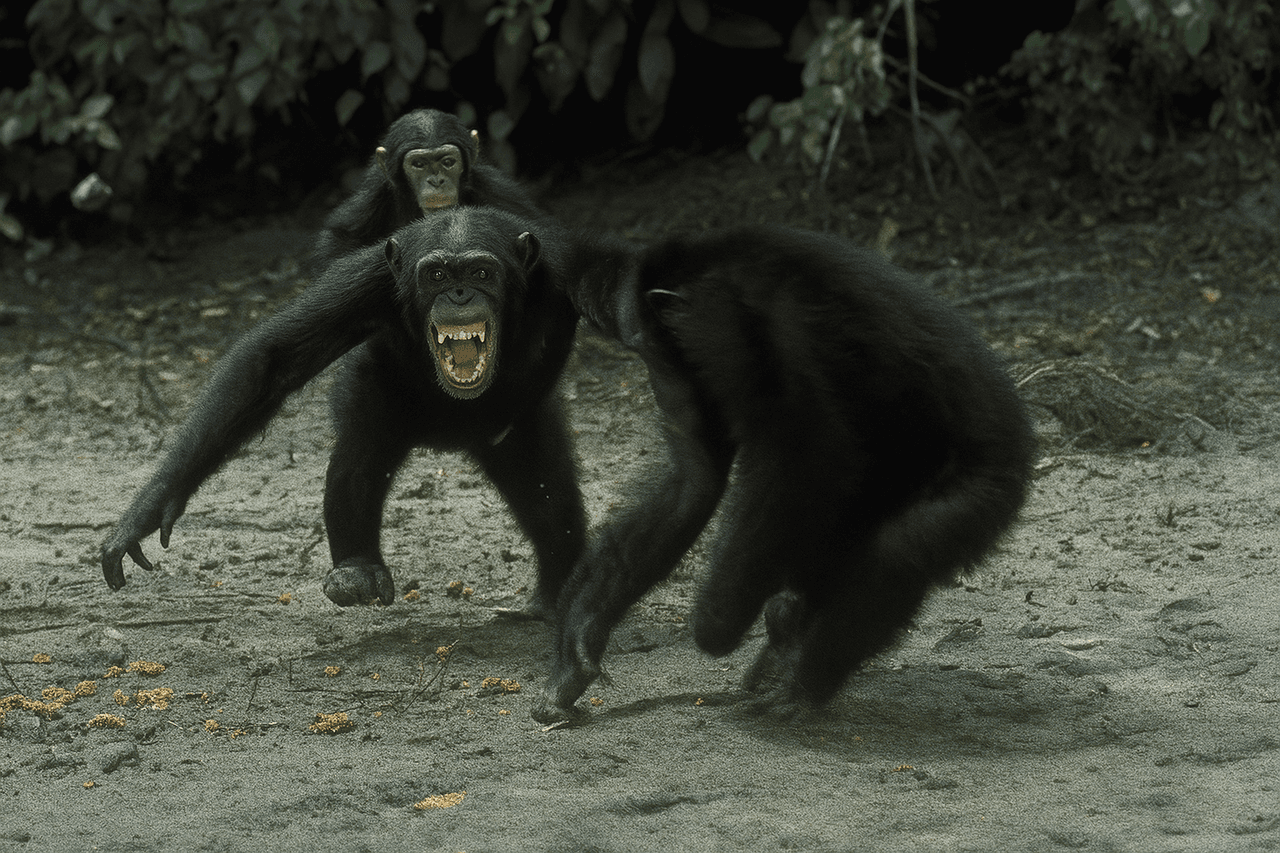
Gombe Şempanze Savaşı (4 Yıl Savaşı)
The Gombe Chimpanzee War is a landmark case in primatology, representing the first documented long-term and organized conflict between chimpanzees, occurring between 1974 and 1978 in Gombe National Park in northwestern Tanzania. This event opened important debates in modern ethology and evolutionary psychology by demonstrating that chimpanzees are capable of group-based violent behaviors, not merely individual aggression.
The observation of the war took place within the framework of long-term field studies initiated by primatologist Jane Goodall in the 1960s in Gombe National Park. Goodall’s observations provided systematic data on the social structures and interactions of wild chimpanzees, revealing the existence of complex social organization in non-human primates.
Initially, the chimpanzees in Gombe formed a single community known as the Kasakela group. However, in 1971, increasing differences in leadership and social bonding within the group led to its division into two factions. The chimpanzees residing in the south broke away to form the Kahama group, while those remaining in the north continued as the Kasakela group.
The conflict began on 7 January 1974, when six adult male chimpanzees from the Kasakela group attacked and killed Godi, a male member of the Kahama group. This incident marked the first link in a chain of systematic and organized attacks that lasted four years.
Between 1974 and 1978, the Kasakela group carried out seven separate attacks against the Kahama group, whose numbers had steadily declined. As a result of these attacks:
The sole surviving Kahama member, a male named Sniff, lived alone for an extended period before joining the Kasakela group in 1978, effectively ending the conflict.
Following the complete elimination of the Kahama group, the Kasakela group took control of the vacated territory. However, this expansion was short-lived. Another nearby group, the Kalande group, exerted pressure on the expanding Kasakela community, forcing them to retreat back northward. This development demonstrated that chimpanzee communities are influenced not only by internal fragmentation but also by external pressures.
The Gombe War produced the first field evidence documenting the following behavioral patterns in chimpanzees:
These behavioral patterns hold significant importance for understanding the evolutionary origins of phenomena previously assumed to be unique to human societies, such as warfare, strategic aggression, internal leadership, and political maneuvering.
The Gombe Chimpanzee War introduced a new paradigm in animal behavior science (ethology) regarding violence, aggression, and group psychology. The organized attacks observed in this event revealed that collective interests and power strategies often supersede individual self-interest. The fact that male chimpanzees united to launch attacks around goals such as acquiring females, achieving social status, and securing regional dominance has fueled the argument that these behaviors may have been shaped by natural selection.
Additionally, several psychosocial effects observed during the conflict drew the attention of scientists:
These findings are not only informative about chimpanzees but also provide explanatory insights into the evolutionary past of the human species. Many primatologists, led by Goodall, have suggested that these behaviors may reflect an evolutionary legacy of human warfare.
The Gombe Chimpanzee War has been widely discussed not only in ethology but also in the human sciences—including sociology, psychology, and anthropology. The chimpanzees’ capacity for:
provides a valuable example for understanding the evolutionary foundations of human societies.
This conflict demonstrated that social structures in non-human animals are not built solely on peaceful cooperation but can also be founded on violence, competition for resources, and the pursuit of dominance. The Gombe War remains a foundational case study in the analysis of primate behavior and the evolutionary nature of human behavior today.

Gombe Şempanze Savaşı (4 Yıl Savaşı)
No Discussion Added Yet
Start discussion for "Gombe Chimpanzee War (Four-Year War)" article
Historical Background and Observation Process
Onset and Course of the War
Outcomes and Social Implications
Ethological and Evolutionary Perspectives
Scientific Significance