


This article was automatically translated from the original Turkish version.
+2 More
Grashof Number
Places Where İt is Used | A number used for natural convection in fluid mechanics and heat transfer. | ||||||||
|---|---|---|---|---|---|---|---|---|---|
Subject İt Represents | A dimensionless number used in heat transfer. | ||||||||
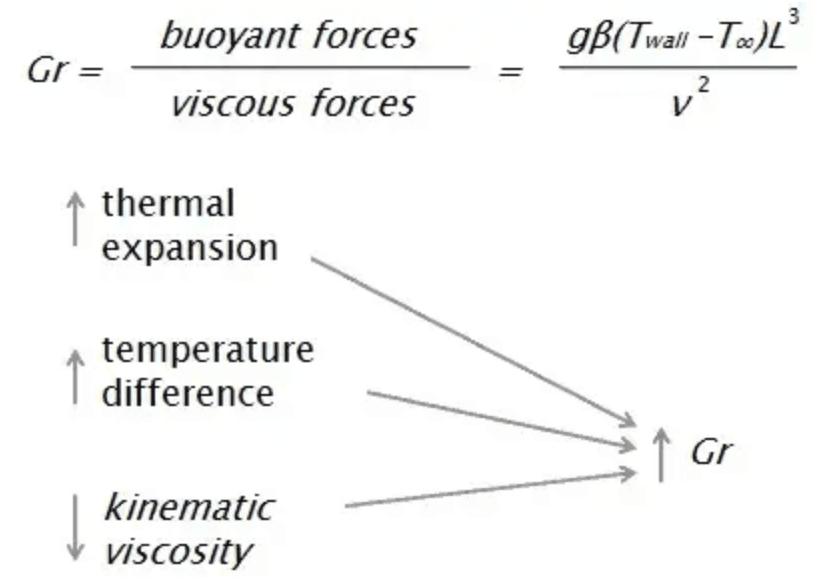
The Grashof number is a dimensionless number named after Franz Grashof. It is defined as the ratio of the buoyant force acting on a fluid in the velocity boundary layer to the viscous force. Its role in natural convection is very similar to that of the Reynolds number in forced convection.
When motion and mixing in the fluid arise due to density variations caused by temperature differences, natural convection is said to occur. Typically, an increase in temperature leads to a decrease in density, causing the fluid to rise. This motion is driven by the buoyant force. The greatest force opposing this motion is the viscous force. The Grashof number provides a means of measuring the balance between these opposing forces.

Formula for the Grashof Number (Nuclear Power)
For gases, β = 1/T, where temperature is in kelvins. For liquids, β can be calculated if the change in density with temperature at constant pressure is known. For a vertical flat plate, the flow transitions to turbulent when Gr.Pr > 10⁹. As in forced convection, the microscopic nature of flow and convection correlations differs markedly between laminar and turbulent regions.
The Grashof number is closely related to the Rayleigh number, which is defined as the product of the Grashof number, describing the relationship between buoyant force and viscosity in a fluid, and the Prandtl number, describing the relationship between momentum diffusivity and thermal diffusivity.
Nuclear Power. "Grashof Number | Definition, Formula & Calculation." Nuclear Power. Accessed May 22, 2025. https://www.nuclear-power.com/nuclear-engineering/heat-transfer/introduction-to-heat-transfer/characteristic-numbers/what-is-grashof-number/.
Rice University. “Free Convection: Grashof Number.” *Owlnet*. Accessed May 22, 2025. http://www.owlnet.rice.edu/~ceng402/proj05/setty/Ceng402/liq.htm.
ScienceDirect. "Grashof Number – an Overview." ScienceDirect Topics. Accessed May 22, 2025. https://www.sciencedirect.com/topics/chemistry/grashof-number.

Grashof Number
Places Where İt is Used | A number used for natural convection in fluid mechanics and heat transfer. | ||||||||
|---|---|---|---|---|---|---|---|---|---|
Subject İt Represents | A dimensionless number used in heat transfer. | ||||||||