This article was automatically translated from the original Turkish version.
World | Animalia | ||||||||
|---|---|---|---|---|---|---|---|---|---|
Branch | Chordata | ||||||||
Class | Aves | ||||||||
Team(s) | Otidiformes | ||||||||
Family | Otididae | ||||||||
Scientific Name(s) | Otis tarda Linnaeus | ||||||||
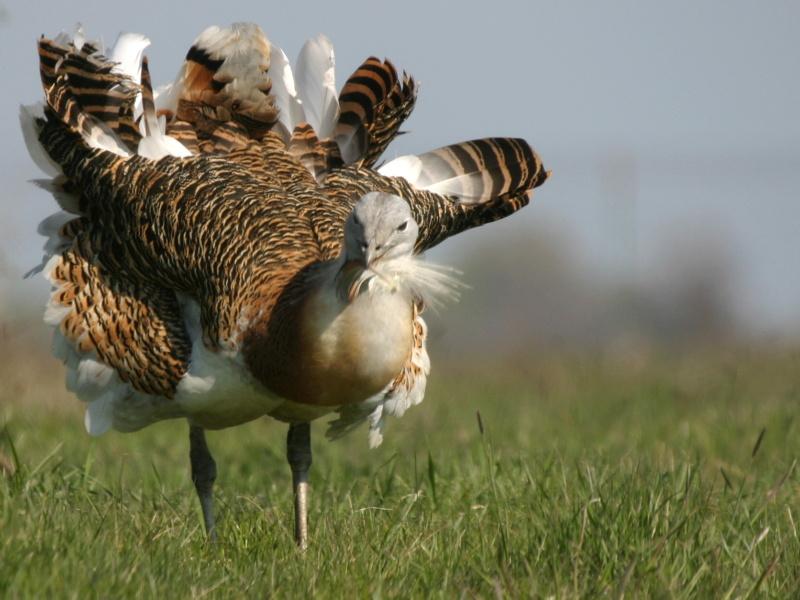
The Great Bustard is a large bird species measuring 75–105 cm in length, with gray-brown plumage. The head and neck are gray, the back is brown with black streaks, and the underparts are white; males develop a chestnut-colored breast band as they age. Males are significantly larger than females and during the breeding season grow a throat sac and long white feathers resembling whiskers. Their flight is powerful and characterized by regular, eagle-like wingbeats.
This species was once widespread across the Eurasian steppes, ranging from Portugal to the Korean Peninsula, but its distribution is now fragmented. Current primary breeding areas include Portugal, Spain, Austria, Germany, Slovakia, Hungary, Serbia, Romania, Türkiye, Russia, Ukraine, Kazakhstan, China, Morocco, Iran, and Mongolia. A large proportion of the population is migratory and winters in regions such as Central Asia, Iraq, Iran, and northern China.

A Great Bustard in the Wild (Flickr)
According to 2023 data, the global population is estimated at 29,600 to 33,000 individuals, with 74 percent residing in Spain. The IUCN Red List classifies it as Endangered. The population declined by 34 percent between 2005 and 2018, and a further decline of up to 65 percent by 2040 is projected.
Originally a steppe-dwelling species, the Great Bustard has adapted to low-intensity agricultural lands. It breeds in open areas with low vegetation, including fields, pastures, alfalfa and wheat croplands. In Asia, it also inhabits steppes, semi-desert habitats, river islands, and moist grasslands. Its diet consists of insects, plants, seeds, and small vertebrates. High horizontal visibility and areas free from human disturbance are critical for successful breeding.

Appearance of a Great Bustard (Flickr)
The species is protected under CITES Appendices I and II and CMS Appendices I and II. Hunting is prohibited in many countries across Europe, Türkiye, and Asia. Numerous national action plans are in place in Europe and Asia. Reintroduction programs are underway in the United Kingdom. Through LIFE+ projects, habitat restoration, undergrounding of power lines, and advisory services to farmers are being implemented in countries such as Austria, Germany, and Spain.
BirdLife International. Otis tarda. The IUCN Red List of Threatened Species 2023: e.T22691900A226280431. Accessed July 11, 2025. https://www.iucnredlist.org/species/22691900/226280431.
Cornell Lab of Ornithology. “Great Bustard (Otis tarda).” eBird. Accessed July 11, 2025. https://ebird.org/species/grebus1?siteLanguage=tr.

World | Animalia | ||||||||
|---|---|---|---|---|---|---|---|---|---|
Branch | Chordata | ||||||||
Class | Aves | ||||||||
Team(s) | Otidiformes | ||||||||
Family | Otididae | ||||||||
Scientific Name(s) | Otis tarda Linnaeus | ||||||||
No Discussion Added Yet
Start discussion for "Great Bustard (Otis tarda)" article
Distribution and Habitat
Population and Conservation Status
Habitat and Ecology
Threats
Conservation Efforts