

This article was automatically translated from the original Turkish version.
+2 More
Guggenheim Bilbao Museum is a modern art museum located in the city of Bilbao in the Basque Country of Spain. The museum was designed by architect Frank Gehry and opened in 1997. It was developed as part of a cultural investment program between the Solomon R. Guggenheim Foundation and the Bilbao local government.
The museum is a cultural structure planned within the context of exhibition space and urban regeneration. The Guggenheim Bilbao Museum is situated in the area of Bilbao where the former port and industrial zones have been redeveloped as part of the city’s post-industrial transformation.

Guggenheim Museum (pexels)
The Guggenheim Bilbao Museum is located in the city of Bilbao in northern Spain, along the banks of the Nervión River in the Abandoibarra district. The building was positioned within the context of revitalizing the riverfront as part of Bilbao’s transition from an industrial production center to a service and culture-oriented city. This site selection is decisive due to its physical relationship with the river and its integration into urban regeneration projects.
The museum’s exterior spatial composition is defined by its visual and spatial relationships with the surrounding urban context. The building integrates with pedestrian axes bridges and public open spaces along the riverbank becoming part of the city’s urban continuity. In this context the museum is not merely a structure for exhibitions but a public focal point integrated into the city’s circulation system. The open spaces and terraces surrounding the building create a gradual spatial transition toward the entrance.
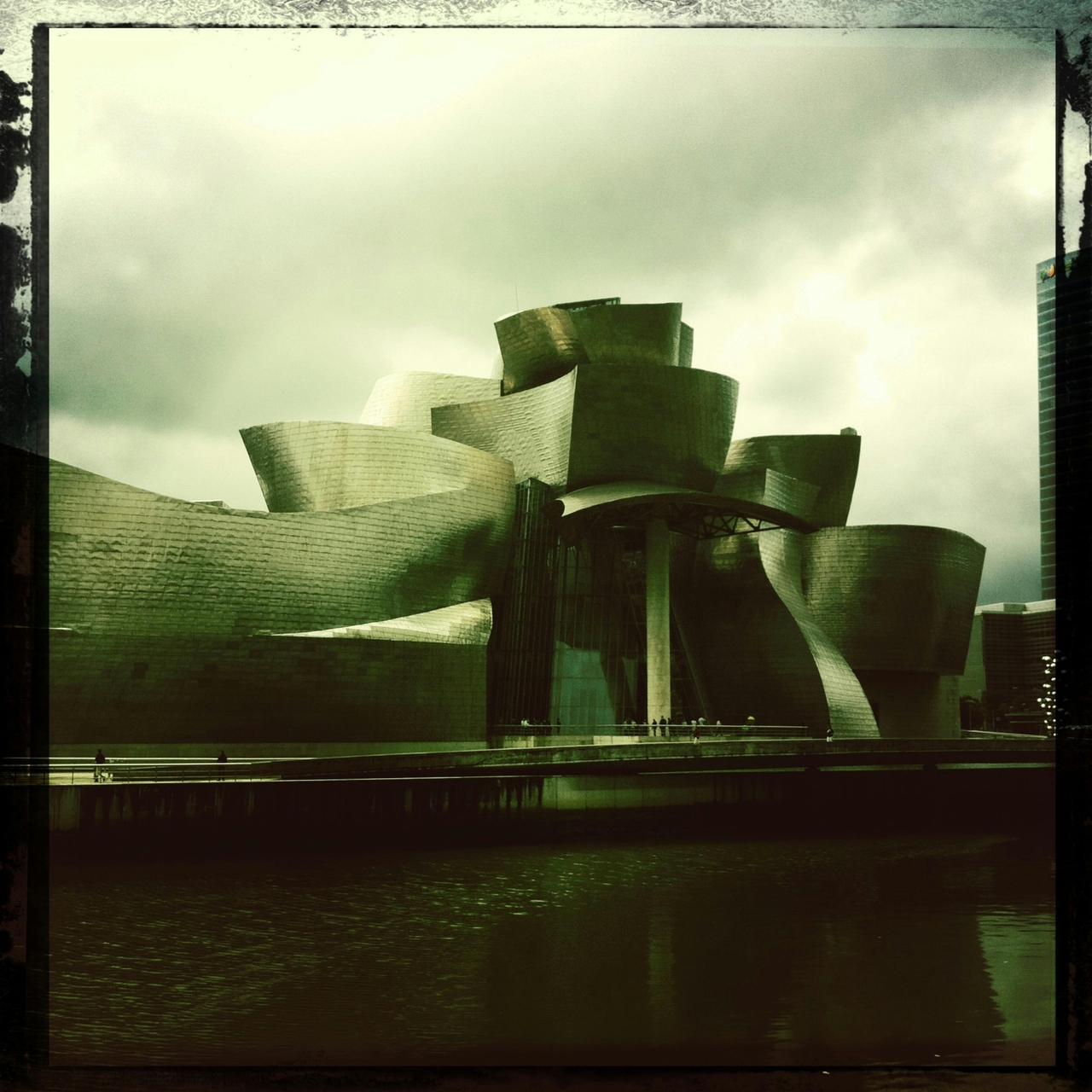
The building’s exterior form designed by Frank Gehry consists of fragmented and fluid geometries. The façade surfaces are largely clad in titanium panels which create variable reflections depending on lighting conditions resulting in a dynamic perception of the structure. The thin layered application of titanium sheets produces a wavy and discontinuous surface effect.
The massing organization presents a multi-layered composition that generates different perceptions from various viewpoints. The building is described in various sources as a reinterpretation of ships whales or industrial forms a characterization that reveals both its relationship with the surrounding context and its formal identity. At the same time the use of materials and forms referencing the city’s industrial past demonstrates continuity with Bilbao’s historical context.
The interior spatial organization of the Guggenheim Bilbao Museum is based on a holistic system centered around a central atrium. This large volume within the building functions as a vertical distribution space connecting galleries at different levels. The atrium serves as the primary spatial node guiding visitor circulation.
The exhibition galleries surrounding the atrium consist of spaces of varying scales and forms. These galleries include both large volumes designed to accommodate large-scale artworks and smaller more controlled environments. The museum’s interior organization is based on a flexible planning approach that adapts to the requirements of different exhibitions.
Circulation within the building is facilitated by bridges balconies and transitional elements extending from the atrium to the galleries. This circulation system establishes visual and physical connections between spaces at different levels creating a cohesive interior experience. The elements surrounding the atrium generate an organizational scheme that supports continuity between the various spaces.

Exterior View of the Guggenheim Museum (pexels)
Natural light is introduced into the interior through the roof and openings creating variations in spatial perception. While some galleries are designed with controlled lighting conditions others are arranged to establish direct relationships with natural light. This approach enables the creation of appropriate spatial conditions for different types of exhibitions.
The museum was constructed on a former quay site along the Nervión River. During the design and construction process the CATIA software developed for the aerospace industry was employed to translate complex geometric surfaces into the building’s form. Approximately 33 000 thin titanium panels were used on the exterior surface. In addition limestone and glass materials are incorporated into the building envelope. The titanium panels applied in thin sheets constitute the primary cladding system of the structure.
The museum operates as part of the international Guggenheim museums network which includes institutions such as the Solomon R. Guggenheim Museum in New York and the Peggy Guggenheim Collection in Venice. Within this framework collection exhibition and project programs are implemented.
The museum’s art program consists of permanent collection displays drawn from the Guggenheim collections alongside temporary exhibitions. The program features exhibitions of modern and contemporary art.

No Discussion Added Yet
Start discussion for "Guggenheim Bilbao Museum" article
Location and Exterior Features
Interior Spatial Organization
Construction Process and Material Use
Institutional Structure and Museum Program