

This article was automatically translated from the original Turkish version.
+2 More
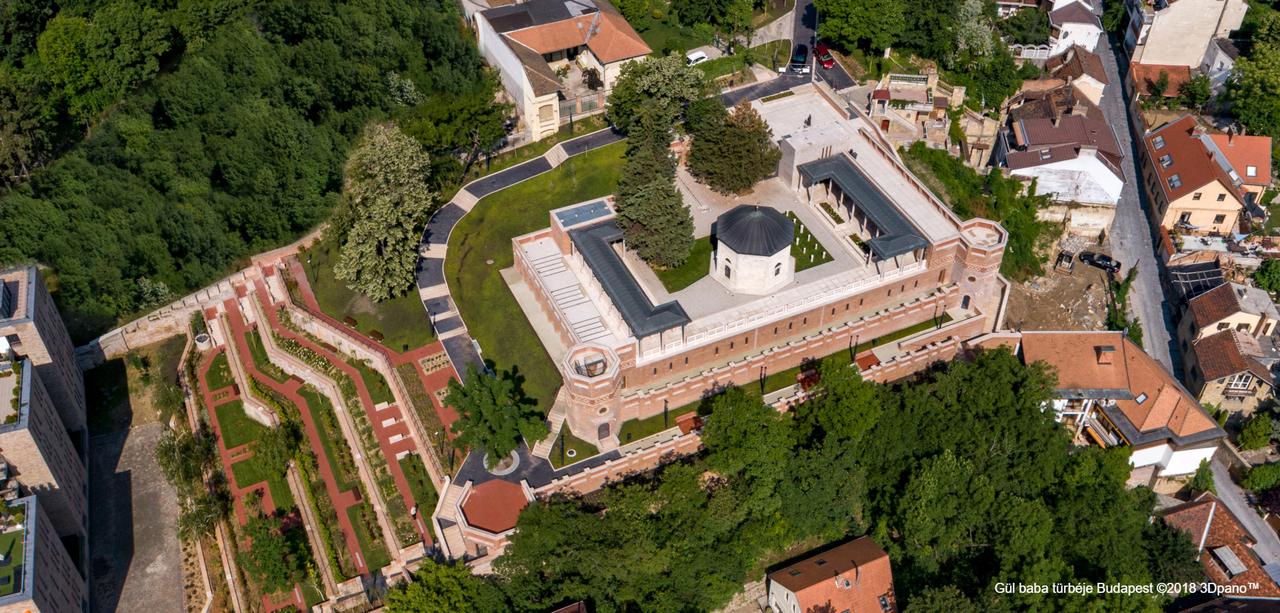
Gül Baba Türbesi is a significant classical Ottoman-era tekke and tomb complex located in the Buda district of Budapest, the capital of Hungary. Recognized as one of the symbols of Ottoman-Hungarian cultural heritage, the structure attracts attention through its architectural features and historical background.
Gül Baba is believed to have died during or immediately after the Ottoman conquest of Buda in 1541. The tomb was constructed between 1543 and 1548 by Yahyâ Paşazâde Mehmed Paşa, the Beylerbey of Buda, and shortly thereafter a tekke was built in Gül Baba’s name. According to Evliya Çelebi, the tekke was at that time the largest Bektashi tekke in Hungary.
During the 16th century, the tekke became an important center both militarily and religiously. During peacetime, the dervishes engaged in agriculture and worship; during wartime, they accompanied the Janissaries, providing spiritual support. According to a document dated 1566, the tekke housed sixty dervishes and possessed rich endowments including mills on the Danube River, several church buildings, and the entire neighborhood of Solymár.
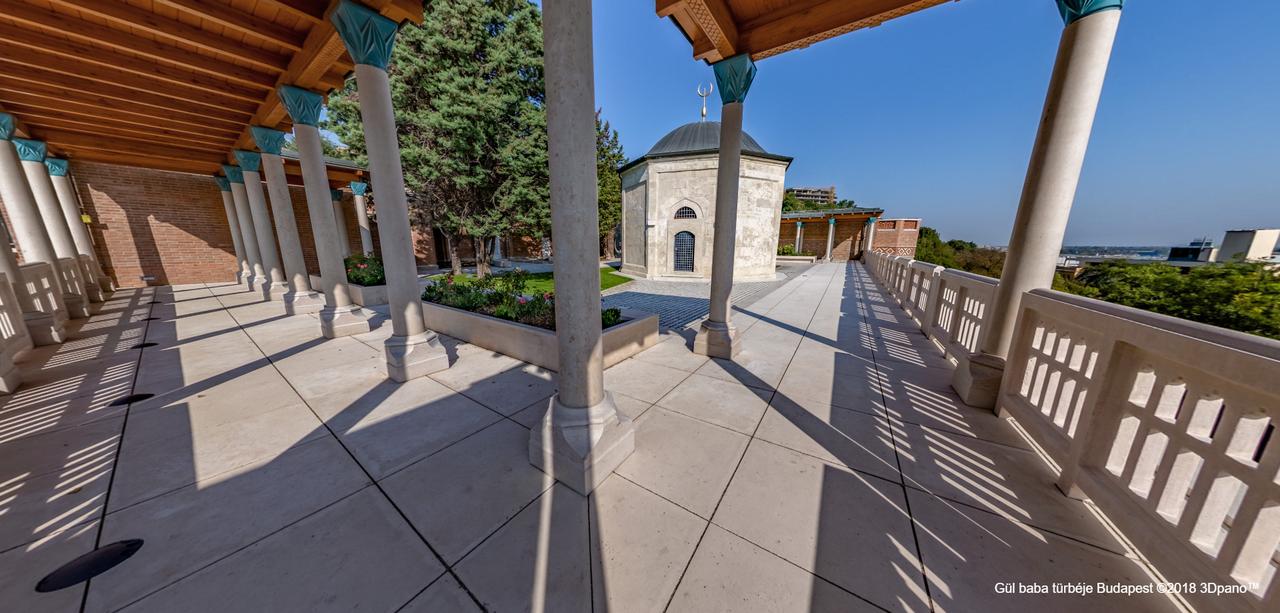
Gül Baba Türbesi (3Dpano.hu)
The tomb is an octagonal structure reflecting the classical Ottoman architectural style. Constructed of cut stone, it is covered by a lead-clad dome without a drum. The length of one wall of the building measures 322 cm from the exterior and 255 cm from the interior. The internal dome height is 670 cm and the facade height is 510 cm.
The entrance door faces the qibla. Above the threshold is a rectangular stone-arched window. The corner stones forming the octagonal plan project approximately 6 cm outward from the facades. When converted into the arşın measurement system, the wall thickness equals one arşın, the dome diameter eight arşın, each side of the octagon four arşın, and the overall plan corresponds to a 10 x 10 arşın grid.
Evliya Çelebi describes the interior of the tomb as “a space covered by a lead-clad dome, buried like a flower-filled garden, with green velvet-covered coffins, bearing a Bektashi cap on its head and adorned with verses from the Qur’an.”
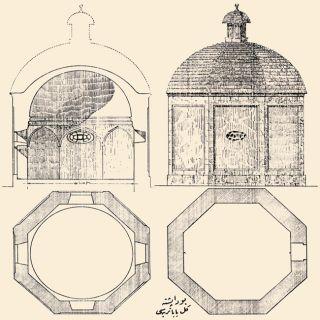
Plan and Section of Gül Baba Türbesi (Türkiye Diyanet Foundation Encyclopedia of Islam)
The Gül Baba Tekke included seasonal quarters for summer and winter, dervish cells, and a large imaret (communal kitchen). The cemetery surrounding the tekke was the largest Muslim burial ground of its time. Warriors departing on campaigns would offer sacrifices, pray, and seek spiritual support here. These traditions elevated Gül Baba in popular belief to the status of a veli.
The 16th-century poet Bosnalı İntizâmî’s work “Budin Şehrengizi” provides detailed descriptions of the tekke’s architecture and social functions. In poetry, Gül Baba is depicted as a mystical and sacred figure.
After Buda was captured by the Habsburgs in 1686, the tekke was demolished and the surrounding Muslim cemetery removed; in their place, monasteries and vineyards were constructed. The tomb structure was converted into a church by the Catholic Jesuit order, with the addition of a lantern for illumination on the dome and oval windows on the facade.
In the late 19th century, the architect Johann Wagner purchased the site and built a Renaissance-style gallery there. During this period, the tomb was sometimes preserved as a Turkish monument and at other times transformed into a Christian structure. In 1867, the possibility of Sultan Abdülaziz visiting Buda prompted restoration efforts; although the sultan never came, soil taken from the site was presented to him on the Danube.
In the 20th century, the tomb underwent various restorations. In 1885, it was restored by the architect Lajos Grill, and in 1973 it was comprehensively restored by the Turkish government. As part of this effort, prayer rugs, carpets, candlesticks, and inscribed plaques were sent. In 1917, Semih Rüstem drew the tomb’s measured drawings, and in the 1940s a film titled “Gülbaba” was produced. Hacı Abdülkerim Germanus emphasized the symbolic value of the structure in his book Düşünceler Gül Baba Türbesi’nde, written in its honor.
The Gül Baba Türbesi holds special significance as the northernmost Islamic burial monument in Europe. In 2018, a comprehensive restoration and landscape improvement project was carried out through cooperation between the Hungarian government and the Republic of Türkiye, and the tomb was reopened to visitors. Today it functions as a place of pilgrimage and cultural exchange, regarded as a symbol of Turkish-Hungarian friendship.
Dikmen, Melek. “Budin Gözcüsü Gül Baba’ya Dair İsmâil Sâdık Kemâl Paşa’nın Bir Medhiyesi.” *Türk Kültürü ve Hacı Bektaş Veli Araştırma Dergisi*, no. 104 (Winter 2022): 77–94. https://dergipark.org.tr/tr/pub/tkhcbva/issue/73734/1136840
Yılmaz, Mehmet Emin. “Budapeşte’deki Gül Baba Türbesi’nin Onarımları (1884–1915).” *Türk Kültürü ve Hacı Bektaş Veli Araştırma Dergisi*, no. 99 (Güz 2021): 211–240. https://dergipark.org.tr/tr/download/issue-file/61373
“Gül Baba Türbesi.” T.C. Başbakanlık Türk İşbirliği ve Koordinasyon Ajansı Başkanlığı (TİKA). Accessed July 15, 2025. https://www.tika.gov.tr/wp-content/uploads/2018/G%C3%BCl%20Baba/G%C3%9CL%20BABA.pdf
“Gül Baba.” *Türkiye Diyanet Vakfı İslâm Ansiklopedisi*. Accessed July 15, 2025. https://islamansiklopedisi.org.tr/gulbaba-tekkesi-ve-turbesi

History
Architectural Features
The Tekke and Pilgrimage Culture
Destruction, Transformation, and Restorations
Current Status