


+2 More

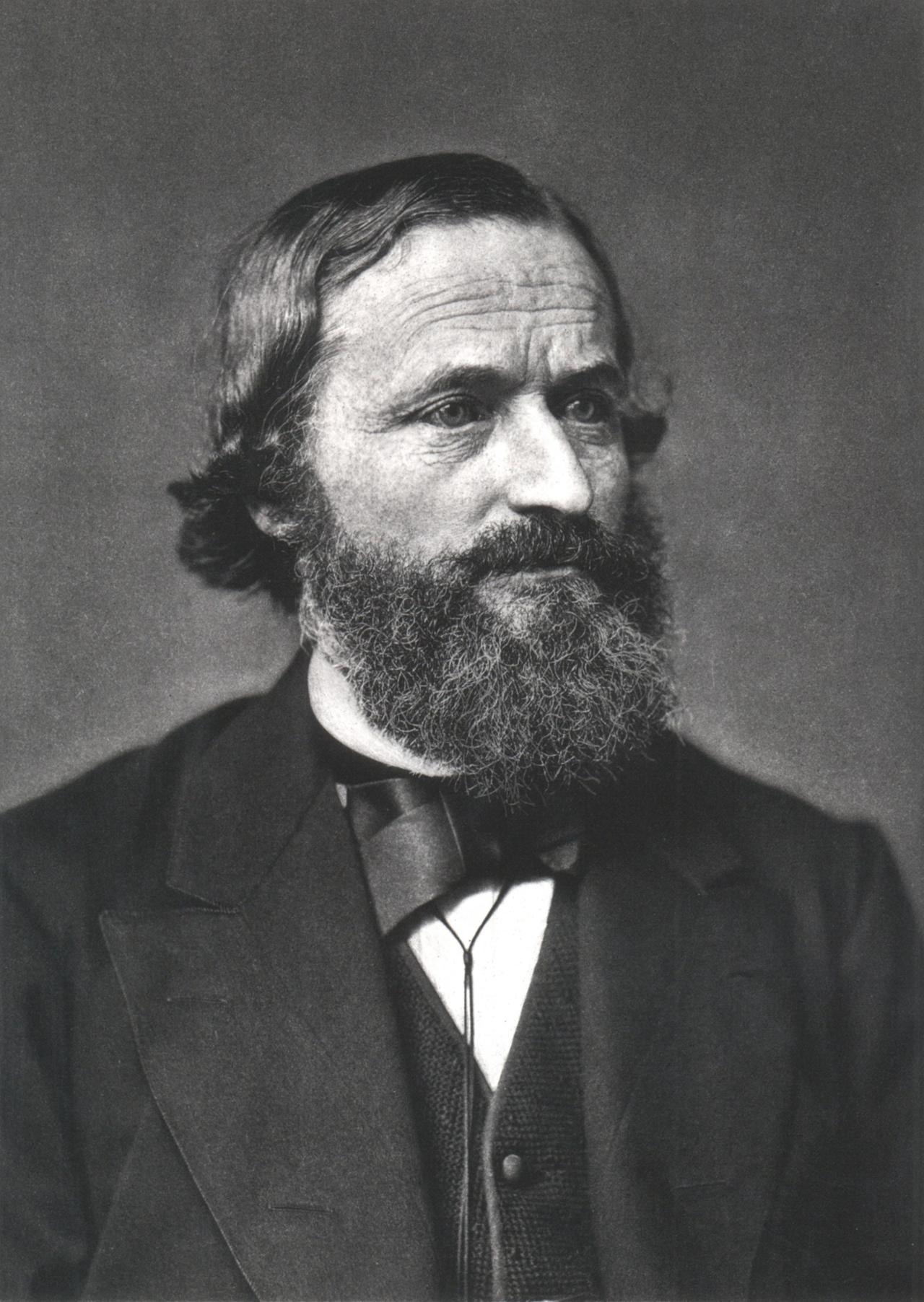
Gustav Robert Kirchhoff
Doğum tarihi | 1824-03-12 | ||||||||
|---|---|---|---|---|---|---|---|---|---|
Eş | Clara Richelot | ||||||||
Ölüm tarihi | 1887-10-17 | ||||||||
Annesi | Johanna Henriette Wittke | ||||||||
Babası | Friedrich Kirchhoff | ||||||||
Çocuk | Hermann Kirchhoff Luise Kirchhoff Anna Kirchhoff Friedrich Kirchhoff | ||||||||
Gustav Robert Kirchhoff (12 March 1824 – 17 October 1887) was one of the leading theoretical physicists of the 19th century and made foundational contributions to the development of physics. His work in circuit theory, thermal radiation, and spectroscopy remains among the most important references in modern physics and engineering.
Kirchhoff was born in Königsberg as the son of a lawyer. After receiving his early education at a local 【1】 for circuit analysis, power calculations in various circuit configurations, and applications linked to electromagnetic field theory. Both laws are indispensable tools in electrical engineering, used across a broad spectrum from simple DC circuits to wireless communication systems. The two laws are complementary: KCL examines current relationships at nodes while KVL reveals energy balance within loops. Together, they enable the mathematical modeling of even the most complex circuits. These laws form the core algorithms of modern computer-aided design tools and circuit simulation software.
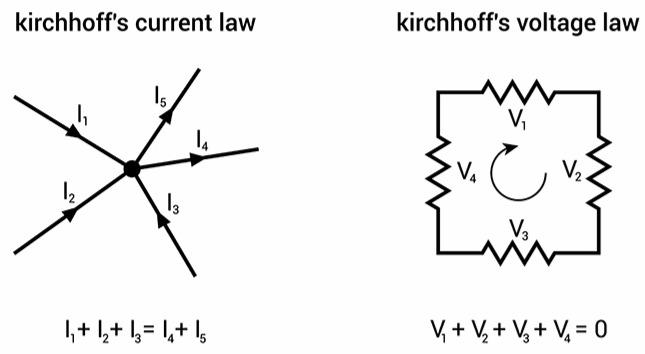
Schematic representation of Kirchhoff’s current and voltage laws (Source: Student Circuit)
The scientific impact and modern applications of Kirchhoff’s laws are extensive. Both laws remain valid for all linear and nonlinear electrical circuits and form the algorithmic basis of circuit simulation software such as 【2】. These laws continue to serve as fundamental references in advanced research areas including nanotechnology and quantum circuits. KCL, in particular, is indispensable for semiconductor physicists analyzing carrier behavior at PN junctions. Kirchhoff’s contributions transformed 19th-century empirical electrical research into a rigorous mathematical discipline and laid the groundwork for the development of modern electronic technologies. All modern electrical systems, from microprocessors to spacecraft, are designed based on the principles of consistency and reliability provided by these laws.
Kirchhoff’s spectroscopy work with Robert Bunsen made significant contributions to scientific analytical methods. The identification of characteristic spectral lines of elements is used not only in chemical analysis but also in astrophysical research. This discovery, by enabling the determination of the chemical composition of distant celestial bodies, played a pivotal role in the development of modern astronomy.
In 1862, Kirchhoff published laws on thermal radiation that provided a theoretical foundation for blackbody radiation and paved the way for Max Planck’s development of quantum theory. By applying thermodynamic principles to radiation problems, Kirchhoff developed models that significantly advanced theoretical physics.
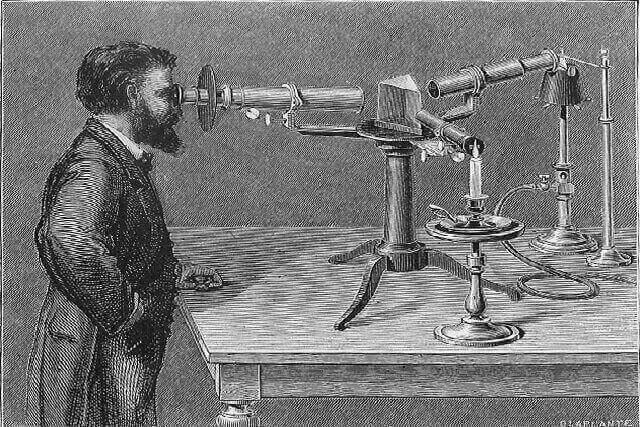
Gustav Kirchhoff analyzing the characteristic emission spectra of elements using a spectroscope (Source: Educational Corner)
Kirchhoff held professorships at the universities of Breslau, Heidelberg, and Berlin, contributing significantly to the establishment of theoretical physics as an academic discipline. His collaborative work with Robert Bunsen in Heidelberg holds a prominent place in the history of science, and in Berlin he led the establishment of the first chair in theoretical physics. Among his students were figures such as Max Planck, who later received the Nobel Prize.
Kirchhoff married Clara Richelot in 1862 and had four children. From 1875 onward, deteriorating health forced him to use a wheelchair. After retiring in 1886, he continued his scientific work until his death in Berlin. Despite physical challenges, he persisted in his research.
Kirchhoff’s work remains a fundamental reference in modern physics education and research. His laws of electricity, spectroscopic methods, and theory of thermal radiation have left a lasting impact on the scientific community. His name is commemorated in a crater on the Moon and the asteroid 10358 Kirchhoff. Events honoring his legacy are held at various universities in Germany.
Aydın, Mehmet. Modern Fiziğin Kurucuları. İstanbul: İstanbul Üniversitesi Yayınları, 2020.
Buchwald, Jed Z. Bilimsel Etkilerin Yaratılışı: Heinrich Hertz ve Elektrik Dalgaları. Çeviren Emre Caner. İstanbul: Boğaziçi Üniversitesi Yayınları, 2017.
Heidelberg Üniversitesi Arşivi. "Gustav Kirchhoff'un Akademik Yazışmaları (1854-1875)." Doküman No: HUA-KIR-1854-01.
Hentschel, Klaus. "Spektroskopik Portreler: Astrofiziğin Doğuşunda Çizimlerin Rolü." *Bilim Tarihi Araştırmaları Dergisi* 42, no. 1 (2019): 15–48. https://doi.org/10.XXXX/bsar.2019.42.1.15.
Jungnickel, Christa, and Russell McCormmach. Doğanın Entelektüel Hakimiyeti: Ohm'dan Einstein'a Teorik Fizik, Volume 1. Çeviren Ali Tolga. Ankara: TÜBİTAK Yayınları, 2005.
Kaiser, Walter. "Kirchhoff'un Kırınım Formülasyonu." Fizik Tarihi 8, no. 2 (1996): 89–120.
TÜBİTAK Bilim ve Teknik Dergisi. "Spektroskopinin Doğuşu." Sayı 645 (2021): 34–41.
[1]
“Gymnasium” is a type of secondary school in Germany and some European countries that provides classical education preparatory for university. It is known for a curriculum emphasizing ancient languages such as Latin and Greek, as well as science and mathematics. It shows partial similarity to Turkey’s “Anadolu Lisesi” but is a distinct educational model with roots tracing back to the Middle Ages. LINK[w3doh7e35] school, he studied at the University of Albertus in Königsberg under prominent scientists of the era such as Franz Neumann and Carl Gustav Jacob Jacobi. He began his academic career in 1847 with a doctoral thesis on electrical conductivity. These early studies laid the foundation for his distinctive approach that integrated theoretical and experimental physics.
Kirchhoff’s Laws and Contributions to Electrical Theory
At the age of 21 in 1845, Gustav Kirchhoff formulated two revolutionary laws that established the foundation of electrical circuit analysis. These laws have played a critical role in the development of modern electrical engineering:
Kirchhoff’s Current Law (KCL – Kirchhoff’s Current Law): One of the fundamental pillars of electrical circuits. This law states that the algebraic sum of currents entering and leaving a
[2]
SPICE is an abbreviation for

Gustav Robert Kirchhoff
Doğum tarihi | 1824-03-12 | ||||||||
|---|---|---|---|---|---|---|---|---|---|
Eş | Clara Richelot | ||||||||
Ölüm tarihi | 1887-10-17 | ||||||||
Annesi | Johanna Henriette Wittke | ||||||||
Babası | Friedrich Kirchhoff | ||||||||
Çocuk | Hermann Kirchhoff Luise Kirchhoff Anna Kirchhoff Friedrich Kirchhoff | ||||||||
No Discussion Added Yet
Start discussion for "Gustav Robert Kirchhoff" article
Early Life and Education
Scientific Impact and Modern Applications
Spectroscopy Research and Chemical Analysis
Thermal Radiation and Blackbody Radiation
Academic Career and Students
Personal Life and Health Issues
Scientific Legacy and Commemoration